ECG-based risk prediction of sudden cardiac arrest in patients with atrial fibrillation
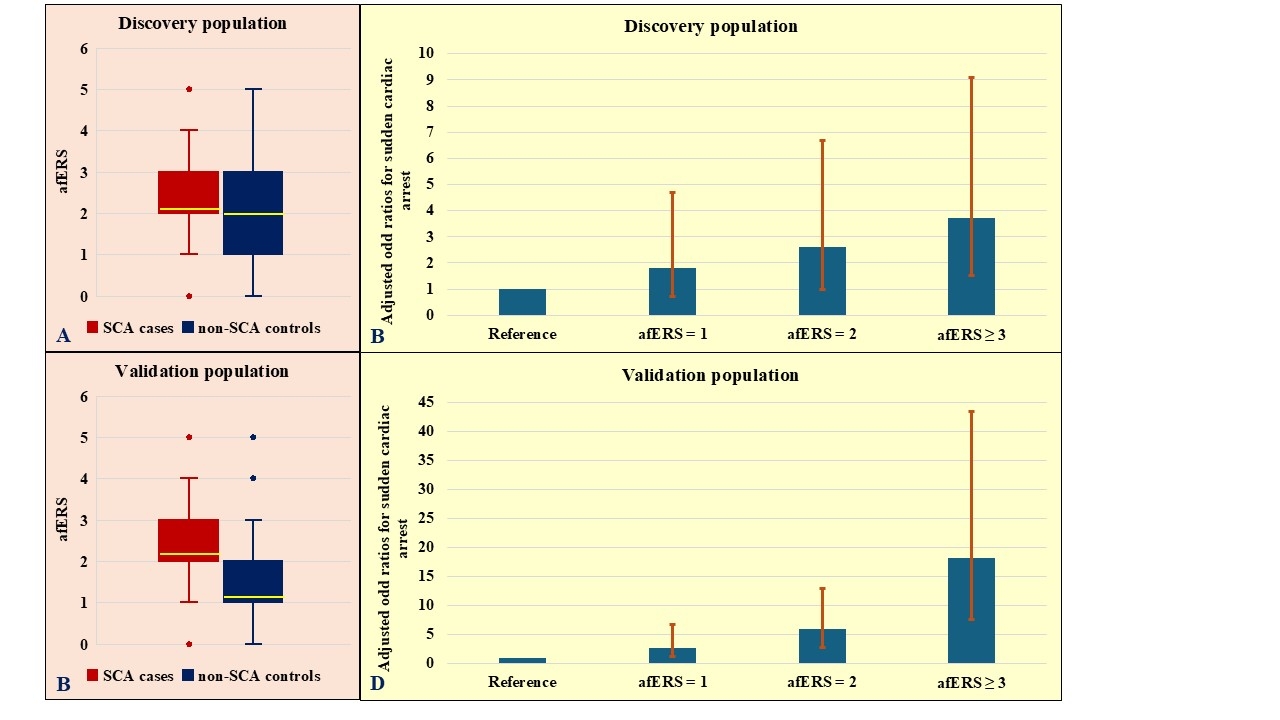
Abstract Body (Do not enter title and authors here): Introduction Both individually as well as in composite risk scores, specific markers on the 12-lead ECG are associated with increased sudden cardiac arrest (SCA) risk. Atrial fibrillation (AF), the most common arrhythmia, has also been associated with increased risk of SCA. However, patients with AF were mostly excluded from these SCA association studies due to the complexity of their ECG features. Hypothesis Specific markers on the 12-lead ECG can also predict SCA risk in individuals with AF. Methods We conducted a case-control study utilizing SCA cases from a large community-based study in the US Northwest (catchment population ~ 1 million; 2002-2020). We included subjects aged ≥18 with detailed lifetime medical records and archived ECG prior and unrelated to the SCA event. Controls with AF ECGs and no history of SCA were recruited from the same area. For validation, we selected SCA cases from a separate community-based study in southern California (catchment population ~ 850,000; 2015-2023), with controls obtained from the same region. ECG variables that were statistically significant in univariable analysis were used to develop an ECG-based score for SCA risk prediction (ECG Risk Score, AF ERS). Results In the discovery population (447 SCA cases and 138 controls, mean age 74.9±11.3 years, 73.5% male), SCA cases had longer QTc (481.5 vs. 471.4 ms; p=0.06) and Tpeak-Tend intervals (87.7 vs. 81.9 ms; p=0.009), higher LVH prevalence (20.4% vs. 9.4%; p=0.003), delayed QRS transition (54.7% vs. 36.8%; p<0.001), and QRS-T angle >90° (55.7% vs. 47.4%; p=0.09). The AF ERS (range 0-5) was developed by adding 1 point for each of these factors: prolonged QTc, QRS-T angle >90°, Tpeak-Tend >89 ms, LVH, and delayed QRS transition zone. After adjusting for demographic characteristics and comorbidities in a multivariable model ORs for SCA increased from 2.6 (95% CI: 1.0–6.7) for AF ERS=2 to 5.1 (95% CI: 1.5–9.1) for AF ERS≥3 compared to the reference group (AF ERS = 0; Figure). The validation cohort comprised 315 SCA cases and 138 controls, mean age 77.7±11.4 years, 64.5% male. The AF ERS score consistently showed significantly higher adjusted ORs for SCA across all AF ERS groups compared to the reference group. Conclusion SCA risk can be predicted successfully from AF ECGs, offering an opportunity to enhance risk stratification and prevention in this important subgroup of individuals. Further research is needed to validate the AF ERS in larger and more diverse populations.
Truyen, Thien Tan Tri Tai
(
Cedars Sinai Medical Center
, Los Angeles , California , United States )
Heckard, Elizabeth
(
Cedars Sinai Medical Center
, Los Angeles , California , United States )
Nakamura, Kotoka
(
Cedars Sinai Medical Center
, Los Angeles , California , United States )
Uy-evanado, Audrey
(
Cedars Sinai Medical Center
, Los Angeles , California , United States )
Chugh, Harpriya
(
Cedars Sinai Medical Center
, Los Angeles , California , United States )
Tfelt-hansen, Jacob
(
RIGSHOSPITALET
, Copenhagen , Denmark )
Reinier, Kyndaron
(
Cedars Sinai Medical Center
, Los Angeles , California , United States )
Chugh, Sumeet
(
Cedars Sinai Medical Center
, Los Angeles , California , United States )
Author Disclosures:
Thien Tan Tri Tai Truyen:DO NOT have relevant financial relationshipsKotoka Nakamura:DO NOT have relevant financial relationships
| Audrey Uy-Evanado:No Answer
| Harpriya Chugh:DO NOT have relevant financial relationships
| Jacob Tfelt-Hansen:No Answer
| Kyndaron Reinier:DO NOT have relevant financial relationships
| Sumeet Chugh:DO have relevant financial relationships
;
Research Funding (PI or named investigator):National Heart Lung and Blood Institute:Past (completed)