AI-Driven Electrocardiographic Detection and Subtyping of Hypertrophic Cardiomyopathy: A Deep Learning Approach Using 12-Lead ECGs
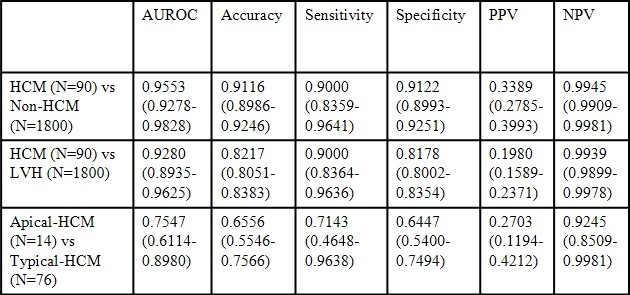
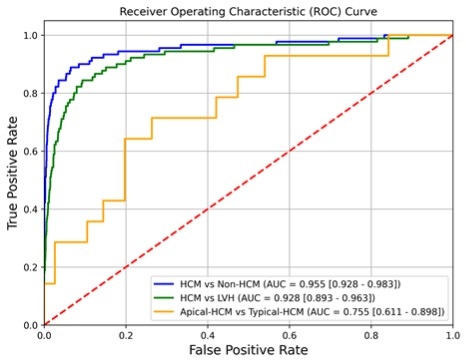
Abstract Body (Do not enter title and authors here): Background: Hypertrophic cardiomyopathy (HCM) is a potentially life-threatening condition in which early detection is crucial for timely management and prevention of sudden cardiac death. While echocardiography is the diagnostic gold standard, it is resource-intensive and not always accessible. In contrast, 12-lead electrocardiograms (ECGs) are rapid, non-invasive, and widely available, offering a potential alternative for screening. We aimed to evaluate whether deep learning models can detect HCM and distinguish apical from typical HCM using only ECG data. Research Question: Can a deep learning ECG model accurately detect HCM using only ECG data? Can it differentiate HCM subtypes? Methods: We retrospectively analyzed 568,252 ECGs from 184,287 adult patients (aged ≥19) at Ajou University Hospital between January 2020 and June 2023, excluding individuals with pacemakers. Among 534 patients with echocardiographically confirmed HCM, 1,713 ECGs from 450 patients (including 164 with apical HCM) obtained within ±30 days of diagnosis were labeled as HCM-positive. A Vision Transformer (ViT) model was pre-trained on unlabeled ECGs and fine-tuned to classify three groups: non-HCM, typical HCM, and apical HCM. Negative controls were selected using age- and sex-matched sampling (±5 years, same sex) at a 1:20 ratio. The dataset was split into training, validation, and test sets (7:1:2). Model performance was assessed using area under the receiver operating characteristic curve (AUROC). A subgroup analysis was conducted in patients with ECG-defined left ventricular hypertrophy (LVH). Results: The model achieved an AUROC of 0.955 (95% CI: 0.927–0.984) for HCM vs. non-HCM classification, with accuracy 0.912 (0.899–0.924), sensitivity 0.900 (0.838–0.962), and specificity 0.912 (0.899–0.925). In the LVH subgroup, AUROC remained robust at 0.928 (0.895–0.961), indicating reliable generalization in a diagnostically challenging population. For apical vs. typical HCM classification, the model achieved an AUROC of 0.755 (95% CI: 0.617–0.893), supporting feasibility of subtype discrimination. Conclusion: A deep learning model trained on 12-lead ECGs accurately detects HCM and demonstrates promising ability to differentiate apical from typical subtypes. The model retained strong performance in patients with ECG-defined LVH, a group commonly associated with diagnostic uncertainty. These findings support the use of ECG-based AI as a scalable and accessible screening tool for HCM.
Soh, Moon Seung
(
Ajou University School of Medicine
, Suwon , Korea (the Republic of) )
Yu, Taehyung
(
VUNO
, Seoul , Korea (the Republic of) )
Na, Yeongyeon
(
VUNO
, Seoul , Korea (the Republic of) )
Joo, Sunghoon
(
VUNO
, Seoul , Korea (the Republic of) )
Shin, Joon-han
(
Ajou University School of Medicine
, Suwon , Korea (the Republic of) )
Author Disclosures:
Moon Seung SOH:DO NOT have relevant financial relationships
| Taehyung Yu:DO NOT have relevant financial relationships
| Yeongyeon Na:DO have relevant financial relationships
;
Employee:VUNO Inc.:Active (exists now)
| Sunghoon Joo:DO have relevant financial relationships
;
Employee:VUNO Inc.:Active (exists now)
| Joon-han Shin:DO NOT have relevant financial relationships