
Logo

American Heart Association

  160
  0


Final ID: 4146046

A Chemical Language Model for the Design of De Novo Molecules Targeting the Inhibition of TLR3

Abstract Body (Do not enter title and authors here): Background: Toll-like receptor 3 plays a role in the development of calcific aortic valve disease (CAVD). However, there are currently no pharmacological treatments for CAVD, and the discovery of de novo molecules targeting a specific protein is a time-intensive and financially demanding process. It is hypothesized that language models, trained on encodings of molecular graphs, can tailor the design of novel molecules with specific molecular and pharmacological properties.

Objective: This study aims to develop a chemical language model tailored for designing novel molecules that target the inhibition of TLR3.

Methods: A language model was pre-trained on 25,000 chemical structures sourced from the ChEMBL database. Each chemical structure was represented through Simplified Molecular Input Line Entry System (SMILES) strings, which were subsequently tokenized into discrete atomic and functional group tokens. The model leverages an Average-Stochastic Gradient Descent Weight-Dropped Long Short-Term Memory (AWD-LSTM) architecture. Transfer learning was employed for domain-specific fine-tuning of the pre-trained language model on the target chemical structures.

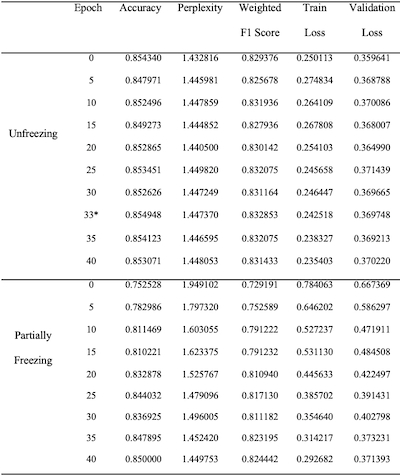
Results: The model achieved strong performance by unfreezing the pre-trained language model’s parameters for fine-tuning in all layers. Specifically, it achieved an accuracy of 85.49%, a weighted F1-score of 83.28%, and a perplexity of 1.44. This approach yielded better results compared to partially freezing the model’s parameters, where only the latter layers were fine-tuned. The partial freezing approach resulted in an accuracy of 85.06%, a weighted F1-score of 82.44%, and a perplexity of 1.44.

Conclusion: A chemical language model was developed for designing novel molecules that target the inhibition of TLR3. This provides an efficient and automated method for developing novel molecules with specific molecular and pharmacological properties.
  • Velasco, Juan  ( Yale School of Medicine , New Haven , Connecticut , United States )
  • Author Disclosures:
    Juan Velasco: DO NOT have relevant financial relationships
Meeting Info:

Scientific Sessions 2024

2024

Chicago, Illinois

Session Info:

CVSA Early Career Investigator Abstract Award Competition

Saturday, 11/16/2024 , 01:30PM - 02:30PM

Abstract Oral Session

More abstracts on this topic:
A large-scale multi-view deep learning-based assessment of left ventricular ejection fraction in echocardiography

Jing Linyuan, Metser Gil, Mawson Thomas, Tat Emily, Jiang Nona, Duffy Eamon, Hahn Rebecca, Homma Shunichi, Haggerty Christopher, Poterucha Timothy, Elias Pierre, Long Aaron, Vanmaanen David, Rocha Daniel, Hartzel Dustin, Kelsey Christopher, Ruhl Jeffrey, Beecy Ashley, Elnabawi Youssef

A Remedy for the Heart and the Hemoglobin: Improvement in Anemia Post Transcatheter Aortic Valve Replacement

Matta Raghav, Roy Aanya, Hammad Bayan, Draffen Arvind, Natsheh Zachary, Tiu Daniel, Tiu David, Salem Edward, Balami Jesse, Kalagara Swetha, Gupta Neil, Uraizee Omar, Sahgal Savina, Mishra Atreya, Ene Adriana, Hattab Aleyah, Arora Aarushi, Sufyaan Humam, Dau Trang, Silberstein Jonathan, Yu Julia, Torres Kayla, Seshadri Suhas, Navarro Laura, Singam Manisha, Ismail Mariam, Rana Riya, Habeel Samer, Liu Simon, Chaganti Srinidhi, Gurbuxani Vidur, Dwyer Kaluzna Stephanie, Groo Vicki, Carlson Andrew, Shroff Adhir, Bhayani Siddharth, Khan Azmer, Bhattaram Rohan, Zhang Runze, Shah Pal

You have to be authorized to contact abstract author. Please, Login
Not Available