Outcomes of Stylet-Driven Versus Non-Stylet-Driven Leads for Conduction System Pacing: Insights from the NCDR
Abstract Body (Do not enter title and authors here): Background Conduction system pacing (CSP), including His bundle (HBP) and left bundle branch area pacing (LBBAP), is a growing alternative to traditional right ventricular or biventricular pacing. However, there is limited comparative data for stylet-driven (SDLs) and non-stylet-driven (NSDLs) leads implantation for CSP.
Objective: To evaluate differences with SDLs versus NSDLs for HBP and LBBAP using data from the National Cardiovascular Data Registry (NCDR).
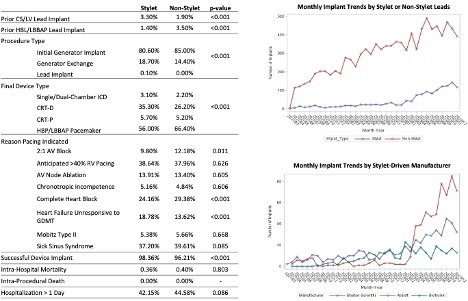
Methods: We analyzed 11,412 CSP lead implantations, with 10,005 NSDLs and 1,407 SDLs, from April 2021 to December 2023 within the NCDR Electrophysiology Device Implant Registry. Baseline characteristics, procedural data, and in-hospital outcomes were compared between groups using multivariable logistic regression adjusted for demographics, comorbidities, implant indication, and hospital characteristics.
Results: NSDLs remained the predominant lead type, though SDL use increased significantly during the study period. Compared with NSDL patients, those undergoing SDL implantation had higher rates of heart failure (61.6% vs. 48.6%, p<0.001), lower left ventricular ejection fraction (42.3% vs. 47.4%, p<0.001), and more frequent prior device implantation. Implant success was slightly higher with SDLs (98.4% vs. 96.2%, p<0.001), but overall complication rates were low and comparable (2.8% vs. 2.1%, p=0.089). No significant differences were observed in cardiac perforation, lead dislodgement, or in-hospital mortality. In multivariable analysis, lead type was not associated with increased odds of complications or prolonged hospitalization.
Conclusion: In the largest analysis to date, both SDL and NSDL strategies achieved exceptionally high implant success rates for CSP, with slightly higher rates for the former, accompanied by low complication rates. These findings support the safety and effectiveness of both strategies and suggest that lead selection may be guided by operator preference.
Katapadi, Aashish
(
Kansas City Heart Rhythm Institute
, Leawood , Kansas , United States )
Tale, Archana Pravin
(
Beth Israel Deaconess Medical Center
, Boston , Massachusetts , United States )
Song, Yang
(
Beth Israel Deaconess Medical Center
, Boston , Massachusetts , United States )
Mi, Jiaqi
(
Northeast Georgia Medical Center
, Powder Springs , Georgia , United States )
Pothineni, Naga Venkata
(
Kansas City Heart Rhythm Institute
, Leawood , Kansas , United States )
Kabra, Rajesh
(
Kansas City Heart Rhythm Institute
, Leawood , Kansas , United States )
Gopinathannair, Rakesh
(
Kansas City Heart Rhythm Institute
, Leawood , Kansas , United States )
Birgersdotter-green, Ulrika
(
University of California San Diego
, San Diego , California , United States )
Lakkireddy, Dhanunjaya
(
Kansas City Heart Rhythm Institute
, Leawood , Kansas , United States )
Kramer, Daniel
(
Beth Israel Deaconess Medical Center
, Boston , Massachusetts , United States )
Darden, Douglas
(
Kansas City Heart Rhythm Institute
, Leawood , Kansas , United States )
Author Disclosures:
Aashish Katapadi:DO NOT have relevant financial relationships
| Daniel Kramer:No Answer
| Douglas Darden:No Answer
| Archana Pravin Tale:No Answer
| Yang Song:DO NOT have relevant financial relationships
| Jiaqi Mi:DO NOT have relevant financial relationships
| Naga Venkata Pothineni:No Answer
| Rajesh Kabra:DO NOT have relevant financial relationships
| Rakesh Gopinathannair:DO NOT have relevant financial relationships
| Ulrika Birgersdotter-Green:No Answer
| Dhanunjaya Lakkireddy:DO NOT have relevant financial relationships