Logo

American Heart Association

  16
  0


Final ID: MP2459

Non-invasive Cardiac Magnetic Resonance Blood Oxygenation Mapping in Single Ventricle Heart Disease

Abstract Body (Do not enter title and authors here): Introduction: Non-invasive estimation of blood oxygen saturation (O2sat) by cardiac magnetic resonance (CMR) has clinical application in single ventricle heart disease. A T2-mapping based CMR method has been described to estimate O2sat in the heart and great vessels in specific regions of interest. This study builds on our prior validation of CMR oximetry maps to visualize O2sat data and determine optimal regions for evaluation in single ventricle hearts.

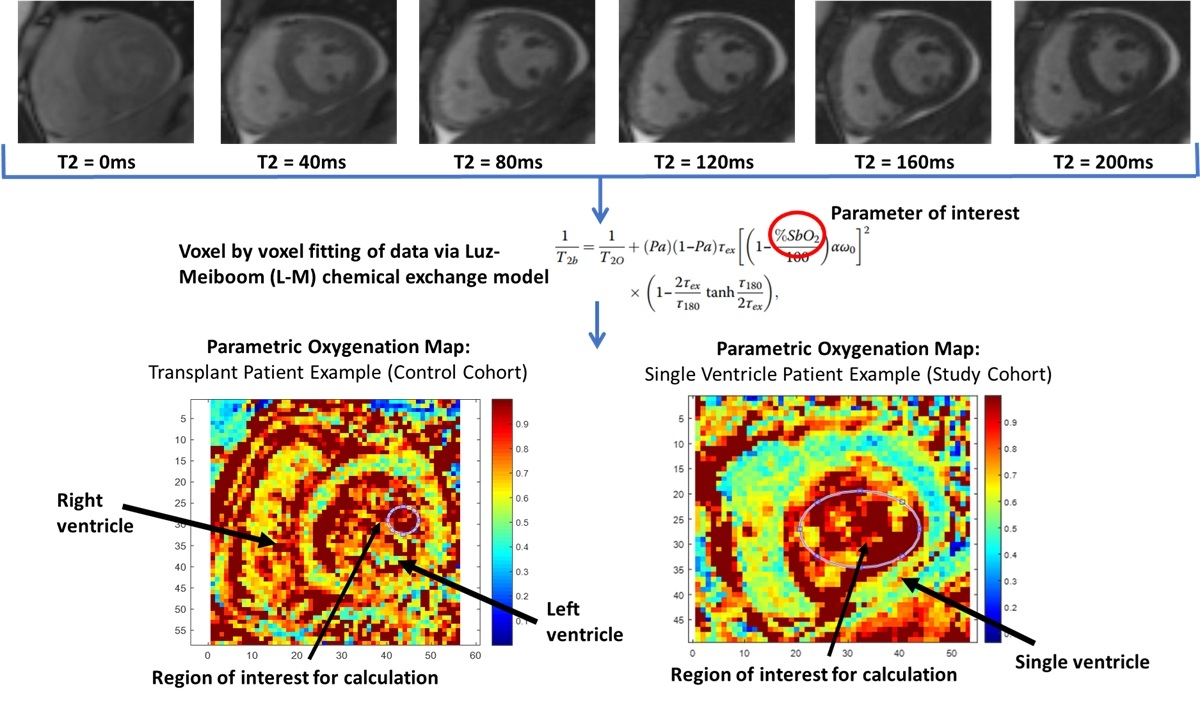
Methods: 14 single ventricle (age 17.1±6.8 years, 4 female) and 15 transplant control (age 16.6±4.6 years, 6 female) patients undergoing clinically indicated cardiac catheterization and CMR were recruited in a tertiary care children’s hospital. A series of T2-prepared single-shot steady-state free-precession images were acquired of intracardiac chambers and great vessels in free-breathing across T2-preparation times of 0 to 200 ms (Fig 1). Inter-echo spacing (τ) ranged from 0 to 25 ms. Color-coded maps were calculated representing estimated O2sat based on voxel-wise fitting of T2 data to the Luz-Meiboom model (S,T,τ,α). Regional O2sat from oximetry maps were compared to corresponding invasive catheterization data.

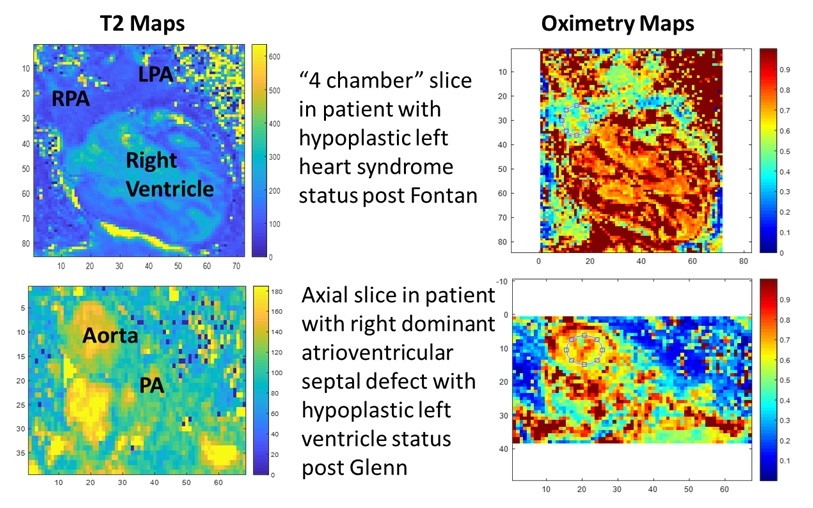
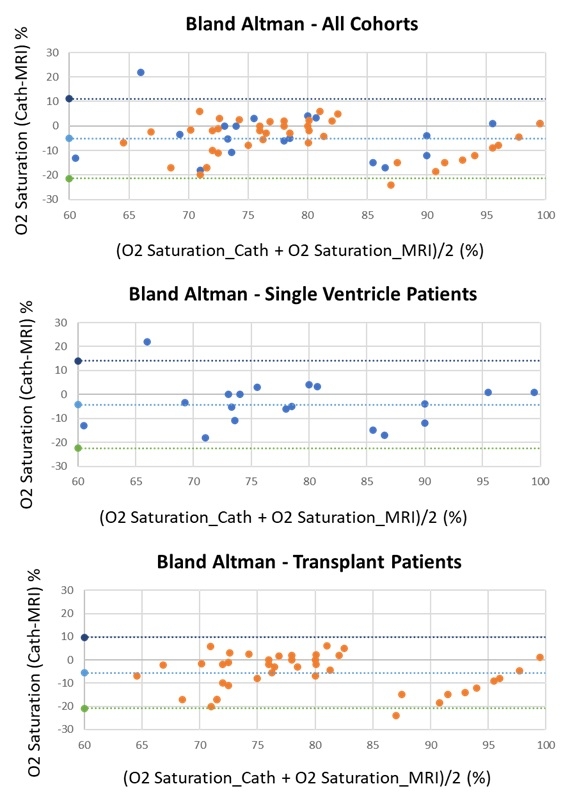
Results: Oximetry maps allowed visualization of O2sat to identify regions with uniform blood pools and with heterogenous O2sat (Fig 2). Correlation between O2sat via oximetry maps and catheterization were favorable overall (r=0.69, p<0.001), in single ventricle patients (r=0.70, p<0.001) and in transplant patients (r=0.69, p<0.001). Bland Altman plots (Fig 3) comparing O2sat via oximetry maps and catheterization demonstrated reasonable agreement overall (mean difference=-5.2, limits of agreement=-21.4,8.3), in single ventricle patients (mean difference=-4.3, limits of agreement=-22.5,14.0) and in transplant patients (mean difference=-5.6, limits of agreement=-21.0, 9.8). Pulmonary veins, atria, and regions with foreign material were difficult to visualize due to data heterogeneity and noise.

Conclusion: CMR can be utilized for non-invasive estimation of O2sat in complex heart disease with good correlation to current gold standard catheter-derived measurements. Oximetry maps can enhance visualization of regional O2sat and may guide further optimization of image acquisition and analysis. Streaming effects in human hearts altered by palliation surgeries may explain why oximetry maps visually depicted heterogenous O2sat. Ongoing patient recruitment is warranted.
  • Desai, Lajja  ( Lurie Children's, Northwestern , Chicago , Illinois , United States )
  • Varghese, Juliet  ( The Ohio State University , Columbus , Ohio , United States )
  • Ahmad, Rizwan  ( THE OHIO STATE UNIVERSITY , Columbus , Ohio , United States )
  • Simonetti, Orlando  ( The Ohio State University , Columbus , Ohio , United States )
  • Rigsby, Cynthia  ( Lurie Children's Hospital , Chicago , Illinois , United States )
  • Markl, Michael  ( NORTHWESTERN UNIVERSITY , Chicago , Illinois , United States )
  • Author Disclosures:
    Lajja Desai: DO NOT have relevant financial relationships | Juliet Varghese: No Answer | Rizwan Ahmad: No Answer | Orlando Simonetti: DO NOT have relevant financial relationships | Cynthia Rigsby: DO NOT have relevant financial relationships | Michael Markl: DO have relevant financial relationships ; Research Funding (PI or named investigator):Siemens:Active (exists now) ; Ownership Interest:Third Coast Dynamics:Active (exists now) ; Research Funding (PI or named investigator):Circle Cardiovascular Imaging:Active (exists now)
Meeting Info:

Scientific Sessions 2025

2025

New Orleans, Louisiana

Session Info:
More abstracts on this topic:
A Comprehensive Study on Machine Learning Models Combining with Oversampling for One-year Persistent Coronary Artery Aneurysm in Kawasaki Disease

Liang Kaizhi, Pang Yusheng, Su Danyan

Altered Cardiac Cell Populations in Hypoplastic Left Heart Syndrome

Morton Sarah, Seidman Christine, Brown Kemar, Wei Eric, Gorham Joshua, Mcdonough Barbara, Beyer Martin, Neyazi Meraj, Layton Olivia, Seidman Jonathan

More abstracts from these authors:
Aortic Valve Type and Stenosis Can Be Identified from Wearable-Recorded Seismocardiograms Using Machine-Learned Classifiers

Johnson Ethan, Chinkers Miriam, Rigsby Cynthia, Robinson Joshua, Allen Bradley, Markl Michael

Feasibility of automated, deep learning-based segmentation of the Fontan aorta in 4D Flow MRI: A Fontan Outcome Registry using Cardiac Magnetic Resonance Examination (FORCE) Study

Mines Ellen, Desai Lajja, Rigsby Cynthia, Robinson Joshua, Berhane Haben, Johnson Ethan, Markl Michael, Ward Kendra, Wang Alan, Lemley Bethan, Ohalloran Conor, Husain Nazia

You have to be authorized to contact abstract author. Please, Login
Not Available