
Logo

American Heart Association

  10
  0


Final ID: MP1930

Effects of Impella 5.5 on Right Ventricular Load and Adaptation

Abstract Body (Do not enter title and authors here): BackgroundRight ventricular failure (RVF) is a leading source of morbidity following durable LVAD implantation. Some propose using Impella 5.5 support as a surrogate “RV stress test” to evaluate RV reserve preoperatively. However, the physiologic effects of Impella 5.5 on RV performance and the validity of this approach remain poorly defined.

ObjectiveTo characterize the trajectory of RV hemodynamics during Impella 5.5 support.

MethodsWe retrospectively identified 124 patients supported with Impella 5.5 for cardiogenic shock between 2020 and 2024. After excluding those on ECMO or lacking serial invasive hemodynamic data, 65 patients were included. Right heart catheterization metrics—including central venous pressure (CVP), pulmonary artery pulsatility index (PAPi), pulmonary vascular resistance (PVR), RV stroke work index (RVSWi), effective arterial elastance (Ea), and RA:PCWP ratio—were assessed at baseline and every 12 hours up to 96 hours. Vasoactive inotrope score (VIS) and total diuretic dosing (in IV furosemide equivalents) were also recorded. RVF was defined per 2015 INTERMACS criteria as requiring RVAD or persistent RV dysfunction post-LVAD, necessitating prolonged inotropic or mechanical support.

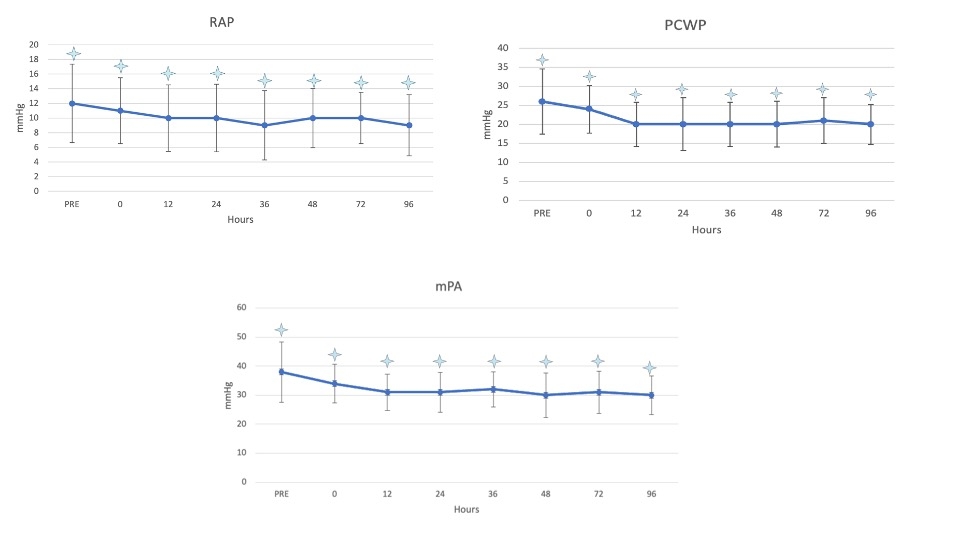
ResultsBaseline demographics and destination therapies are summarized in Table 1. Hemodynamic changes over the 96-hour window are shown in Table 2. RAP, PCWP, and mPAP decreased significantly, indicating effective biventricular unloading (Figure 1). PVR and Ea declined, while PAPi and RVSWi remained stable to modestly improved, reflecting reduced RV afterload and preserved contractility (Figure 2A). RA:PCWP remained consistently <0.6 without significant change. These shifts occurred without escalation in pharmacologic therapy: both VIS and total diuretic dosing declined or remained stable over time (Figure 2B), supporting mechanical unloading as the primary driver.
Among the 23 patients who underwent LVAD, 10 (43.5%) developed RVF. Five of these had a pre-Impella PAPi <1.85; however, 7 of 13 patients without RVF also had PAPi <1.85, limiting the discriminative value of this threshold. Group-level PAPi values are shown in Table 3.

ConclusionImpella 5.5 support preserved or improved RV hemodynamics without unmasking dysfunction. These findings challenge the use of Impella as a diagnostic stress test for RV reserve and suggest intraoperative factors—such as septal distortion or pericardiotomy—may better explain post-LVAD RVF.
  • Silkowski, Molly  ( MUSC , Charleston , South Carolina , United States )
  • Olson, Alex  ( Med University of South Carolina , Charleston , South Carolina , United States )
  • Asempah, Moses  ( MUSC , Charleston , South Carolina , United States )
  • Houston, Brian  ( MUSC , Charleston , South Carolina , United States )
  • Author Disclosures:
    Molly Silkowski: DO NOT have relevant financial relationships | Alex Olson: DO NOT have relevant financial relationships | Moses Asempah: DO NOT have relevant financial relationships | Brian Houston: No Answer
Meeting Info:

Scientific Sessions 2025

2025

New Orleans, Louisiana

Session Info:

Pressure Points: PH, PE, and RV Failure After LVAD

Monday, 11/10/2025 , 09:15AM - 10:15AM

Moderated Digital Poster Session

More abstracts on this topic:
More abstracts from these authors:
Hemodynamic Dance: Navigating Physiological Shifts in Ventricular Septal Defects After Myocardial Infarction

Olson Alex, Edwards William

Association of Moderate-Severe Tricuspid Regurgitation with Exercise Hemodynamics and Outcomes in Patients in Heart Failure with Preserved Ejection Fraction: Multicenter Study

Dorsey Natalie, Caravita Sergio, Tedford Ryan, Rao Vishal N., Baratto Claudia, Biscopink Alec, Taylor Eric, Atkins Jessica, Amoroso Nicholas, Carnicelli Anthony, Houston Brian, Silkowski Molly

You have to be authorized to contact abstract author. Please, Login
Not Available