
Plasma Protein Biomarkers of Coronary Artery Ectasia Based on Multiple Cohort Studies
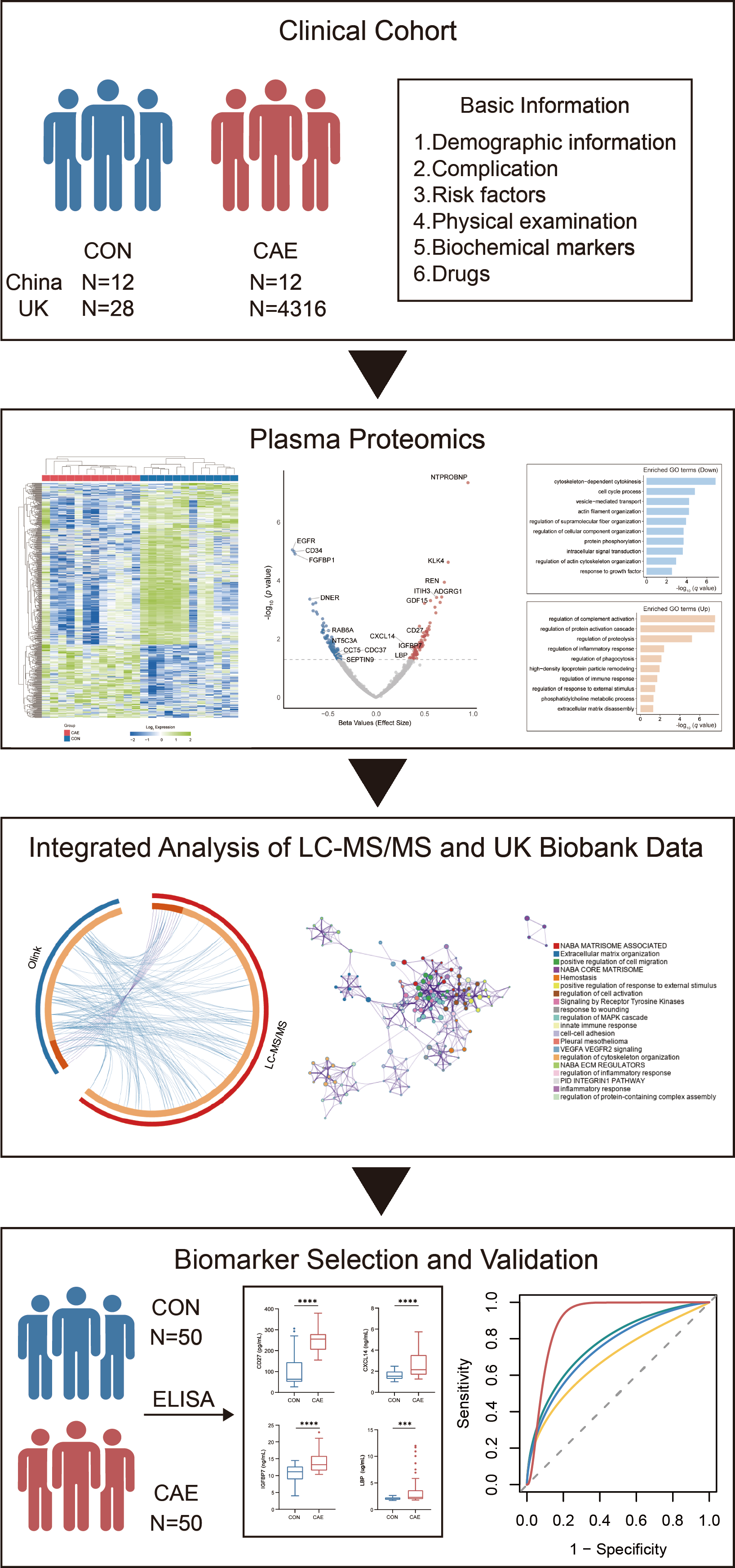
Abstract Body (Do not enter title and authors here): Background: Coronary artery ectasia (CAE), defined as pathological coronary dilation exceeding 1.5 times the diameter of adjacent normal segments, is a complex cardiovascular disorder. Its pathogenic mechanisms remain incompletely understood, and non-invasive diagnostic tools are currently limited. Methods: Plasma proteomic profiles from a Chinese cohort (analyzed by data-independent acquisition (DIA)) were integrated with UK Biobank data (Olink Explore platform) to identify CAE-specific biomarkers. Cross-platform meta-analysis identified consistently dysregulated proteins. Four candidate biomarkers were subsequently validated using enzyme-linked immunosorbent assay (ELISA) in independent cohorts. Results: We identified CAE-associated biomarkers enriched in pathways involving immune activation, extracellular matrix remodeling, and cytokine signaling. Meta-analysis revealed nine consistently dysregulated proteins. Four biomarkers were validated as reliable diagnostic tools: cluster of differentiation 27 (CD27), C-X-C motif chemokine ligand 14 (CXCL14), Insulin-like growth factor-binding protein 7 (IGFBP7), and Lipopolysaccharide-binding protein (LBP). These demonstrated robust diagnostic performance (area under the curve [AUC] range: 0.70–0.90), correlated significantly with disease severity, and were markedly elevated in CAE patients complicated by myocardial infarction. The findings implicate chronic low-grade vascular inflammation and T-cell immune dysregulation as potential pathogenic mechanisms driving CAE progression. Conclusion: This study identifies novel non-invasive biomarkers (CD27, CXCL14, IGFBP7, LBP) for the early detection and risk stratification of CAE, addressing critical gaps in clinical management. The results establish key pathogenic pathways driving CAE progression.
Tang, Muyun
( Peking Union Medical College Hospital
, Beijing
, China
)
Luan, Xiaodong
( Peking Union Medical College Hospital
, Beijing
, China
)
Zhang, Shuyang
( Peking Union Medical College Hospital
, Beijing
, China
)
Li, Qingao
( Peking Union Medical College Hospital
, Beijing
, China
)
Cao, Han
( The Hong Kong University of Science and Technology
, Hong Kong
, Hong Kong
)
Sun, Jiejun
( Peking Union Medical College Hospital
, Beijing
, China
)
Liu, Zhenyu
( Peking Union Medical College Hospital
, Beijing
, China
)
Jin, Ye
( Peking Union Medical College Hospital
, Beijing
, China
)
Fu, Amy
( The Hong Kong University of Science and Technology
, Hong Kong
, Hong Kong
)
Tian, Ran
( Peking Union Medical College Hospital
, Beijing
, China
)
Ip, Nancy
( The Hong Kong University of Science and Technology
, Hong Kong
, Hong Kong
)
Author Disclosures:
Muyun Tang:DO NOT have relevant financial relationships
| Xiaodong Luan:No Answer
| Shuyang Zhang:No Answer
| Qingao Li:DO NOT have relevant financial relationships
| Han CAO:DO NOT have relevant financial relationships
| Jiejun Sun:No Answer
| Zhenyu Liu:No Answer
| ye jin:No Answer
| Amy Fu:No Answer
| Ran Tian:DO NOT have relevant financial relationships
| Nancy IP:No Answer