Logo

American Heart Association

  15
  0


Final ID: MP1971

The predictive value of Atherogenic index of plasma and plaque characteristics after percutaneous coronary intervention in ST-elevated myocardial infarction patients: an intravascular optical coherence tomography study

Abstract Body (Do not enter title and authors here): Background and Aim This prospective study investigated plaque morphologies based on the underlying culprit lesion pathology in relation to the Atherogenic Index of Plasma (AIP) in patients with acute ST-elevated myocardial infarction (STEMI) who underwent primary percutaneous coronary intervention and optical coherence tomography (OCT) for assessment of culprit lesions. The aim of the study was to elucidate the effects of the AIP index and plaque type on the incidence of major adverse cardiovascular events (MACEs).
Methods A total of 274 patients with STEMI aged ≥ 18 years who underwent pre-intervention OCT imaging of culprit lesions between March 2017 and March 2019 were enrolled. AIP index was calculated using the formula: log 10 (triglycerides [TG]/ high-density lipoprotein cholesterol [HDL-C]). We stratified the cohort into four groups according to the presence of Thin-Cap Fibroatheroma (TCFA), as assessed by OCT, and the median value of AIP: Group I consisted of patients with AIP < median & without TCFA; Group II had AIP < median & with TCFA; Group III included those with AIP > median & without TCFA; and Group IV comprised patients with AIP > median & with TCFA.
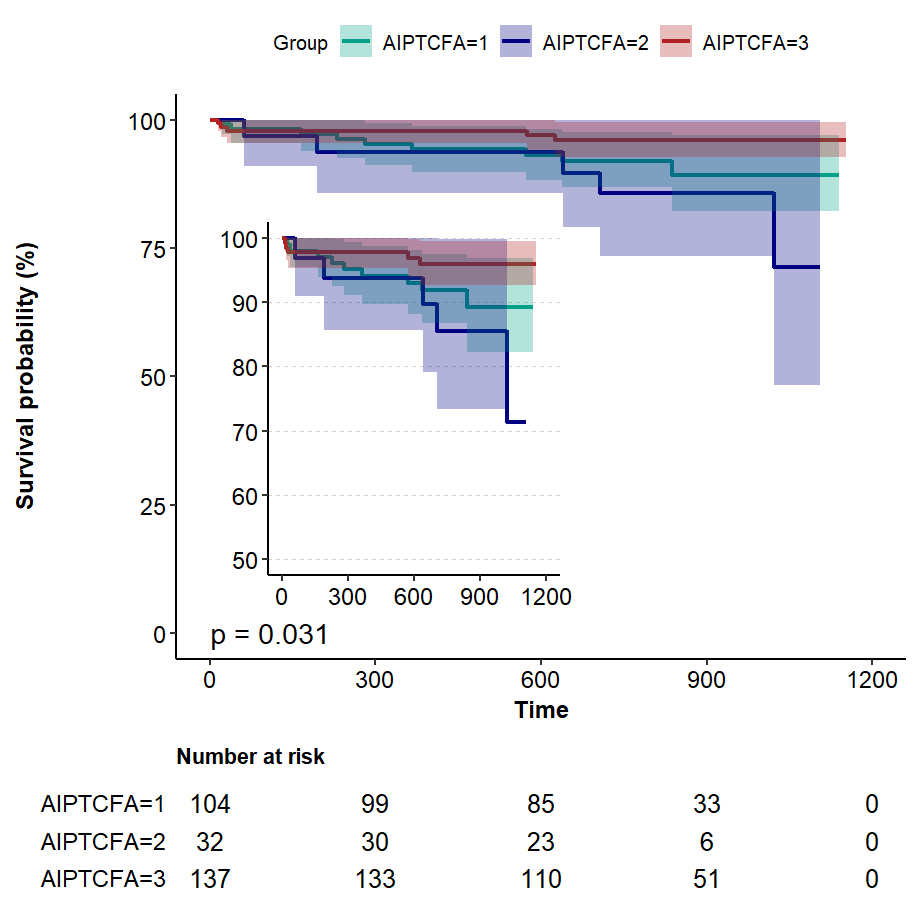
Outcomes Patients in Group IV exhibited a higher prevalence of Diabetes Mellitus (p = 0.006), elevated triglyceride-glucose index (TyG index) levels (p < 0.001), increased LDL-C levels (p = 0.006), higher triglycerides levels (p < 0.001), and elevated LP(a) rates (p < 0.001), indicating accelerated atherosclerosis. Furthermore, individuals within higher tertiles of AIP demonstrated a greater frequency of healing plaques (p = 0.021). Multivariable Cox regression analysis revealed that the incidence of MACEs among patients in Group IV (AIP > median & with TCFA) increased by 72% compared to those in Group I. Kaplan-Meier analyses confirmed risk stratification for MACEs based on interactions between AIP-TCFA interaction (log-rank p =0.031) and AIP-fibrous plaque interaction(log-rank p =0.032).
Conclusion Microstructural features observed via OCT for culprit lesions, combined with the AIP index—an important marker for cardiovascular disease—may be utilized clinically to support risk stratification and predict adverse events among STEMI patients.
  • Zhao, Xiaoxiao  ( Fuwai Hospital , Beijing , China )
  • Author Disclosures:
    Xiaoxiao Zhao: DO NOT have relevant financial relationships
Meeting Info:

Scientific Sessions 2025

2025

New Orleans, Louisiana

Session Info:

Management of Unstable Angina, NSTEMI and STEMI

Monday, 11/10/2025 , 09:15AM - 10:30AM

Moderated Digital Poster Session

More abstracts on this topic:
A novel method for measuring HDL-bound unconjugated bilirubin using an eel fluorescent protein reveals its association with reduced coronary artery disease

Fujioka Tomoo, Iino Takuya, Toh Ryuji, Harada Amane, Nagao Manabu, Shinohara Masakazu, Ishida Tatsuro, Otake Hiromasa

A Contemporary Machine Learning-Based Risk Stratification for Mortality and Hospitalization in Heart Failure with Preserved Ejection Fraction Using Multimodal Real-World Data

Fudim Marat, Weerts Jerremy, Patel Manesh, Balu Suresh, Hintze Bradley, Torres Francisco, Micsinai Balan Mariann, Rigolli Marzia, Kessler Paul, Touzot Maxime, Lund Lars, Van Empel Vanessa, Pradhan Aruna, Butler Javed, Zehnder Tobias, Sauty Benoit, Esposito Christian, Balazard Félix, Mayer Imke, Hallal Mohammad, Loiseau Nicolas

You have to be authorized to contact abstract author. Please, Login
Not Available