
Logo

American Heart Association

  14
  0


Final ID: MP982

Efficiency of Artificial Intelligence-Assisted Temporal Dispersion Mapping with Pulsed Field Ablation: Integration of Volta AF-Xplorer and Affera Sphere-9 System

Abstract Body (Do not enter title and authors here): Introduction:
Pulsed Field Ablation (PFA) using the Sphere-9 catheter with the Affera™ Mapping System (S9A) has recently been approved for the treatment of paroxysmal and persistent atrial fibrillation (AF) and atrial flutter. The Volta AF-Xplorer™ mapping software (VX), which detects and maps regions of spatial and temporal dispersion, has shown promise in improving procedural outcomes in AF ablation. However, the combined use of VX with S9A has not been studied. This study aims to evaluate the safety, efficacy, and efficiency of integrating VX with the S9A system during AF ablation.
Methods:
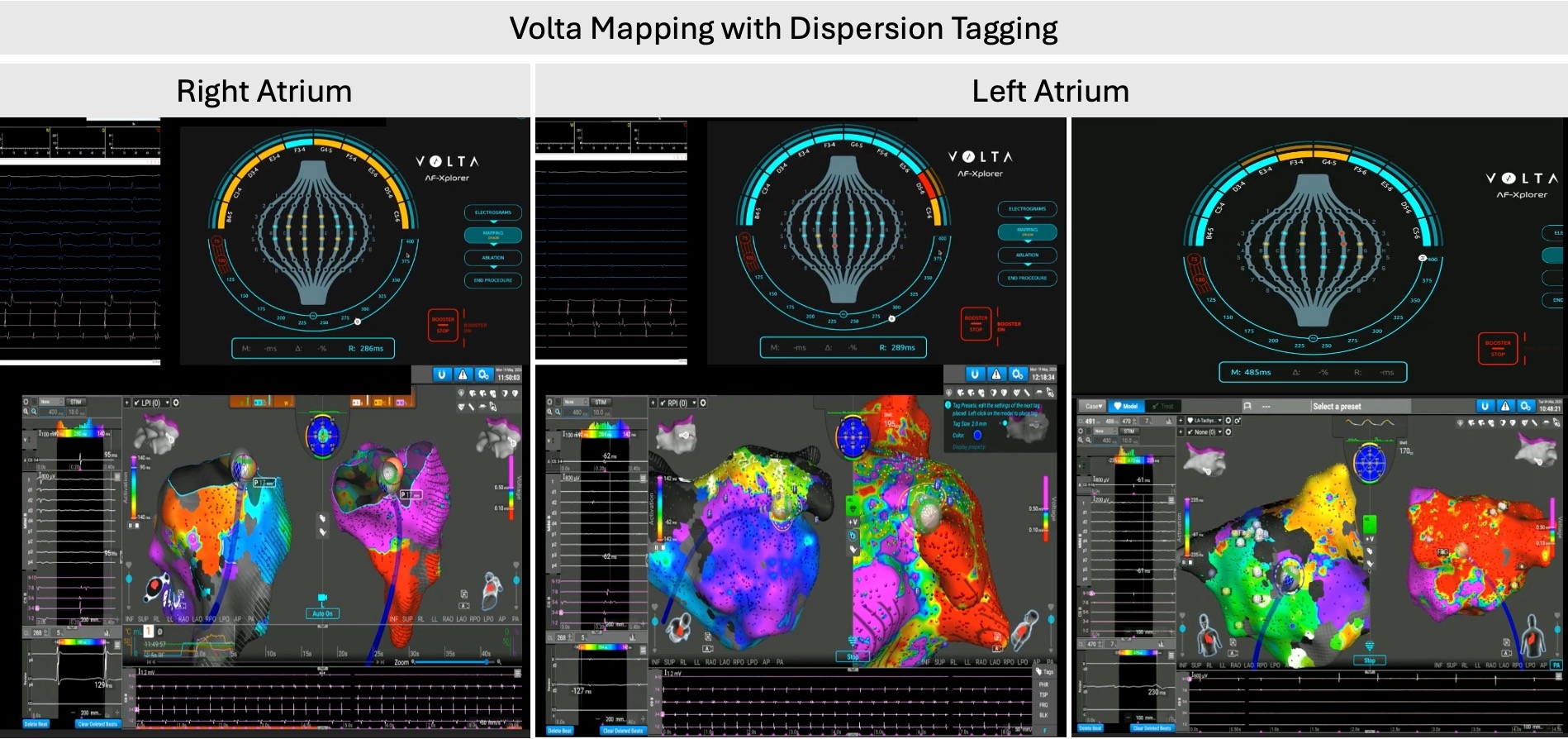
This prospective, single-center study enrolled patients undergoing PFA with S9A and VX between February and May 2025. Real-time 3D mapping of the right and left atria (RA and LA) was performed, with VX used to identify and label regions of spatiotemporal dispersion. Baseline dispersion mapping in AF was conducted, and ablation was carried out at all identified dispersion sites unless contraindicated by clinical judgment.
Results:
Data from 21 patients (52.4% female, mean age 68.8 ± 13.6 years) were analyzed. Pre-procedural ECG showed AF in 76.2% (n=16) and atrial flutter in 23.8% (n=5). Of the cases, 19% were de novo, and 81% were redo ablations. The average procedure duration was 60 ± 10 minutes, with all procedures performed using a zero-fluoroscopy approach. VX identified an average of 12±4 dispersion points in the RA and 18±2 in the LA. AF was terminated with ablation in 85.7% of cases, and only three patients required intraprocedural cardioversion from AF.
Conclusion:
Our findings suggest that combining the Volta AF-Xplorer with the Affera Sphere-9 mapping system during PFA is safe, effective, and efficient. This integrated approach shows promise for improving ablation outcomes. Further studies are warranted to assess long-term results and broader applicability.
  • Gabrah, Kirollos  ( Arrhythmia Research Group , Jonesboro , Arkansas , United States )
  • Nair, Ganesh  ( Arrhythmia Research Group , Jonesboro , Arkansas , United States )
  • Maldonado, Noel  ( Arrhythmia Research Group , Jonesboro , Arkansas , United States )
  • Doty, Brandon  ( Arrhythmia Research Group , Jonesboro , Arkansas , United States )
  • Nair, Devi  ( St. Bernards Medical Center , Jonesboro , Arkansas , United States )
  • Author Disclosures:
    Kirollos Gabrah: DO NOT have relevant financial relationships | Ganesh Nair: No Answer | Noel Maldonado: No Answer | Brandon Doty: DO NOT have relevant financial relationships | Devi Nair: DO have relevant financial relationships ; Consultant:Abbott:Active (exists now) ; Consultant:Bioston Scientific:Active (exists now) ; Consultant:J&J Medtech:Active (exists now) ; Consultant:Medtronic:Active (exists now)
Meeting Info:

Scientific Sessions 2025

2025

New Orleans, Louisiana

Session Info:

Harnessing AI: Innovations in Arrhythmia Detection and Management

Saturday, 11/08/2025 , 09:15AM - 10:30AM

Moderated Digital Poster Session

More abstracts on this topic:
Adverse Events with Pulsed Field Ablation - A Review of the Food and Drug Administration’s Manufacturer and User Facility Device Experience Database

Cooper Julie, Zagrodzky William, Zagrodzky Jason, Omotoye Samuel, Sardana Mayank, Kaplan Andrew, Link Mark, Bunch Thomas, Daniels James

A Retrospective Analysis of Papillary Muscle PVC Ablations and Postprocedural Outcomes

Gulati Arvind, Praveen Niharika, Poddar Aastha, Futela Pragyat, Quelal Karol, Thomas Varghese Ben, Deshmukh Abhishek, Kowlgi Gurukripa

You have to be authorized to contact abstract author. Please, Login
Not Available