Sex Differences in the Association of Obesity and Adiposity with Eicosanoid Metabolites
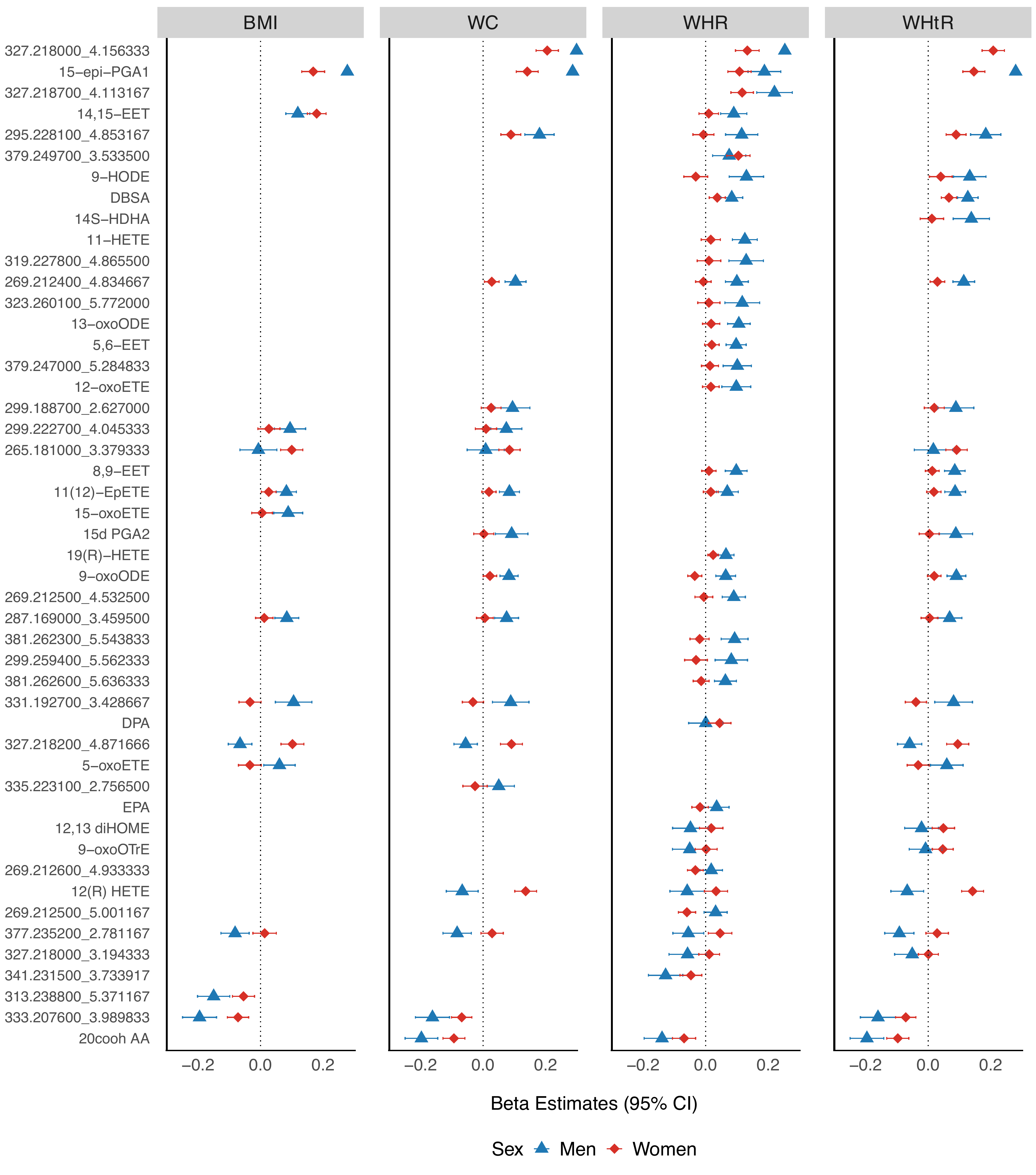
Abstract Body (Do not enter title and authors here): Introduction: Sex differences in obesity-related cardiovascular disease (CVD) are widely recognized, but the underlying inflammatory pathways driving these differences remain poorly understood.Eicosanoids are bioactive lipids that govern the upstream initiation of inflammatory activity and may mediate obesity-related cardiovascular risk. Objective: We examined sex differences in the associations of obesity and adiposity measures, including body mass index (BMI), waist circumference (WC), waist-to-hip ratio (WHR), and waist-to-height ratio (WHtR), with over 800 eicosanoid metabolites. Methods: We studied Multi-Ethnic Study of Atherosclerosis (MESA) participants at exam 2 with available samples for eicosanoid analysis. Eicosanoids were assessed using a directed, non-targeted mass spectrometry-based platform. We examined the cross-sectional association of adiposity measures with eicosanoids using multivariable linear regression models. To assess sex differences, we included interaction terms (obesity measure × sex) and performed sex-stratified analyses. Analyses were considered significant at FDR q-value <0.05. Results: We included 5064 adults (age 63 ± 10 years; 53% women, BMI 28.3 ± 5.4 kg/m2). Among 811 eicosanoids and related metabolites assayed, 61 displayed significant sex differences for at least one obesity measure (Figure, FDR q <0.05 for sex interaction term). For example, lower BMI and other adiposity measures were associated with higher levels of linoleic acid derivatives (HpODE), with stronger associations in men vs women (men: βBMI ≈ -0.20, SE = 0.03, p ≈ 1.3×10⁻⁶; women: βBMI ≈ -0.09, SE = 0.02, p ≈ 8.8×10⁻⁷). Conversely, higher BMI and worse adiposity measures were associated with higher levels of prostaglandin A1, with stronger associations in men vs women (men: βBMI ≈ 0.28, SE = 0.02, p < 1×10-12; women: βBMI ≈ 0.15, SE = 0.02, p < 1×10⁻⁸). Conclusions: We found that sex modified the associations of obesity and adipose traits with pro- and anti-inflammatory eicosanoids. Lower levels of obesity measures were associated with higher levels of pro-inflammatory octadecadienoic acid derivatives (e.g., 13-HpODE), more pronounced in men, while higher levels of obesity measures were associated with higher levels of anti-inflammatory prostaglandin derivatives (e.g., PGA1), again more pronounced in men. These findings may reflect inflammatory pathways that contribute to sex differences in obesity-related cardiovascular disease.
Grundmann, Amanda
(
Beth Israel Deaconess Medical Center at Harvard Medical School
, Boston , Massachusetts , United States )
Parekh, Juhi
(
Beth Israel Deaconess Medical Center at Harvard Medical School
, Boston , Massachusetts , United States )
Chitsazan, Mandana
(
Beth Israel Deaconess Medical Center at Harvard Medical School
, Boston , Massachusetts , United States )
Lau, Emily
(
Massachusetts General Hospital
, Chestnut Hill , Massachusetts , United States )
Allen, Norrina
(
NORTHWESTERN UNIVERSITY
, Chicago , Illinois , United States )
Ndumele, Chiadi
(
JOHNS HOPKINS HOSPITAL
, Silver Spring , Maryland , United States )
Norby, Faye
(
University of Minnesota
, Minneapolis , Minnesota , United States )
Jain, Mohit
(
Univ. of California - San Diego
, La Jolla , California , United States )
Cheng, Susan
(
Cedars-Sinai Medical Center
, Los Angeles , California , United States )
Ho, Jennifer
(
Beth Israel Deaconess Medical Center at Harvard Medical School
, Boston , Massachusetts , United States )
Author Disclosures:
Amanda Grundmann:DO NOT have relevant financial relationships
| Jennifer Ho:DO have relevant financial relationships
;
Individual Stocks/Stock Options:Pfizer:Active (exists now)
; Consultant:Lilly:Active (exists now)
| Juhi Parekh:DO NOT have relevant financial relationships
| Mandana Chitsazan:DO NOT have relevant financial relationships
| Emily Lau:DO have relevant financial relationships
;
Consultant:SystoleHealth, Inc.:Active (exists now)
; Advisor:Amissa Health:Active (exists now)
; Advisor:Roon :Active (exists now)
| Norrina Allen:DO NOT have relevant financial relationships
| Chiadi Ndumele:DO NOT have relevant financial relationships
| Faye Norby:DO NOT have relevant financial relationships
| Mohit Jain:No Answer
| Susan Cheng:DO have relevant financial relationships
;
Consultant:UCB:Active (exists now)