Impact of Exercise Capacity and Blunted Blood Pressure Response on Clinical, Echocardiographic, and Prognostic Outcomes of Exercise Echocardiographic Stress Testing
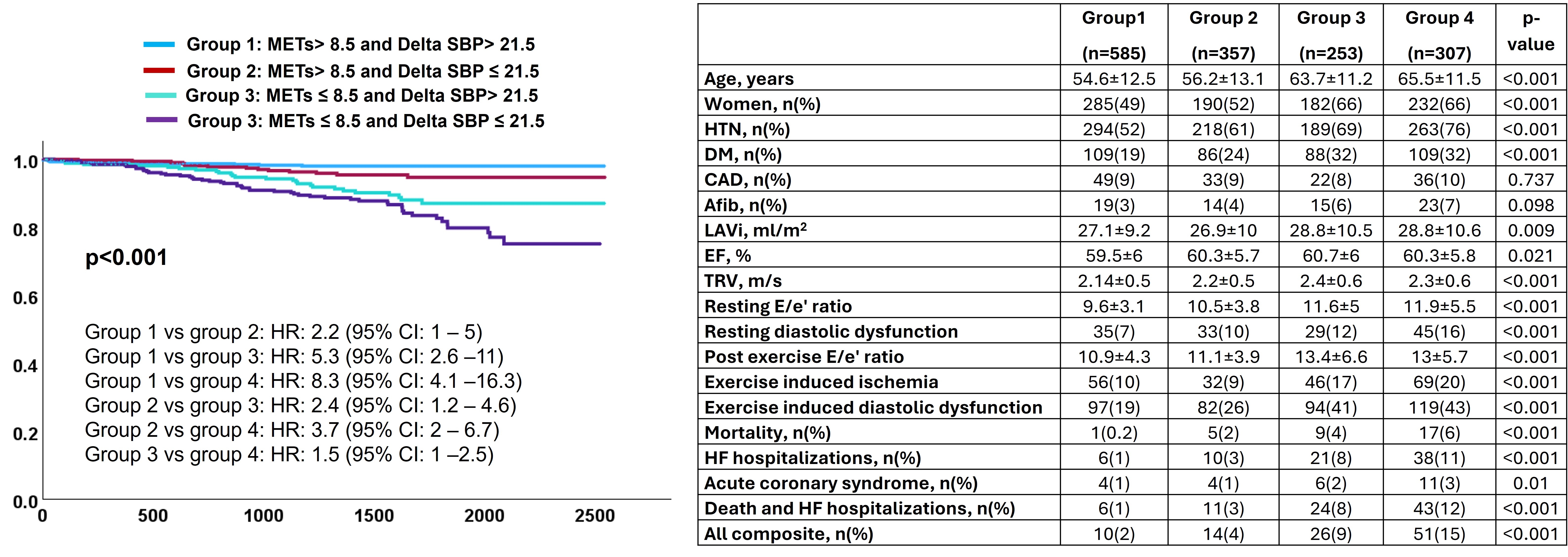
Abstract Body (Do not enter title and authors here): Background: We studied the additive prognostic value of systolic blood pressure (SBP) response and exercise capacity on clinical, echocardiographic, and prognostic outcomes in symptomatic patients referred for exercise stress echocardiography (ExE). Methods: We studied 1580 patients [59±13.1 years, 889(51%) women, EF 60±6, all>50%] referred for ExE who were followed for a median of 2.7 years for heart failure (HF), acute coronary syndrome (ACS) hospitalization, and all-cause mortality. Patient exercise capacity defined by metabolic equivalent of tasks (METs), and the change in their SBP at peak exercise (D- SBP) were assessed. Patients were classified based on abnormal METs and D-SBP and compared for outcomes, ischemia on ExE, and baseline and exercise induced diastolic function. Results: During follow up 84 had the combined outcomes (32 died, 75 HF hospitalization, 25 ACS hospitalization). Baseline and exercise SBP were 134±19 and 160±33 mmHg, with D-SBP 25.3±18 mmHg and METs 9.8±14. ROC-curve suggested D-SBP≤21.5 and METs≤8.5 were predictive of outcomes. Patients were classified into (figure1): group 1 METs>8.5 and D-SBP>21.5 (normal exercise capacity and BP response, 585 patients), group 2 METs>8.5 and D-SBP≤21.5 (normal exercise capacity and blunted BP response, 368 patients), group 3 METs≤8.5 and D-SBP>21.5 (blunted exercise capacity with normal BP response, 277 patients), and group 4 METs≤8.5 and D-SBP≤21.5 (blunted exercise capacity and BP response, 350 patients). It was noted that from group1 to 4, a progressive worsening of clinical, baseline and post exercise parameters of LV function occurred as a progressively increased exercise induced ischemia. The individual and combined outcomes were more increasingly prevalent from group 1 to 4. Survival analyses suggested that Group 1 is the lowest risk and group 4 is the highest risk with group 2 and 3 with varying degrees of intermediate risk. These relationships remained in normal or elevated baseline SBP. Conclusions: Our study confirms that blunted BP response to exercise and exercise capacity are both independent predictors of ischemia and future adverse outcomes. However, these variables had additive prognostic values and likely reflect different pathophysiologic states. The occurrence of both during graded exercise testing carries worse prognosis compared to either alone suggesting that blunted BP response at lower workloads is of more prognostic impact compared to that at higher workloads.
Omar, Alaa
(
Cardiovascular Institute of Mississippi
, Mccomb , Mississippi , United States )
Alam, Loba
(
Mount Sinai Morningside
, New York , New York , United States )
Veshtaj, Marinela
(
Mount Sinai Morningside
, New York , New York , United States )
Argulian, Edgar
(
Mount Sinai
, New York , New York , United States )
Author Disclosures:
Alaa Omar:DO NOT have relevant financial relationships
| Loba Alam:No Answer
| Marinela Veshtaj:DO NOT have relevant financial relationships
| Edgar Argulian:DO NOT have relevant financial relationships