Logo

American Heart Association

  13
  0


Final ID: MP2474

Virtual Home-based Exercise Improves Functional and Fitness Outcomes in Veterans with Peripheral Artery Disease: The Smart MOVE Study

Abstract Body (Do not enter title and authors here): Background: Approximately 8.5 million US adults and 10% of veterans suffer from peripheral artery disease (PAD), the primary symptom of which is reproducible leg pain with walking (claudication) that leads to impaired mobility, loss of functional status, and increased risk of amputation. While supervised exercise improves walking ability and is first-line therapy for symptomatic PAD, fewer than 25% of patients enroll due to the physical, fiscal, and logistical barriers associated with on-site therapy.
Research Question: We evaluated the feasibility of a 12-week virtual home-based exercise therapy (HBET) program to improve functional status and cardiopulmonary fitness (CPF) in veterans with symptomatic PAD.
Methods: Participants were prescribed up to 45 minutes of moderate-to-high intensity walking (Borg RPE: 12-14, 3x per week) to the point of near-maximal claudication. Weekly behavioral coaching via phone/video and wearable activity monitors were also provided to monitor participant activity and exercise adherence. We used 6-minute walk test (6MWT) and submaximal graded exercise testing (GXT) with the Gardner protocol to measure functional status and cardiopulmonary fitness (GXT duration, peak VO2, VE/VCO2 slope), and the Veterans Rand 12-item (VR-12) survey to assess quality of life. Paired T-tests were used to compare outcomes after 12 weeks over baseline.
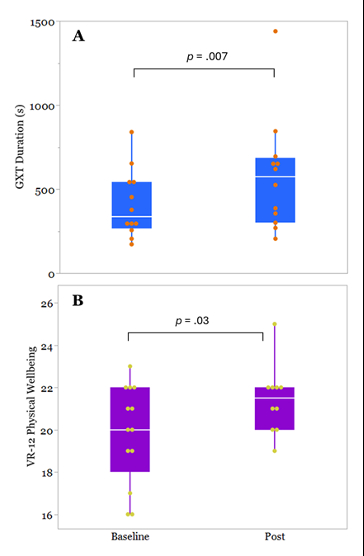
Results: We report data from 13 Veterans, mean (SD) age 69.6 (5.8) years, who completed the 12 week intervention. HBET significantly increased GXT duration (576±338 vs. 410±201 seconds; p = .007) and VR-12 physical wellbeing scores (22.0±1.5 vs. 19.9±2.8; p = .03)(Figure 1). Non-significant improvements in 6MWT distance (1121.6 vs. 1056.9 feet, p = .13) and VE/VCO2 slope (32.0 vs 35.4, p = .12) were also observed.
Conclusions: Virtual home exercise improved walking duration and perceived physical well-being in veterans with symptomatic PAD. These preliminary results support the feasibility of HBET as an alternative to supervised exercise therapy, however future studies need to assess whether HBET improves enrollment, adherence, and clinical outcomes.
  • Novak, Tom  ( Atlanta VA Medical Center , Decatur , Georgia , United States )
  • Goodwin-hamel, Cydney  ( Atlanta VA Medical Center , Decatur , Georgia , United States )
  • Patel, Risha  ( Atlanta VA Medical Center , Decatur , Georgia , United States )
  • Jones, Brandon  ( Atlanta VA Medical Center , Decatur , Georgia , United States )
  • Nocera, Joe  ( Atlanta VA Medical Center , Decatur , Georgia , United States )
  • Shah, Amit  ( Emory University , Atlanta , Georgia , United States )
  • Harzand, Arash  ( Atlanta VA Medical Center , Decatur , Georgia , United States )
  • Author Disclosures:
    Tom Novak: No Answer | Cydney Goodwin-Hamel: No Answer | Risha Patel: No Answer | Brandon Jones: No Answer | Joe Nocera: DO NOT have relevant financial relationships | Amit Shah: DO NOT have relevant financial relationships | Arash Harzand: DO NOT have relevant financial relationships
Meeting Info:

Scientific Sessions 2025

2025

New Orleans, Louisiana

Session Info:

Medical Therapies in Vascular Medicine

Monday, 11/10/2025 , 10:45AM - 12:00PM

Moderated Digital Poster Session

More abstracts from these authors:
Center-Based, Home-Based, and Technology-Enhanced Cardiac Rehabilitation Equally Reduce Mortality Risk in Veterans

Shah Amit, Li Louis, Aggarwal Vinod, Zafari Abarmard, Park Linda, Harzand Arash

Digital Health Intervention Boosts Health-Conscious Behaviors in Veterans with PAD Despite Technological Challenges

Xginjupallix Xramyax, Dunlap Phenesse, Goodwin-hamel Cydney, Escoffery Cam, Shah Amit, Harzand Arash

You have to be authorized to contact abstract author. Please, Login
Not Available