
Logo

American Heart Association

  19
  0


Final ID: MP147

In Vivo Cardiac Diffusion Tensor Imaging for the Differentiation between Hypertrophic Cardiomyopathy and Hypertensive Heart Disease: Insights into Myocardial Microstructure

Abstract Body (Do not enter title and authors here): Background
Left ventricular hypertrophy (LVH) is a common feature of both hypertrophic cardiomyopathy (HCM) and hypertensive heart disease (HHD), making differentiation through macrostructural imaging challenging. Given the distinct tissue characteristics of these two conditions, the emerging cardiac diffusion tensor imaging (cDTI) allows in vivo characterization of myocardial microstructure, offering insights for differential diagnosis. Purpose
To validate the feasibility of cDTI for non-invasive myocardial microstructural characterization in HCM and HHD and to explore its potential value in distinguishing them.
Materials and methods
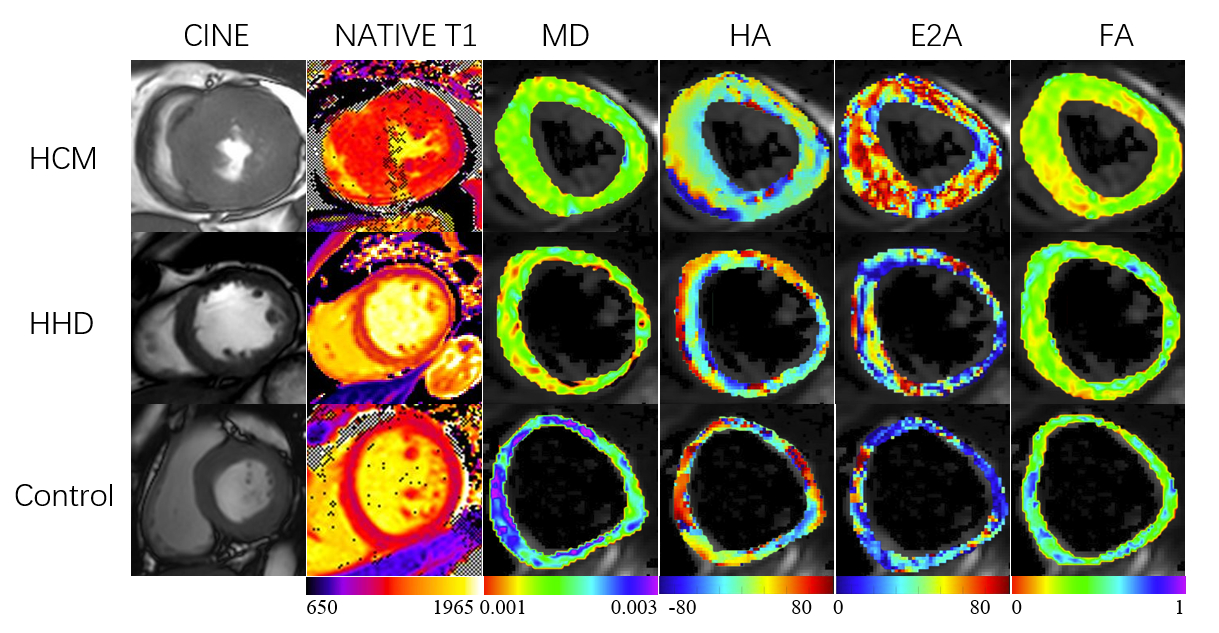
In this prospective study, 40 participants diagnosed with HCM, 20 diagnosed with HHD and 20 controls were enrolled. All consecutively underwent a 3.0-T CMR protocol including DTI, cine imaging, T1 mapping and late gadolinium enhancement (LGE) imaging. LGE was performed in HCM and HHD participants. Fractional anisotropy (FA) and secondary eigenvector angle (E2A) were assessed after adjusting for hypertrophy and fibrosis.
Results
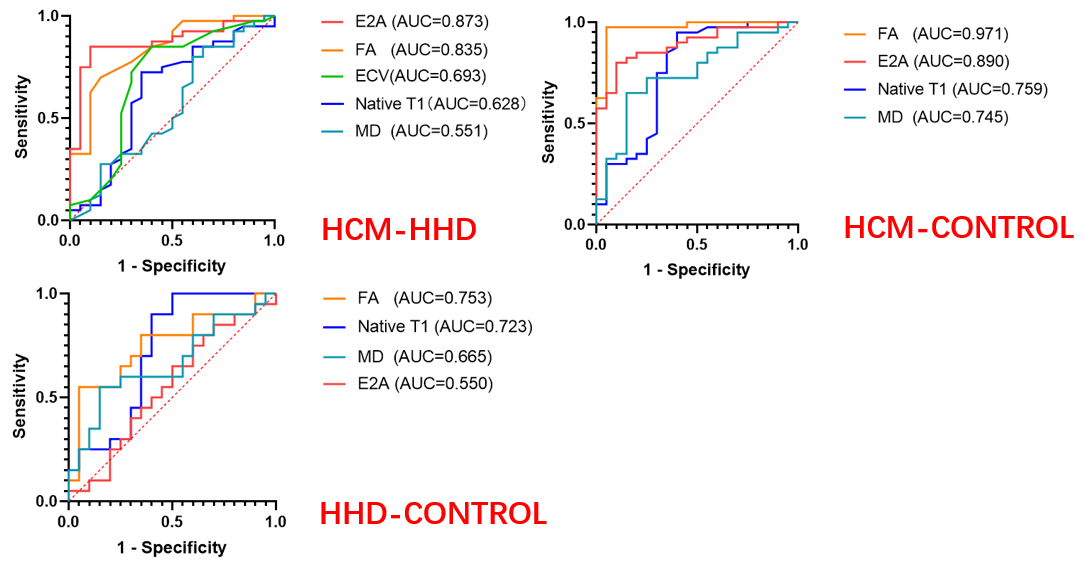
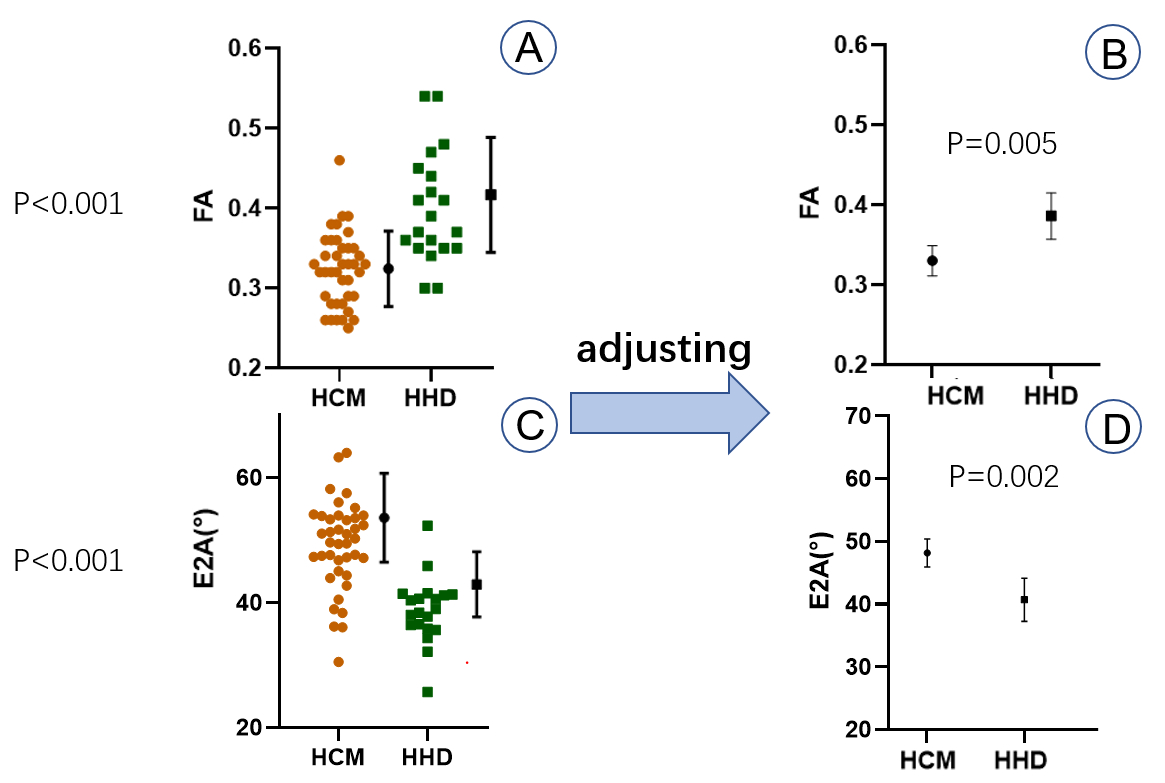
FA was reduced in HCM and HHD participants compared with healthy controls (FAHCM = 0.32 ± 0.05, FAHHD = 0.4 ± 0.07, FAControl = 0.46 ± 0.06, p<0.001). Meanwhile, HCM participants had significantly higher E2A (E2AHCM = 49.2 ± 7.1°, E2AHHD = 38.7 ± 5.3°, E2AControl = 38.1 ± 5.3°, p<0.001). FA (p=0.005) and E2A (p=0.002) remained significant even after adjusting for left ventricular wall thickness (LVWT), native T1 and extracellular volume (ECV). FA showed the best diagnostic performance in identifying HCM (area under the curve [AUC]=0.97), HHD (AUC=0.75) from healthy controls and differentiating HCM from HHD (AUC=0.84). E2A also exhibited excellent precision for identifying HCM (AUC=0.89) and discriminating HCM from HHD (AUC=0.87).
Conclusions
In our study, there were significant differences in FA and E2A between HCM and HHD even after adjusting for hypertrophy and fibrosis. cDTI demonstrates potential as a useful tool for discriminating HCM, HHD and healthy controls with great diagnostic efficiency.
  • Liu, Yujie  ( Fuwai hospital , Beijing , China )
  • Zhao, Shihua  ( Fuwai hospital , Beijing , China )
  • Author Disclosures:
    Yujie Liu: DO NOT have relevant financial relationships | Shihua Zhao: No Answer
Meeting Info:

Scientific Sessions 2025

2025

New Orleans, Louisiana

Session Info:

Precision Phenotyping in Hypertrophic Cardiomyopathy: Imaging, AI, and Genomics

Saturday, 11/08/2025 , 01:45PM - 02:55PM

Moderated Digital Poster Session

You have to be authorized to contact abstract author. Please, Login
Not Available