
Logo

American Heart Association

  26
  0


Final ID: MP2670

From Voltage to Velocity: Functional Insights via Integrated Unipolar–Bipolar Mapping

Abstract Body (Do not enter title and authors here): Background:
Accurate delineation of the atrial substrate is critical to tailoring therapy for atrial fibrillation (AF). Although bipolar voltage (BV) mapping is widely used, its functional meaning and correlation with local conduction velocity (CV) remain unclear. Unipolar voltage (UV) mapping, which captures deeper tissue, may complement bipolar data by better reflecting transmural structural changes.

Objective:
To determine whether combining UV and BV thresholds can classify atrial tissue into conduction-based phenotypes.

Methods:
High-density sinus-rhythm electro-anatomic maps from 63 patients with AF were retrospectively analysed. Local activation times in sinus rhythm were used to compute CV via a triangulation algorithm. Point-by-point CV values were plotted against corresponding unipolar and bipolar voltages. Using iterative threshold optimisation, regions exhibiting similar CV were clustered to define voltage-based tissue classes.

Results:
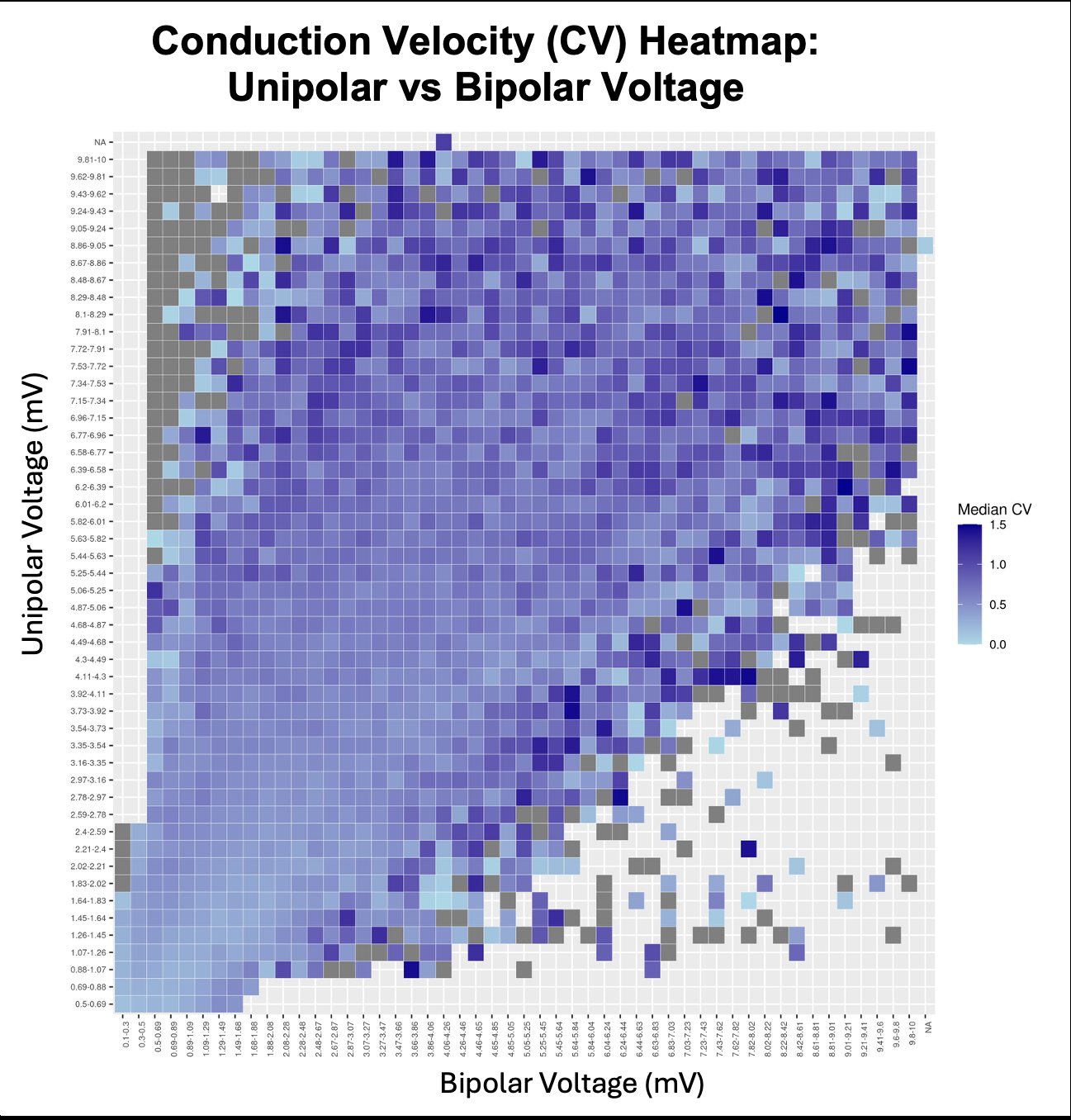
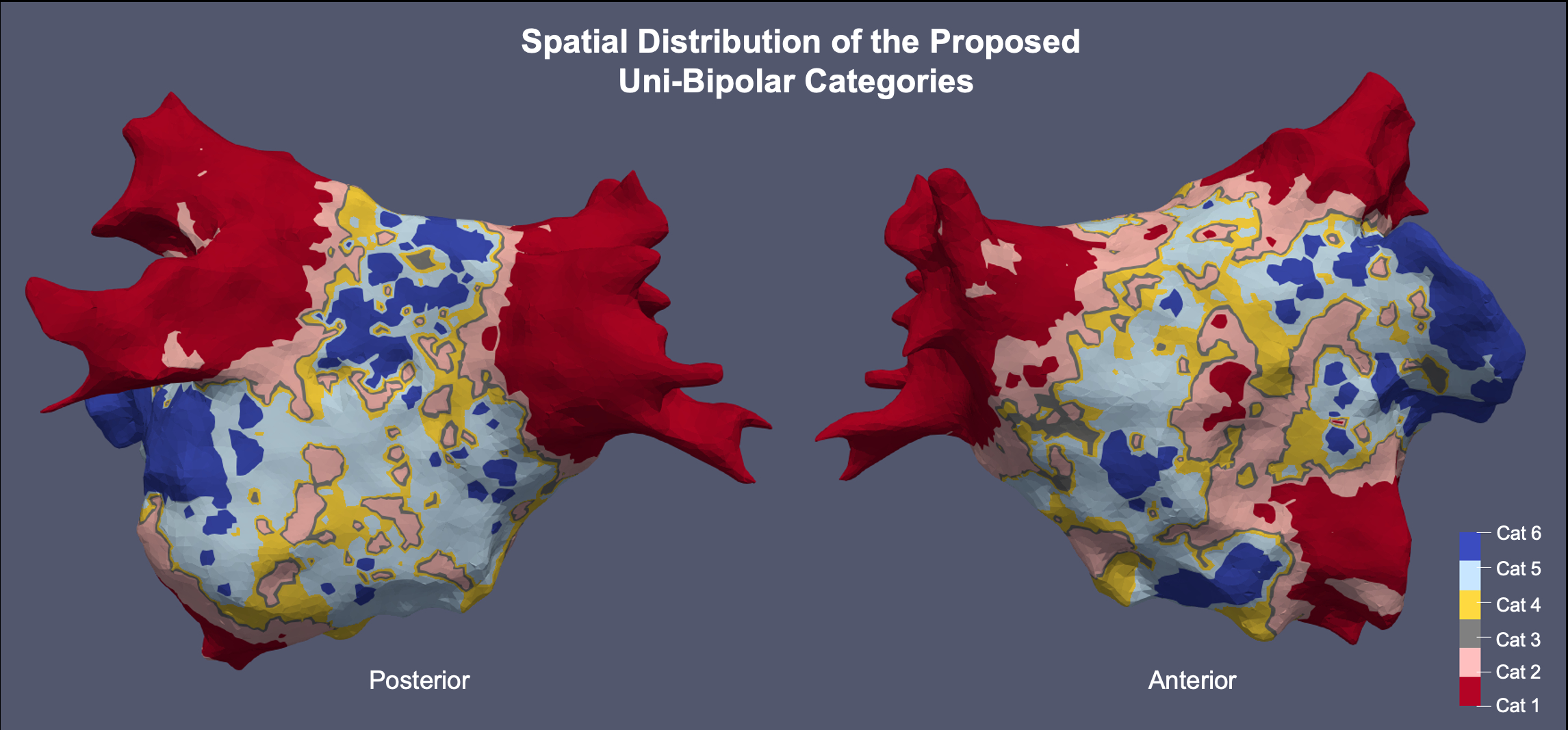
Plotting CV against UV–BV pairs revealed that CV rose steadily as both voltages increased (Figure 1). Six UV–BV ranges best separated conduction characteristics as shown in Figure 2:
Cat 1: BV < 0.10 mV & UV < 0.50 mV—designated deep scar; hence, no CV was assigned to this category.
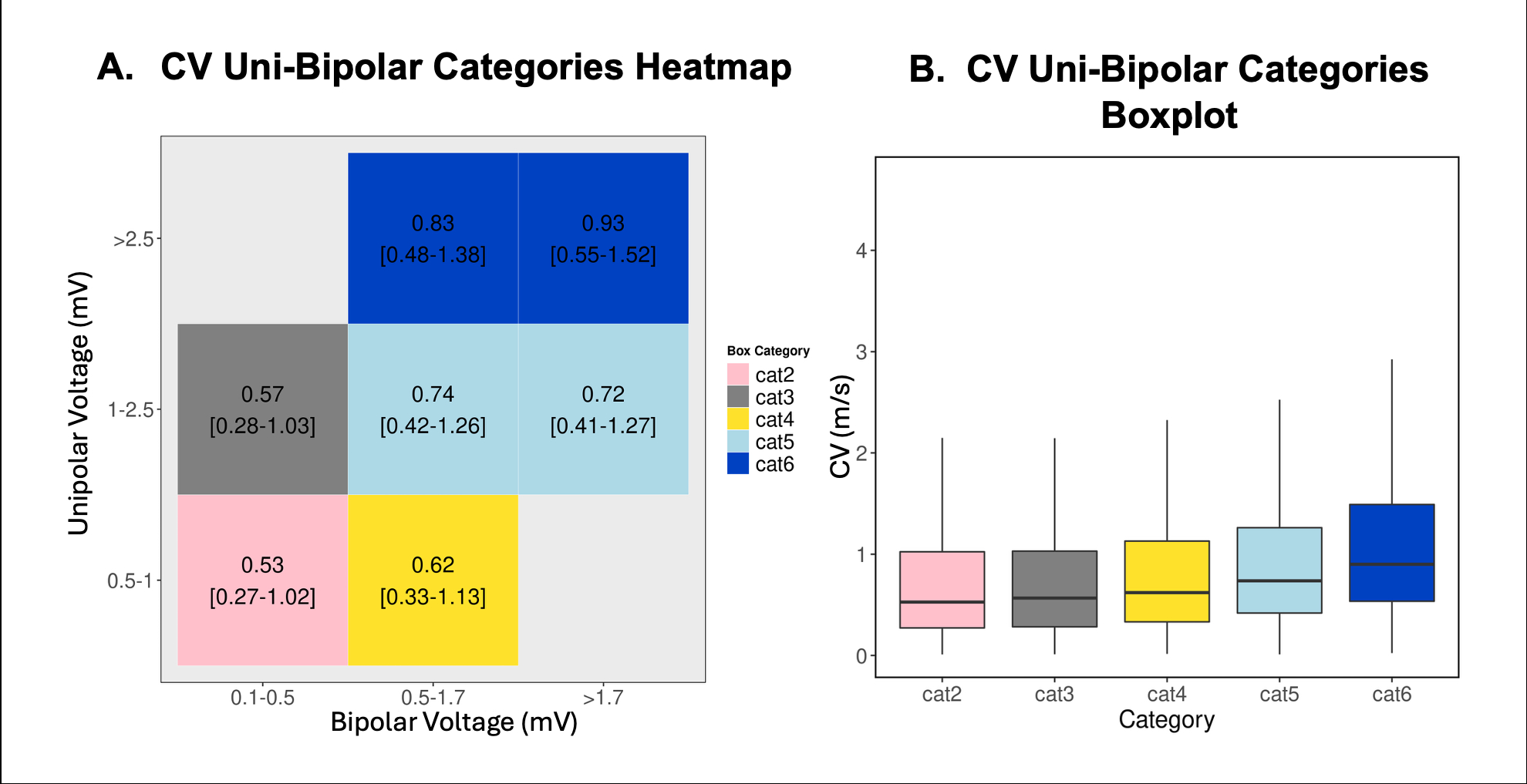
Cat 2: 0.10 ≤ BV < 0.50 mV & 0.50 ≤ UV < 1.00 mV—median CV 0.53 m/s (IQR 0.27–1.02).
Cat 3: 0.10 ≤ BV < 0.50 mV & 1.00 ≤ UV < 2.50 mV—0.57 m/s (0.28–1.03).
Cat 4: 0.50 ≤ BV < 1.70 mV & 0.50 ≤ UV < 1.00 mV—0.62 m/s (0.33–1.13).
Cat 5: 0.50 ≤ BV < 1.70 mV & 1.00 ≤ UV < 2.50 mV—0.74 m/s (0.73–1.27).
Cat 6: BV ≥ 1.70 mV & UV ≥ 2.50 mV—0.88 m/s (0.52-1.45).
Pairwise comparisons between adjacent classes (Cat 6 vs 5, 5 vs 4, 4 vs 3, and 3 vs 2) showed progressively faster conduction with higher voltages (t-tests; all p < 0.001, Figure 3). The empirically derived thresholds align closely with histology-guided voltage ranges reported previously.

Conclusion:
The integration of unipolar and bipolar voltage thresholds effectively enables a conduction-based classification of atrial substrate, offering a promising approach for enhanced substrate characterization in AF.
  • Mohsen, Yazan  ( Johns Hopkins University , Baltimore , Maryland , United States )
  • Ali, Syed Yusuf  ( Johns Hopkins University , Baltimore , Maryland , United States )
  • Sabareesan, Shreeram  ( Johns Hopkins University , Baltimore , Maryland , United States )
  • Loeffler, Shane  ( Johns Hopkins University , Baltimore , Maryland , United States )
  • Stoeckigt, Florian  ( Krankenhaus Porz am Rhein , Cologne , Germany )
  • Trayanova, Natalia  ( Johns Hopkins University , Baltimore , Maryland , United States )
  • Author Disclosures:
    Yazan Mohsen: DO NOT have relevant financial relationships | Syed Yusuf Ali: DO NOT have relevant financial relationships | Shreeram Sabareesan: DO NOT have relevant financial relationships | Shane Loeffler: DO NOT have relevant financial relationships | Florian Stoeckigt: DO NOT have relevant financial relationships | Natalia Trayanova: DO NOT have relevant financial relationships
Meeting Info:

Scientific Sessions 2025

2025

New Orleans, Louisiana

Session Info:

Chasing VT: Evolving Strategies in Mapping and Ablation to Augment Procedural Success

Monday, 11/10/2025 , 01:45PM - 03:00PM

Moderated Digital Poster Session

More abstracts on this topic:

A Large Animal Model of Persistent Atrial Fibrillation

Mostafizi Pouria, Goldman Steven, Moukabary Talal, Lefkowitz Eli, Ref Jacob, Daugherty Sherry, Grijalva Adrian, Cook Kyle Eric, Chinyere Ike, Lancaster Jordan, Koevary Jen

Artificial Intelligence Can Match Atrial Fibrillation Electrograms to Action Potential Recordings in Patients

Abad Juan Ricardo Carlos, Anbazhakan Suhaas, Ruiperez-campillo Samuel, Rodrigo Miguel, Narayan Sanjiv

More abstracts from these authors:
Epicardial Adipose Tissue Association with Fibrotic Substrate Distribution and Rotor-attracting Locations: A Study Using Contrast Computed Tomography (CCT) Scans and Late Gadolinium Enhancement Magnetic Resonance Imaging (LGE-MRI)-based Digital Twins of Persistent Atrial Fibrillation

Sakata Kensuke, Prakosa Adityo, Yamamoto Alves Pinto Carolyna, Ali Syed Yusuf, Loeffler Shane, Kholmovski Eugene, Trayanova Natalia

Digital Twins Enable Noninvasive Prediction of Roof-Dependent Atrial Tachycardia Occurrence Following Pulmonary Vein Isolation

Sakata Kensuke, Spragg David, Trayanova Natalia, Yamamoto Carolyna, Ali Syed Yusuf, Loeffler Shane, Prakosa Adityo, Tice Brock, Kholmovski Eugene, Marine Joseph, Calkins Hugh

You have to be authorized to contact abstract author. Please, Login
Not Available