Extracellular miR-150 Released by hAMSC in Response to Ischemia/Reperfusion Injury Identifies a Novel Target for Myocardial Repair
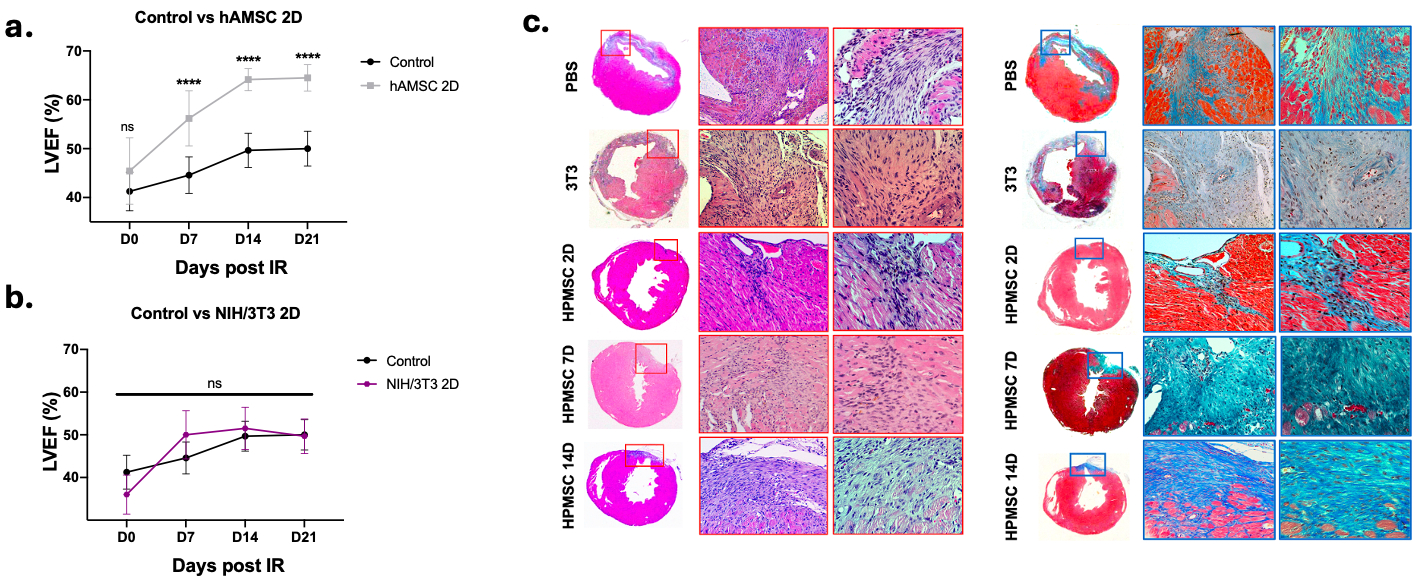
Abstract Body (Do not enter title and authors here): Introduction. Human amniotic mesenchymal stem cells (hAMSC) possess substantial therapeutic potential in hepatic, oncological, and degenerative disorders; however, their role in cardiovascular diseases in the context of acute myocardial infarction still remains unexplored. Methods and results. We investigated the contribution of hAMSC in a murine model of myocardial ischemia/reperfusion (I/R). C57BL/6 mice were subjected to 40 minutes transient ligation of the left anterior descending coronary artery, followed by intravenous administration of 2x10^5 hAMSC at 2, 7, or 14 days post-I/R. Cardiac function and molecular signaling involving the MIAT/miR-150/Hoxa4 axis were evaluated. Mice receiving hAMSC two days after I/R exhibited significant cardioprotection, evidenced by an improved left ventricular ejection fraction (LVEF) at 21 days post-injection (64.5 ± 2.7 vs. 50.0 ± 3.6), and a marked reduction in myocardial necrosis and fibrosis. Immunohistochemical analysis of cardiac tissue using a human-specific anti-hAMSC antibody, SSEA-4, revealed minimal cellular engraftment, limiting the assessment of direct cell-mediated effects. Interestingly, hAMSC-treated hearts showed elevated levels of miR-150 and concomitant downregulation of Hoxa4, consistent with its cardioprotective role. This effect is likely mediated by suppression of MIAT effect, a lncRNA known to upregulate Hoxa4 by sponging miR-150. To assess the functional role of miR-150, we employed CRISPR-Cas9 to generate miR-150-deficient hAMSC. Notably, these modified cells lost their cardioprotective effects when administered to I/R-injured mice (56.45 ± 4.94 vs 44 ± 5.29). Further analysis revealed that miR-150 is present in extracellular vesicles (EVs) secreted by hAMSC in response to I/R stimuli. Administration of purified EVs reproduced the cardioprotective effects observed with intact hAMSC (57.33 ± 2.51 vs 49.66 ± 3.50), underscoring a paracrine mechanism mediated by the miR-150 cargo. Following the above, engineered lipid nanoparticles containing miR150 also exerted the same levels of protection (55 ± 2 vs 44.58 ± 3.73). Conclusions: hAMSC promote cardiac repair following acute myocardial infarction through mechanisms involving the MIAT/miR-150/Hoxa4 axis. These findings highlight the therapeutic relevance of hAMSC-derived EVs and suggest that miR-150-based interventions, such as exosome therapy or nanoparticle delivery, may serve as effective alternatives to conventional cell-based treatments.
Alcharani, Nunzio
(
Fundacion Univ Francisco de Vitoria
, Pozuelo De Alarcon , Spain )
Tesoro, Laura
(
Fundacion Univ Francisco de Vitoria
, Pozuelo De Alarcon , Spain )
Hernandez Navarro, Ignacio
(
Fundacion Univ Francisco de Vitoria
, Pozuelo De Alarcon , Spain )
Cook, Alberto
(
UNIVERSIDAD ALCALA
, Alcala De Henares Madrid , Spain )
Gonzalez-cucharero, Claudia
(
Hospital Ramon y Cajal
, Madrid , Spain )
Jimenez-guirado, Beatriz
(
Fundacion Univ Francisco de Vitoria
, Pozuelo De Alarcon , Spain )
Zamorano, Jose
(
Hospital Ramon y Cajal
, Madrid , Spain )
Saura, Marta
(
UNIVERSIDAD ALCALA
, Alcala De Henares Madrid , Spain )
Iglesias, Maite
(
Fundacion Univ Francisco de Vitoria
, Pozuelo De Alarcon , Spain )
Zaragoza, Carlos
(
Fundacion Univ Francisco de Vitoria
, Pozuelo De Alarcon , Spain )
Author Disclosures:
Nunzio Alcharani:DO NOT have relevant financial relationships
| Carlos Zaragoza:DO NOT have relevant financial relationships
| Laura Tesoro:DO NOT have relevant financial relationships
| Ignacio Hernandez Navarro:DO NOT have relevant financial relationships
| Alberto Cook:DO NOT have relevant financial relationships
| Claudia Gonzalez-Cucharero:DO NOT have relevant financial relationships
| Beatriz Jimenez-Guirado:No Answer
| Jose Zamorano:DO NOT have relevant financial relationships
| Marta Saura:DO NOT have relevant financial relationships
| Maite Iglesias:DO NOT have relevant financial relationships