Hepatic Steatosis and Subsequent Fibrosis Are Strongly Associated with Cardiometabolic Risk Clustering in Adults in the United States
Abstract Body (Do not enter title and authors here): Background Hepatic steatosis and hepatic fibrosis are systemic conditions that increase cardiometabolic risk. However, nationally representative data evaluating these associations are limited.
Research Question Among adults in the United States, does the presence of hepatic steatosis, and within steatosis, the presence of hepatic fibrosis, increase the likelihood of having metabolic syndrome and higher levels of insulin resistance?
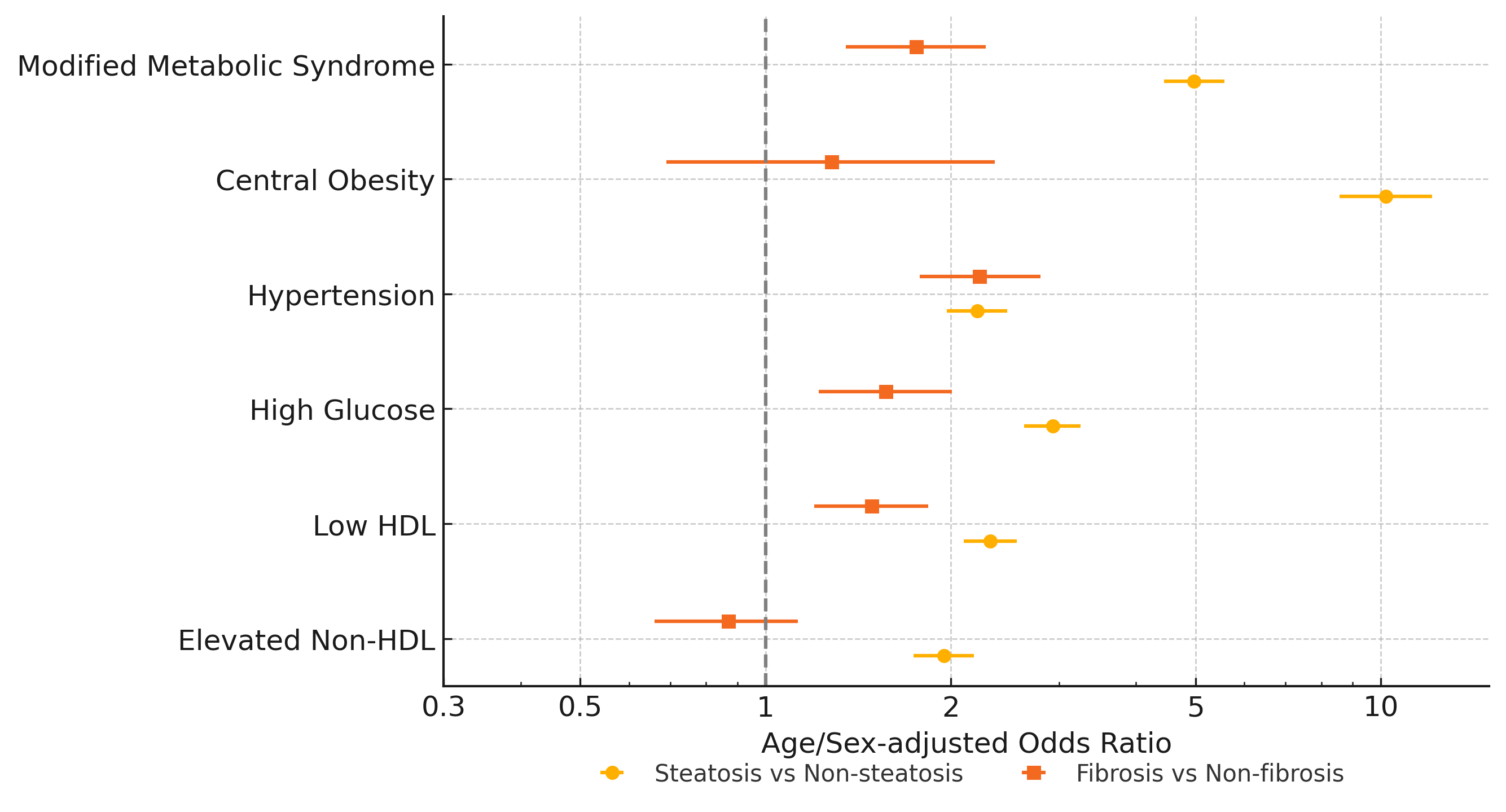
Methods We analyzed data from 9,086 adults aged ≥20 years from the 2017–2023 National Health and Nutrition Examination Survey. Hepatic steatosis was defined by a controlled attenuation parameter ≥290 dB/m (corresponding to S3 steatosis), and significant hepatic fibrosis by liver stiffness measurement ≥8.0 kPa (corresponding to F2 fibrosis). Modified metabolic syndrome was defined as meeting ≥3 of 5 criteria: central obesity, hypertension, dysglycemia, low high-density lipoprotein cholesterol, and elevated non-high-density lipoprotein cholesterol. Insulin resistance was assessed using the homeostasis model assessment. Analyses applied appropriate complex survey weights. Adjusted odds ratios (OR) and 95% confidence intervals (CI) were estimated using logistic regression. Group differences in insulin resistance were tested with weighted t-tests.
Results After adjusting for age and sex, hepatic steatosis was associated with a fivefold increase in odds of modified metabolic syndrome (OR 4.97; 95% CI, 4.44–5.57). The strongest contributing components were central obesity (OR 10.19; 95% CI, 8.57–12.11) and dysglycemia (OR 2.93; 95% CI, 2.63–3.25). Among individuals with hepatic steatosis, those with hepatic fibrosis had 76% higher odds of metabolic syndrome (OR 1.76; 95% CI, 1.35–2.28). Mean insulin resistance was significantly higher in those with hepatic steatosis compared to those without (6.57 ± 11.57 vs 2.90 ± 6.97; p < 0.001), and was further elevated in those with hepatic fibrosis (10.53 ± 19.30 vs 5.55 ± 8.23; p < 0.001).
Conclusion In a nationally representative sample of U.S. adults, hepatic steatosis was strongly associated with clustering of cardiometabolic risk factors and elevated insulin resistance. Hepatic fibrosis further intensified these associations. These findings support early metabolic screening and intensive risk-factor management in individuals with hepatic steatosis, particularly those with hepatic fibrosis.
Hyun, Sangho
(
Catholic University of Korea COM
, Seoul , Korea (the Republic of) )
Chung, Jun Ku
(
Catholic University of Korea COM
, Seoul , Korea (the Republic of) )
Author Disclosures:
Sangho Hyun:DO NOT have relevant financial relationships
| Jun Ku Chung:No Answer