Disparities in Age, Sex, Race, and Ethnic Representation in Coronary Artery Disease Clinical Trials in the United States
Abstract Body (Do not enter title and authors here): Introduction: Coronary artery disease (CAD) is estimated to affect 1 in 20 adults over the age of 20 in the United States (U.S.). Due to its profound public health impact, diverse representation in clinical trials remains imperative in promoting equity and ensuring the applicability of diagnostic and therapeutic interventions across all demographics. Despite the growing number of cardiovascular disease trials in the U.S., disparities in representation continue to be a significant concern. This study aims to examine the representation of participants across age, sex, race, and ethnicity in CAD clinical trials, with the goal of identifying gaps and promoting inclusive research practices.
Methods: A comprehensive review of all clinical trials studying CAD registered on clinicaltrials.gov up until April 2025 was performed. Data was limited to completed interventional trials performed in the U.S. Information was gathered on participants’ mean age, age range, sex, and racial/ethnic composition.
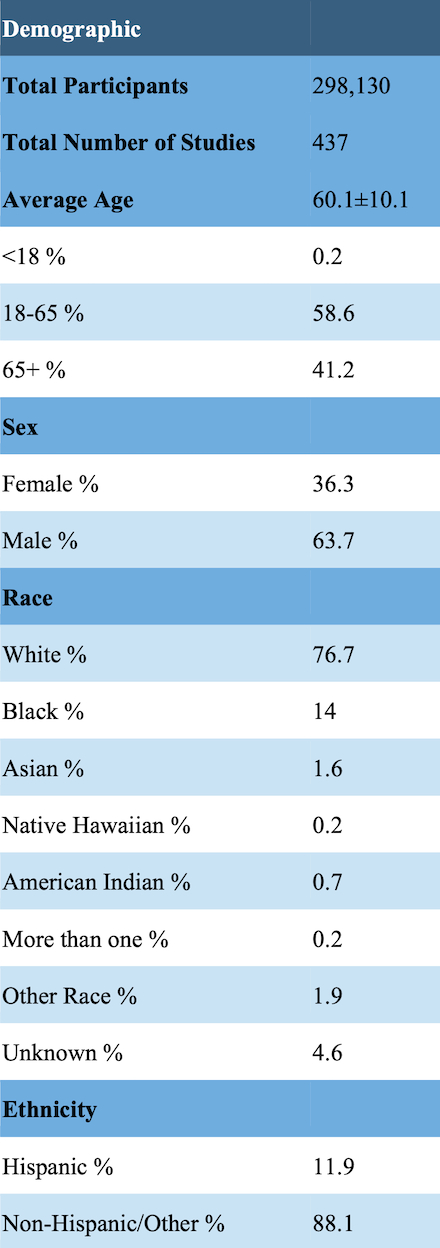
Results: A total of 437 trials were analyzed, including 298,130 total participants. A mean age of 60.1±10.1 amongst all participants was identified, with the majority of participants between the ages of 18-65 (58.6%). Females were notably underrepresented, accounting for only 36.3% of the study population. The racial distribution of participants was predominantly white (76.7%), with lower representation of black (14%) and asian (1.6%) participants, as well as other racial groups. Hispanic participants accounted for a total of 11.9% of all participants, highlighting continued underrepresentation in CAD research.
Conclusion: Our study demonstrates CAD trials exhibiting notable disparities in age, sex, race, and ethnicity when compared to the demographic composition of the US population. These disparities limit the generalizability of research and contribute to ongoing inequities in diagnosis, treatment options, and outcomes amongst underrepresented groups. Future studies should examine barriers to participation faced by underrepresented groups to ensure inclusivity. Moreover, efforts to improve the recruitment and inclusion of underrepresented groups are vital to ensuring future research accurately reflects a more diverse patient population.
Ghay, Sahil
(
Mount Sinai Medical Center
, Miami Beach , Florida , United States )
Singh, Roopin
(
Virginia College of Osteopathic Medicine-Louisiana
, Monroe , Louisiana , United States )
Kaur, Baneet
(
Mount Sinai Medical Center
, Miami Beach , Florida , United States )
Venkataraman, Pranav
(
Mount Sinai Heart Institute
, Miami Beach , Florida , United States )
Author Disclosures:
Sahil Ghay:DO NOT have relevant financial relationships
| Roopin Singh:No Answer
| Baneet Kaur:No Answer
| Pranav Venkataraman:No Answer