Anasplasmosis with a Twist: Polymorphic Ventricular Tachycardia and Sudden Cardiac Arrest
Abstract Body (Do not enter title and authors here): Introduction: Human granulocytic anaplasmosis (HGA), caused by Anaplasma phagocytophilum, is a tick-borne illness ranging in manifestation from mild febrile syndromes to life-threatening complications. Cardiac manifestations are rare and often attributed to co-infection with Lyme or – even more rarely – myocarditis.1 We present a case of isolated HGA associated with prolonged QTc and polymorphic ventricular tachycardia (PMVT) cardiac arrest in an immunocompetent adult.
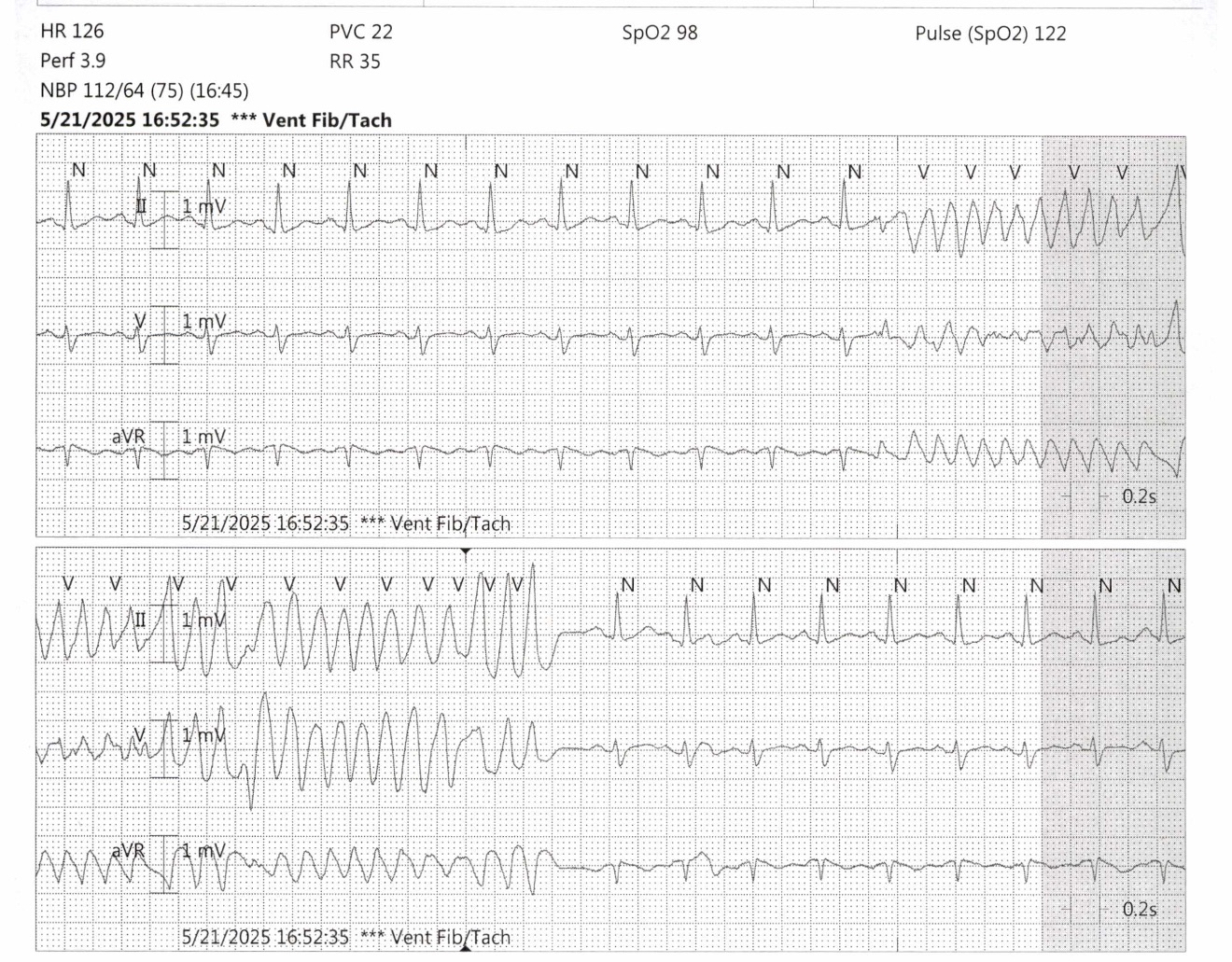
Case Presentation A 61-year-old man with hypertension and hyperlipidemia presented to a New England ED in late May with four days of fevers, malaise, and headaches, culminating in syncope. He was febrile (101.2°F) and tachycardic (121 bpm) but otherwise hemodynamically stable. Labs showed thrombocytopenia (135,000/µL), hyponatremia (Na 133 mEq/L), hypokalemia (K 3.4 mEq/L), elevated transaminases (AST 81 IU/L, ALT 121 IU/L), and high-sensitivity troponin (294 ng/L). ECG showed sinus tachycardia with normal QTc; telemetry revealed multiple salvos of non-sustained polymorphic VT (Figure 1). Initial infectious workup—including cultures, urinalysis, viral panels, Lyme serology, and lumbar puncture—was unrevealing. Empiric doxycycline was started for suspected tick-borne illness. On hospital day 1, he had two episodes of PMVT cardiac arrest, two hours apart, requiring CPR and defibrillation. Post-arrest ECG showed QTc >550 ms. He received magnesium and was started on amiodarone and lidocaine. On hospital day 3, Anaplasma testing returned positive. Cardiac workup (TTE, coronary angiography, cardiac MRI) showed no structural disease, obstructive CAD, or myocardial edema/scar, with normal systolic function. With doxycycline and supportive care, QTc normalized and anti-arrhythmics were weaned with no further PMVT. As no reversible cause was identified, he underwent ICD placement for secondary prevention.
Discussion A few case reports describe HGA-associated atrial arrhythmias and myopericarditis, but there are no reports of HGA-associated ventricular arrhythmias or associated cardiac arrest.2–4 The initial hypothesis was that HGA-associated myocarditis led to QTc prolongation and PMVT. However, normal cardiac MRI and no other identifiable causes of QT prolongation raise the possibility of QTc prolongation via a yet-undiscovered direct mechanism or inflammatory cascade secondary to anaplasmosis. Further research is warranted to define the arrhythmogenic potential of anaplasmosis.
Vargas, Irene
(
Brown University
, Providence , Rhode Island , United States )
Joice, Melvin
(
Brown University
, Providence , Rhode Island , United States )
Mcilvaine, Susan
(
Brown University
, Providence , Rhode Island , United States )
Shim, David
(
Brown University
, Providence , Rhode Island , United States )
Author Disclosures:
Irene Vargas:DO NOT have relevant financial relationships
| Melvin Joice:DO NOT have relevant financial relationships
| Susan McIlvaine:No Answer
| David Shim:No Answer