Evolving the Scribe: Leveraging Agentic AI for Clinical Documentation
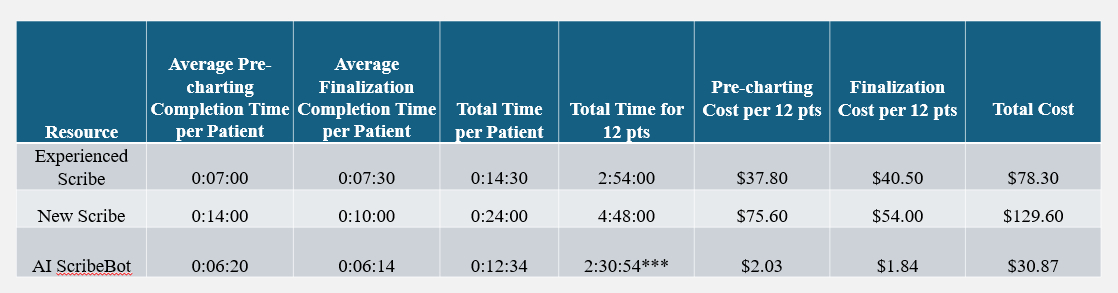
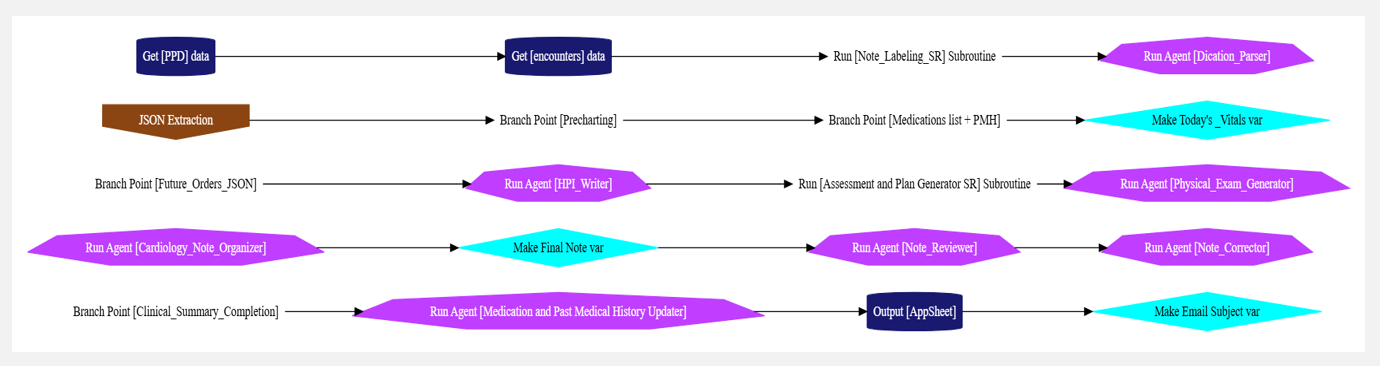
Abstract Body (Do not enter title and authors here): Background The burden of documentation has led to the adoption of Medical Scribes to ease Clinician workloads. However, Scribe duties have evolved beyond note taking; Pre-charting, care-coordination, and other administrative tasks are increasingly completed by Scribes. Moreover, training is time-intensive, and high turnover limits Scribe efficiency and efficacy. The development of Agentic AI, individual AI units capable of processing data and communicating with each other autonomously, presents opportunities to optimize workflows while reducing costs and maintaining proficiency. Methods: Our AI ScribeBot was developed from a modular system of AI agents, each designed with a complex prompt to perform a task, such as extracting clinical information or interpreting visit transcriptions, with outputs passed to subsequent agents in the chain. All data is run through a secure instance of google cloud with a BAA connected to a private instance of Open AI. We compared an Experienced Scribe, a New Scribe, and our AI ScribeBot during 12 outpatient cardiology visits. Scribes, contracted at $27/hr, were timed while Pre-charting and writing notes. Visits were transcribed from ambient audio recording. AI performance was then measured in cost per execution and completion time. A Scribe spent 1 hour reviewing the AI notes and made any necessary corrections. Results AI documentation demonstrated similar speed and lower cost compared to Scribes. The average time spent per patient was 00:12:34 for the AI, compared to 00:14:30 for a well-trained scribe and 00:24:00 for a newly trained scribe. Additionally, while the Experienced Scribe cost $78.30 per 12-patient day and New Scribe cost $129.60, the AI processing cost was $3.87. Even with the reviewer's hourly rate, the total cost was $30.87. Discussion Our findings demonstrate that Agentic AI offers a scalable, cost-effective alternative to traditional Scribes. Even with limited human oversight, AI generated notes were completed at lower cost, a 60–76% reduction compared to Human Scribes. Given AI operates concurrently, total completion time was not an accurate measurement of AI performance. However, this asynchronous processing had the added benefit of reducing delays associated with sequential note-writing allowing for improved clinic flexibility and speed. While larger-scale studies are needed to evaluate long-term accuracy and impact, our pilot demonstrates that Agentic AI can reduce documentation costs and enhance efficiency.
Reed, Mills
(
Mount Sinai Hospital
, New York , New York , United States )
Bander, Jeffrey
(
Mount Sinai Hospital
, New York , New York , United States )
Author Disclosures:
Mills Reed:DO NOT have relevant financial relationships
| Jeffrey Bander:DO NOT have relevant financial relationships