Genetic Evidence Suggests Combined Inhibition of Lipoprotein(a) and PCSK9 to Lower Atherosclerotic Cardiovascular Disease Risk.
Abstract Body (Do not enter title and authors here): Background Elevated low-density lipoprotein cholesterol (LDL-C) and lipoprotein(a) [Lp(a)] are each independent drivers of atherosclerotic cardiovascular disease (ASCVD). Although PCSK9 inhibitors effectively lower LDL-C and Lp(a)-lowering therapies are currently being developed, their combined effect on long-term ASCVD risk remains unclear.
Research Question In this study, we investigate the effects of genetically proxied inhibition of LPA and PCSK9, both individually and in combination, on ASCVD risk.
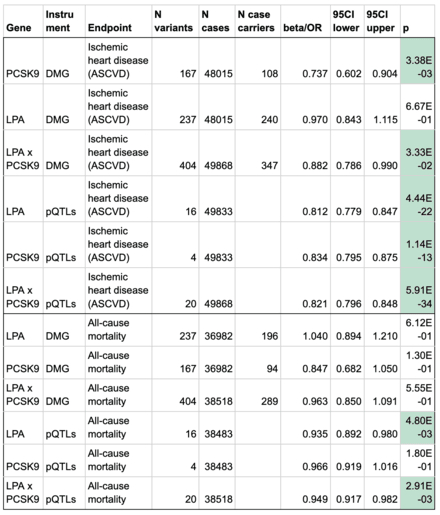
Methods We analyzed ~450,000 unrelated European ancestry participants from the UK Biobank. Two sets of complementary genetic instruments for LPA and PCSK9 were derived: (1) rare (minor allele frequency < 0.001) predicted loss-of-function (pLoF) variants from whole-exome sequencing and (2) common cis-pQTLs (cis-acting protein quantitative trait loci) from imputed genotype arrays and the proteomics data. We used logistic regression models (separately for rare variants and common cis-pQTLs), adjusted for age, sex, and the first five genetic principal components, to estimate associations between these genetic instruments and ASCVD (a composite of coronary artery disease, myocardial infarction, and ischemic stroke) and all-cause mortality. Odds ratios (ORs) were reported per allele (for cis-pQTLs) or per carrier status (for rare variants). Mendelian randomization (MR) and other cardiovascular endpoints served as a sensitivity analysis.
Results Rare pLoF variants in PCSK9 (OR 0.74, p=0.0034) - as well as having a rare variant in either LPA or PCSK9 (OR 0.88, p=0.033) - were associated with lower ASCVD odds. In contrast, rare LPA variants alone showed no significant association with ASCVD (OR, 0.97; p = 0.67). For the common cis-pQTL instruments, lower genetically proxied LPA, PCSK9, or both were associated with significantly reduced ASCVD odds. Dual inhibition showed the greatest effect on reducing ASCVD risk (OR 0.82, p = 5.9 × 10^-34) and was also associated with reduced all-cause mortality (OR 0.95, p = 0.003). MR analyses supported these findings. Notable risk reduction was also found for endpoints including aortic stenosis, abdominal aortic aneurysm, and peripheral artery disease.
Conclusion In this large genetic analysis, combined inhibition of Lp(a) and PCSK9 was associated with the most pronounced reduction in ASCVD and mortality risk. These findings support the use of dual inhibition strategies in patients with elevated Lp(a) and LDL-C levels.
Steinfeldt, Jakob
(
Pheiron GmbH
, Berlin , Germany )
Kaisinger, Lena
(
Pheiron GmbH
, Berlin , Germany )
Buergel, Thore
(
Pheiron GmbH
, Berlin , Germany )
Wikstrom, Johannes
(
Ribocure Pharmaceuticals AB
, Mölndal , Sweden )
Gan, Li-ming
(
Ribocure Pharmaceuticals AB
, Mölndal , Sweden )
Gabrielsen, Anders
(
Ribocure Pharmaceuticals AB
, Mölndal , Sweden )
Author Disclosures:
Jakob Steinfeldt:DO NOT have relevant financial relationships
| Lena Kaisinger:No Answer
| Thore Buergel:No Answer
| Johannes Wikstrom:No Answer
| Li-ming Gan:No Answer
| Anders Gabrielsen:No Answer