
Logo

American Heart Association

  21
  0


Final ID: MP597

Extreme Temperatures are Associated with Hospital Admissions Across Central Massachusetts

Abstract Body (Do not enter title and authors here): Background
Extreme weather and temperature can impact human health and influence acute care needs, particularly among older patients. Assessing for better metrics to measure extreme temperature is necessary to better model how extreme temperature affect these acute care needs.
Hypothesis
Hospital admissions will be more strongly associated with Extreme hot and cold temperatures and advanced metrics will better capture these associations.
Methods
A retrospective cohort was created based on electronic health record data from the predominant safety-net health system in central Massachusetts from April 2021 to April 2024. The primary exposure variables were daily weather indices defined for each patient’s residential address: ambient temperature, wet bulb globe temperature (WBGT), universal thermal climate index (UTCI), and heat index. The primary outcome variable was the daily count of inpatient admissions due to cardiovascular, stroke, renal, and pulmonary disease among adults. Separate generalized additive model with a Poisson distribution were used to estimate the incidence rate ratio of daily hospital admissions in association with different daily temperature indices.
Results
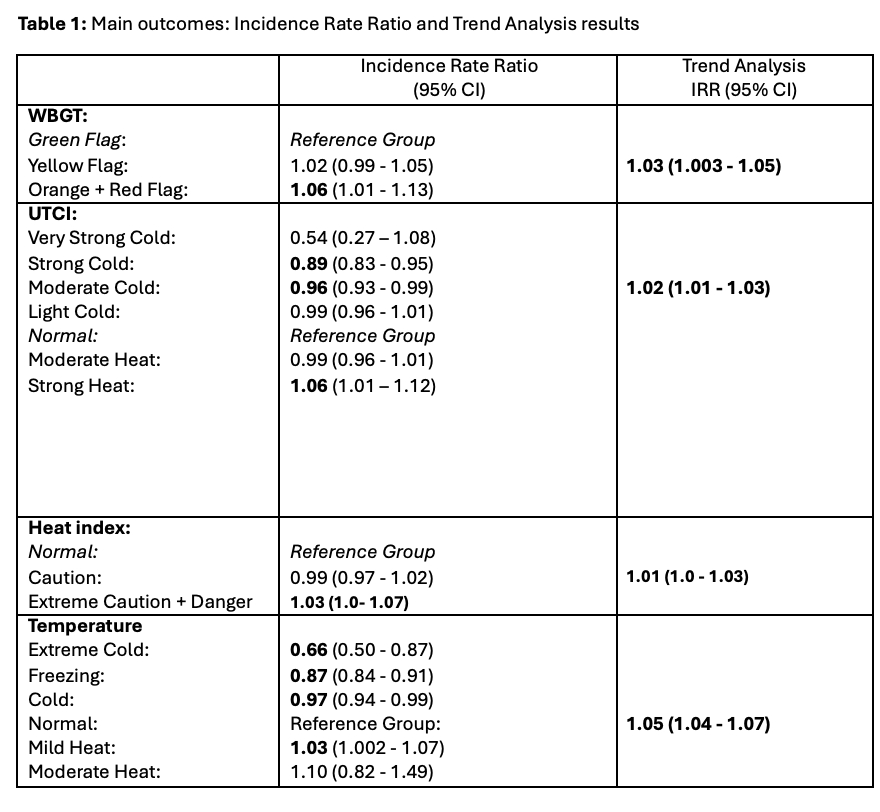
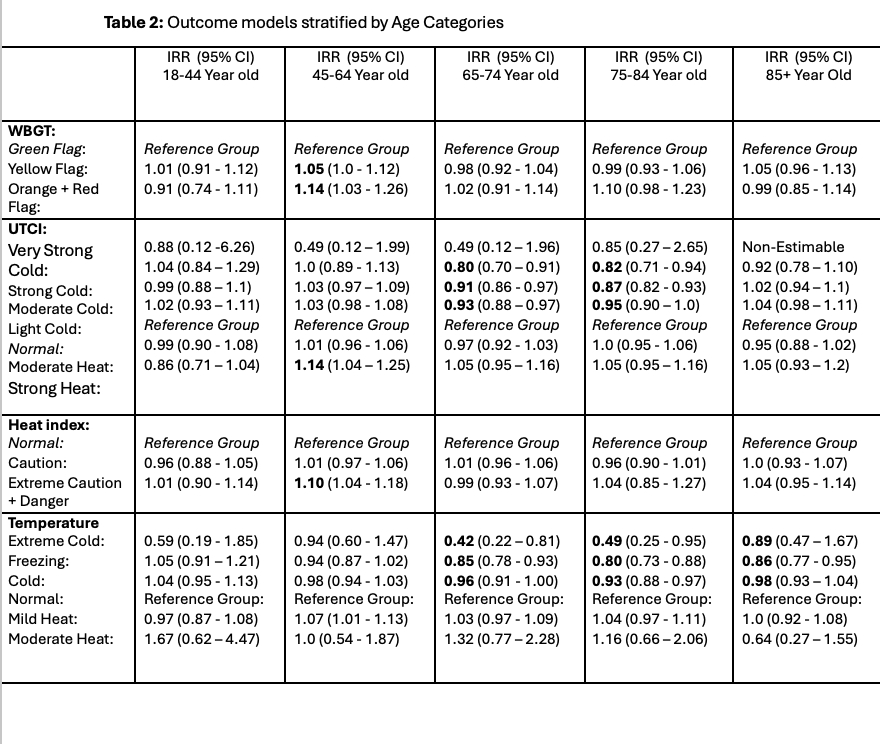
We observed 83,469 hospital admissions that met the inclusion criteria during the study period; these were based on data from 44,156 individual patients (mean age 67.9 years; 50.8% male). In comparison with normal temperature indices, we observed a decreased association for hospital admission on extreme cold days as measured by ambient temperature (IRR: 0.66 [95% CI, 0.50-0.87]) and UTCI (IRR: 0.89 [0.83-0.95]) but an increased association for hospital admission on extreme warm days as measured by WBGT (IRR: 1.06 [1.01-1.13]) and UTCI (IRR: 1.06 [1.01-1.12]) (table 1). Through stratified trend analysis, we observed stronger association between weather variables and admissions among older patients (table 2).
Conclusions
Hospital admissions across central Massachusetts were associated with extreme heat events but not extreme cold events. Strategies that consider temperature pattern and its effects on acute care needs can be helpful in healthcare planning and hold potential to inform individual-level risk for exacerbation of neuro-cardio-pulmonary-renal conditions.
  • Tejan, Joseph  ( UMass Chan Medical School , Worcester , Massachusetts , United States )
  • Mcmanus, David  ( UMMS , Worcester , Massachusetts , United States )
  • Soni, Apurv  ( UMass Chan Medical School , Worcester , Massachusetts , United States )
  • Degaetano, Amy  ( SUNY Upstate , Syracuse , New York , United States )
  • Li, Xiang  ( UMass Chan Medical School , Worcester , Massachusetts , United States )
  • Ye, Zehao  ( UMass Chan Medical School , Worcester , Massachusetts , United States )
  • Wong, Koon  ( UMass Chan Medical School , Worcester , Massachusetts , United States )
  • Degaetano, Arthur  ( Cornell University , Ithaca , New York , United States )
  • Martinez, Fernando  ( UMass Chan Medical School , Worcester , Massachusetts , United States )
  • Dosa, David  ( UMass Chan Medical School , Worcester , Massachusetts , United States )
  • Ruiz De Luzuriaga, Katherine  ( UMass Chan Medical School , Worcester , Massachusetts , United States )
  • Author Disclosures:
    Joseph Tejan: DO NOT have relevant financial relationships | David McManus: No Answer | Apurv Soni: No Answer | Amy DeGaetano: DO NOT have relevant financial relationships | Xiang Li: DO NOT have relevant financial relationships | Zehao Ye: No Answer | Koon Wong: No Answer | Arthur DeGaetano: DO NOT have relevant financial relationships | Fernando Martinez: No Answer | David dosa: No Answer | Katherine Ruiz de Luzuriaga: No Answer
Meeting Info:

Scientific Sessions 2025

2025

New Orleans, Louisiana

Session Info:

Health in a Changing Climate: Understanding Environmental Drivers of Disease

Saturday, 11/08/2025 , 03:15PM - 04:20PM

Moderated Digital Poster Session

More abstracts on this topic:
A blood biomarker of accelerated aging associates with cardiometabolic biomarkers in response to weight-loss dietary interventions

Kou Minghao, Li Xiang, Heianza Yoriko, Bazzano Lydia

4D Flow MRI Evaluation of Cardiovascular Risk-Related Alterations in Heart-Brain Hemodynamics in Cognitively Healthy Aging Adults

Najafi Anahita, Rogalski Emily, Jarvis Kelly, Richter Adam, Lytchakov Anna, Benson Theresa, Jin Ning, Davids Rachel, Schnell Susanne, Ragin Ann, Weintraub Sandra

More abstracts from these authors:
Population Screening for LV Dysfunction Using Single-Lead ECG-AI: Insights from the RURAL Study

Hayit Tolga, Karabayir Ibrahim, Ramachandran Vasan, Bloomfield Gerald, Douglas Pamela, Mcmanus David, Soliman Elsayed, Herrington David, Akbilgic Oguz

Cardiometabolic Therapy Reduces Electrocardiogram-Derived Biological Age: A Time-Weighted Analysis

Losos Wojciech, Ye Zehao, Lin Honghuang, Mcmanus David, Soni Apurv

You have to be authorized to contact abstract author. Please, Login
Not Available