
Logo

American Heart Association

  6
  0


Final ID: MP2656

Increased use of temporary mechanical circulatory support is not associated with higher long-term mortality in heart transplantation

Abstract Body (Do not enter title and authors here): Introduction:
Following the 2018 revision to the heart transplantation (HT) allocation policy by UNOS, the criteria for transplant candidates were changed to enhance access to HT and reduce waitlist times. With expanded donor/recipient matching, HT has become more accessible to sicker patients on temporary mechanical circulatory support (tMCS), despite limited data on their long-term survival.

Hypothesis:
This study aims to investigate the impact of policy revision by comparing post-policy survival outcomes between patients on tMCS and those without. We hypothesized that the probability of survival has not changed for tMCS patients.

Methods:
The UNOS registry was used for analysis of adult HT recipients prior and after the policy change. The cohort consists of HT between 2018-2019 (n=2280) which was further separated into recipients on tMCS (ECMO, IABP, and/or Impella) at transplant (n=981). The 5-year Kaplan-Meier survival curves and hazard ratios were generated with multivariable Cox regression statistical testing. Transplant recipient characteristics were also compared with t-test and chi-square statistical evaluation.

Results:
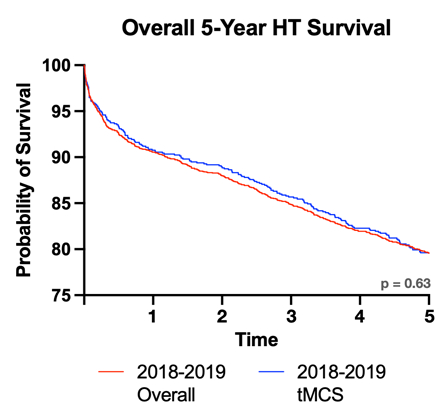
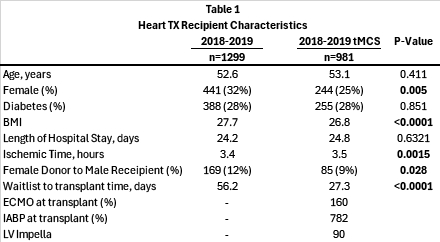
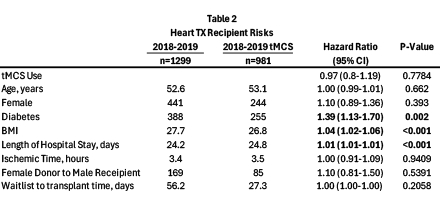
Patients using tMCS in the first year of post-policy HT during 2018-2019 did not have a higher long-term risk of mortality compared patients without tMCS. Regardless of tMCS status, patients that had higher BMI, diabetes, or lengthened hospital stays were observed to have significantly increased risk of mortality (Table 2). The use of tMCS itself was not associated with mortality (Table 2). The 5-year survival did not significantly change between the overall cohort and tMCS patients (p>0.5). Furthermore, there were a significant decrease in female recipients and female donor to male recipient HT with an increase in ischemic time; however, these did not impact the risk of mortality (Table 1).

Conclusion:
Contrary to preliminary studies of the UNOS policy, this survival consistency suggests that the policy revisions have not adversely impacted long-term HT success, offering insight into allocation strategies. Our findings demonstrate that despite a significant shift in use of tMCS in the post-policy era as well as changes in perioperative factors, the 5-year survival outcomes and mortality risk for HT recipients remain unchanged.
  • Fatmi, Mohammad  ( Nova Southeastern University , Lakewood Ranch , Florida , United States )
  • Dhingra, Ravi  ( Medical College of Wisconsin, Froedtert Hospital , Milwaukee , Wisconsin , United States )
  • Lozonschi, Lucian  ( University of South Florida, Tampa General Hospital , Tampa , Florida , United States )
  • Author Disclosures:
    Mohammad Fatmi: DO NOT have relevant financial relationships | Ravi Dhingra: No Answer | Lucian Lozonschi: No Answer
Meeting Info:

Scientific Sessions 2025

2025

New Orleans, Louisiana

Session Info:

Advancing Research in Advanced Heart Failure

Monday, 11/10/2025 , 12:15PM - 01:30PM

Moderated Digital Poster Session

More abstracts on this topic:
A novel reproducible low-cost model of acute myocardial infarction in swine

Li Yichen, Zheng Zilong, Tang Weijie, Chen Wangping, Yang Jinfu, Fan Chengming

Ascending Thoracic Aortic Aneurysms in a Veterans Affairs Health System: Longitudinal Outcomes and Risk Factors

Gomez Axel, Carroway William, Ge Liang, Boskovski Marko, Tseng Elaine

You have to be authorized to contact abstract author. Please, Login
Not Available