Progressive Myocardial Flow Reserve Impairment Across Cardio-Kidney-Metabolic Syndrome Stages Predicts Cardiovascular Risk: Insights from Cardiac PET
Abstract Body (Do not enter title and authors here): Background: Cardio-Kidney-Metabolic (CKM) Syndrome represents a progressive multisystem disorder associated with increasing cardiovascular risk. However, the evolution of coronary microvascular dysfunction across CKM stages and the prognostic value of myocardial flow reserve (MFR) within the CKM construct remain incompletely understood.
Hypothesis: Stress myocardial blood flow (MBF) and MFR, as measured by 82Rb PET/CT, progressively decline with advancing CKM stage. Abnormal MFR remains independently predictive of adverse cardiovascular outcomes.
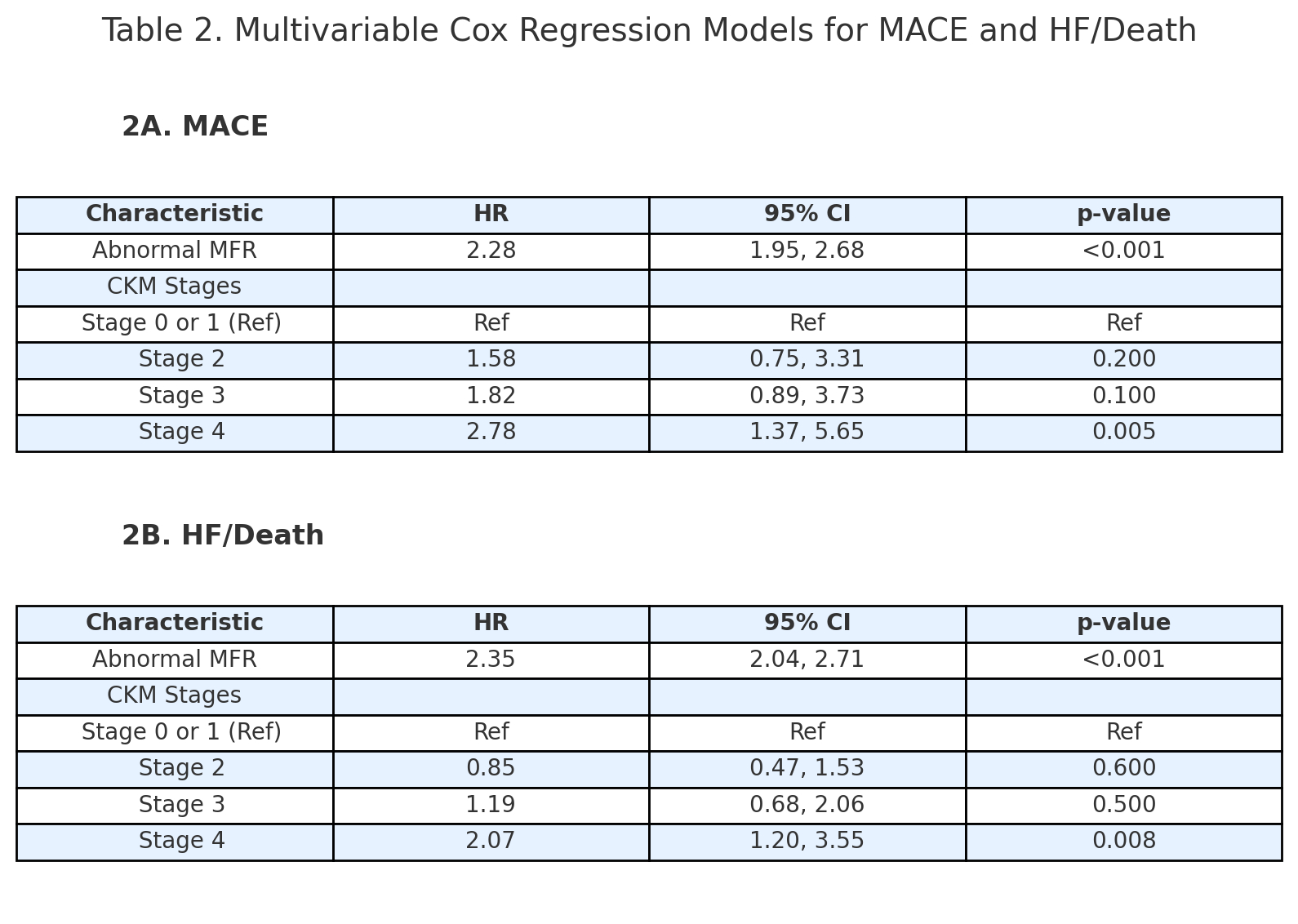
Methods: We retrospectively analyzed 5,749 total patients who underwent rest/stress cardiac 82Rb PET/CT at our institution between 2016 and 2022. Patients were then defined as having CKM stages 0–4 according to AHA criteria. MFR was calculated as the ratio of stress to rest MBF. Comparisons of stress MBF and MFR across CKM stages were performed using ANOVA. Reduced stress MBF was defined as <1.8 mL/g/min and abnormal MFR as <2.0. Associations between CKM stage, abnormal MFR, and clinical outcomes were evaluated using unadjusted (CKM 0–4) and multivariable-adjusted (CKM 0–4, age, sex, abnormal MFR) Cox regression models. The co-primary endpoints were major adverse cardiovascular events (MACE: death, myocardial infarction, stroke, or revascularization) and heart failure or death (HF/Death).
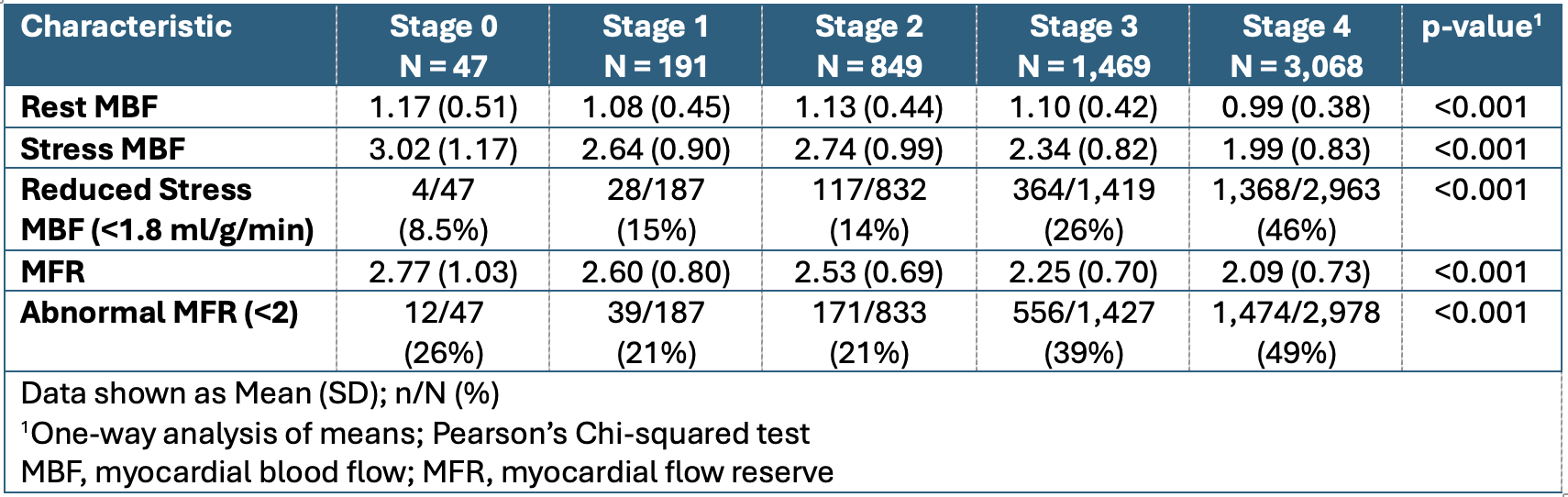
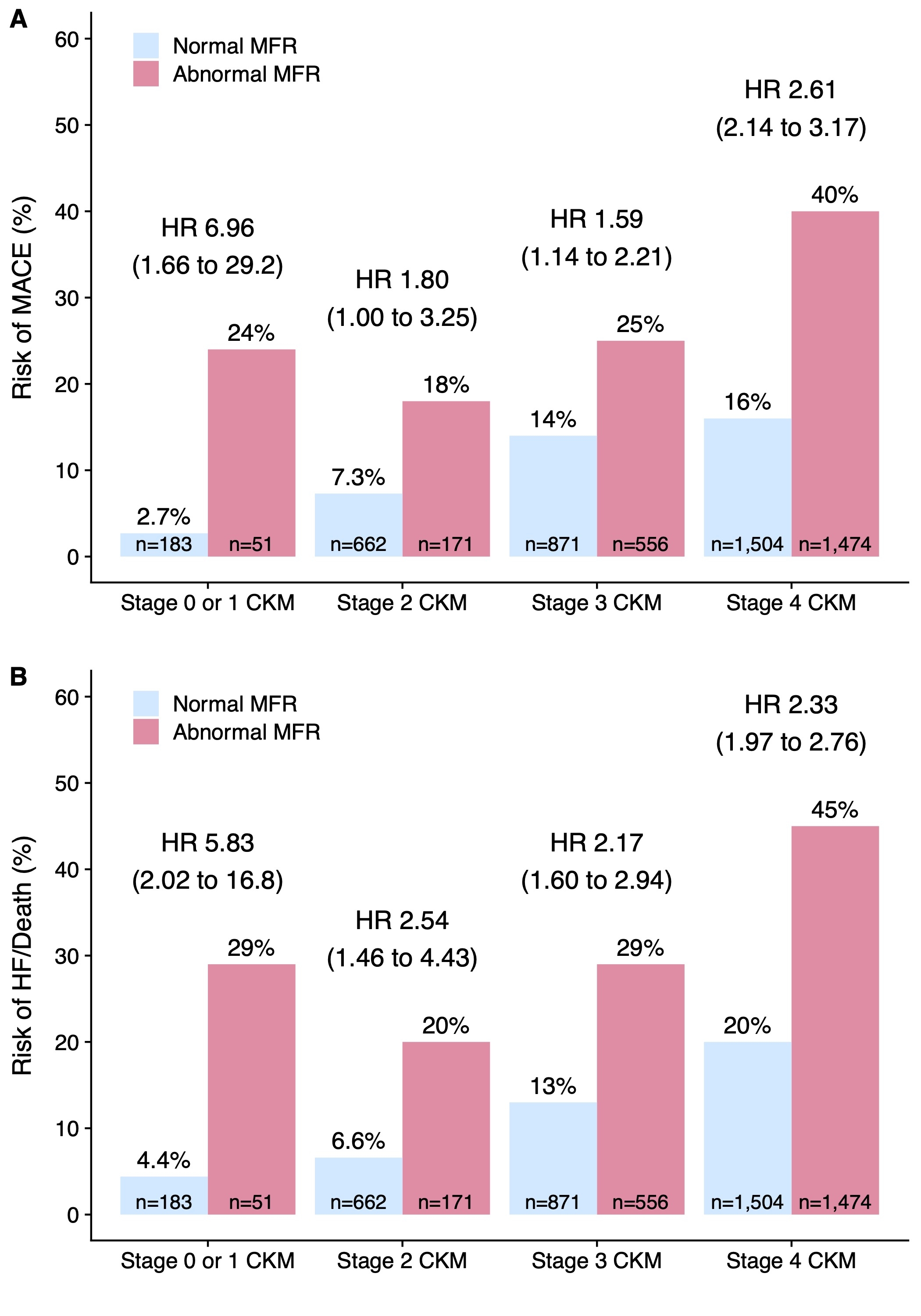
Results: Among 5,624 CKM patients (median age 54 years [IQR 55–73]; 52% women), 1,178 MACE and 1,329 HF/Death events occurred over a median follow-up of 3.9 years (IQR 2.4–5.6). Distribution across CKM stages 0 to 4 was: 47 (0.8%), 191 (3.4%), 849 (15.1%), 1,469 (26.1%), and 3,068 (54.6%), respectively. Rest MBF, stress MBF, and MFR progressively declined with advancing CKM stage (p for trend <0.001), and the prevalence of abnormal MFR increased (p for trend <0.001; Table 1). CKM stage 4 and abnormal MFR were independently associated with higher risk of MACE and HF/Death (Table 2), with event rates rising across the CKM spectrum (Figure 1). Abnormal MFR discriminated high-risk populations within each CKM stage, even in early (0 or 1) stages of CKM (Figure 1).
Conclusions CKM Syndrome is associated with worsening coronary microvascular function as reflected by PET-derived MBF and MFR. Abnormal MFR provides additional prognostic discrimination across all CKM stages and may help identify patients at particularly high cardiovascular risk.
Moura, Filipe
(
Yale University
, New Haven , Connecticut , United States )
Nogueira, Alleh
(
Federal University of Rio Grande do Sul
, Porto Alegre , Brazil )
Barreto, Joaquim
(
State University of Campinas
, Campinas , Brazil )
Zimerman, Andre
(
Brigham and Women's Hospital
, Boston , Massachusetts , United States )
Sposito, Andrei
(
State University of Campinas
, Campinas , Brazil )
Sinusas, Albert
(
YALE UNIVERSITY SCHOOL MEDICINE
, New Haven , Connecticut , United States )
Miller, Edward
(
YALE UNIVERSITY SCHOOL OF MEDICINE
, New Haven , Connecticut , United States )
Feher, Attila
(
YALE UNIVERSITY SCHOOL OF MEDICINE
, New Haven , Connecticut , United States )
Author Disclosures:
Filipe Moura:DO NOT have relevant financial relationships
| Alleh Nogueira:No Answer
| Joaquim Barreto:No Answer
| Andre Zimerman:DO have relevant financial relationships
;
Speaker:Novartis:Past (completed)
| Andrei Sposito:DO NOT have relevant financial relationships
| Albert Sinusas:DO have relevant financial relationships
;
Research Funding (PI or named investigator):Siemens:Active (exists now)
; Consultant:MicroVide:Active (exists now)
; Research Funding (PI or named investigator):Revalia:Active (exists now)
; Research Funding (PI or named investigator):Jubilant:Active (exists now)
| Edward Miller:No Answer
| Attila Feher:DO NOT have relevant financial relationships