Comparable One-Year Efficacy and Safety of Spironolactone Versus Amiloride in Resistant Hypertension: A Retrospective Cohort Analysis
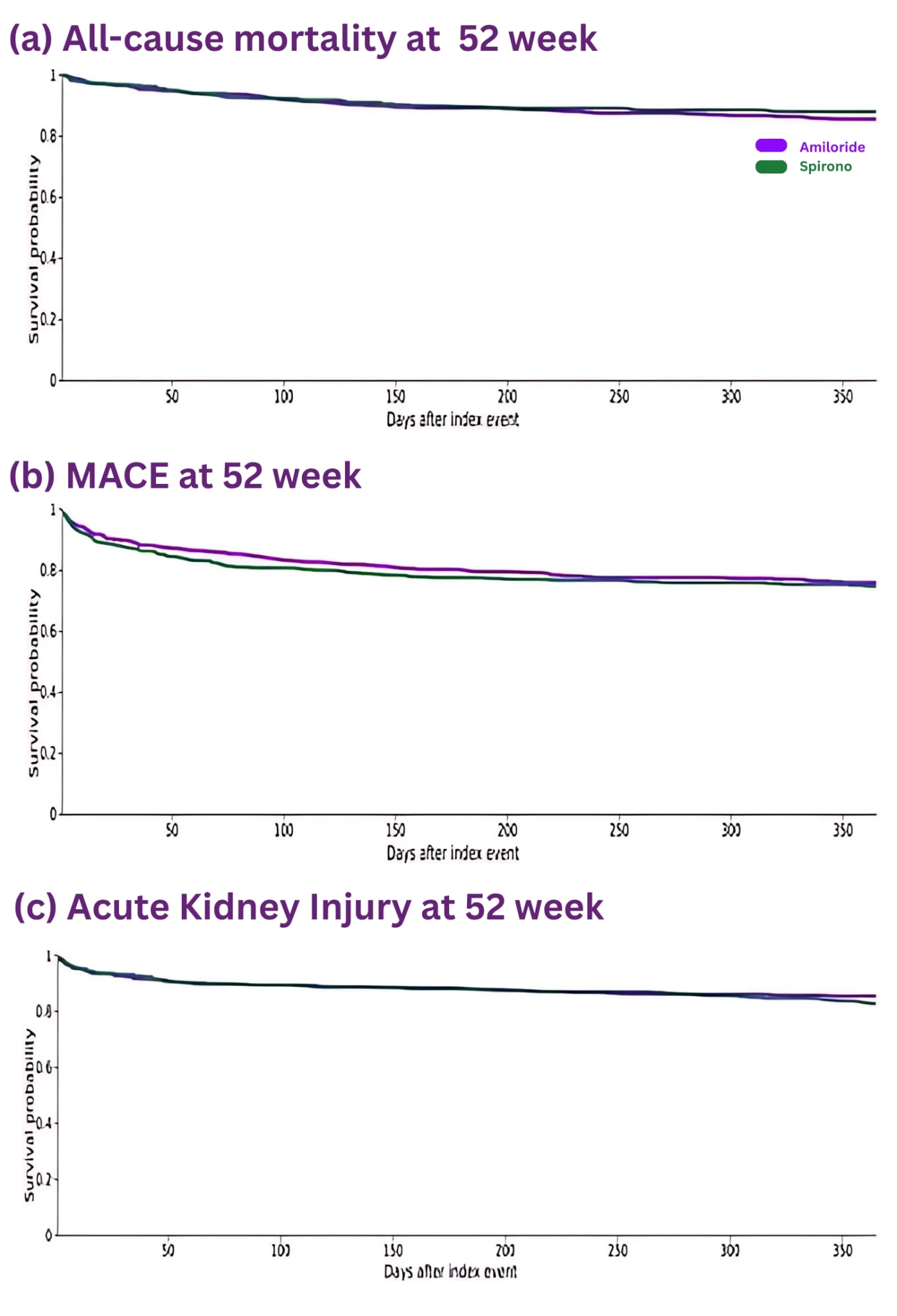
Abstract Body (Do not enter title and authors here): Background Spironolactone is frequently used as the fourth-line agent for resistant hypertension, but concerns over hyperkalemia have prompted some clinicians to use amiloride despite limited comparative data. In this study, we compared outcomes between amiloride and spironolactone in patients with resistant hypertension. Methods We performed a retrospective cohort study using the TriNetX database. We identified adults with hypertension who were previously prescribed an angiotensin converting enzyme inhibitor or angiotensin receptor blocker, dihydropyridine calcium channel blocker, and a thiazide diuretic within the 12 months prior to the index treatment who initiated either amiloride (n=420) or spironolactone (n=10,434) between January 2012 and April 2024. Eligible patients had systolic blood pressure (SBP) ≥ 140 mm Hg or diastolic blood pressure (DBP) ≥ 90 mm Hg taken the same day on the index treatment. Patients with stage 4 or 5 kidney disease were excluded. The study evaluated the following outcomes through 52 weeks: acute kidney injury (AKI), all-cause mortality, major adverse cardiovascular events (MACE; defined as all-cause mortality, myocardial infarction, and ischemic or hemorrhagic stroke), and attainment of SBP ≤ 130 mm Hg and DBP ≤ 80 mm Hg. Cohorts were matched using propensity matching based on demographics, comorbidities, concomitant medications, and pertinent laboratory values. We matched for a total of 30 variables. Results Propensity-score matching generated two well-balanced cohorts (n = 414 each), with comparable age (mean 62.7 vs 63.8 years), sex distribution (54.3 % vs 56.5 % male), and comorbidities (Table 1). At 4 weeks, more amiloride-treated patients achieved SBP ≤ 130 mm Hg (53.6 % vs 44.2 %; RR 1.21, 95 % CI 1.05–1.40) and DBP ≤ 80 mm Hg (62.3 % vs 53.6 %; RR 1.16, 95 % CI 1.03–1.31), whereas by 52 weeks there were no differences in attainment of any blood-pressure target (SBP ≤ 130, SBP ≤ 140, DBP ≤ 80, DBP ≤ 90). There was no statistically significant difference between groups in all-cause mortality (13.3% vs 11.1%; RR 1.20, 95% CI 0.83–1.73), incidence of acute kidney injury (13.0% vs 15.2%; RR 0.86, 95% CI 0.61–1.20), or major adverse cardiovascular events (22.5% vs 23.7%; RR 0.95, 95% CI 0.74–1.22) at 52 weeks. Conclusion Amiloride and spironolactone had similar one-year AKI, MACE, all-cause mortality, and BP control.
Elgendy, Mohamed
(
Tanta University
, Tanta , Egypt )
Shubietah, Abdalhakim
(
Advocate Illinois Masonic Med Ctr
, Chicago , Illinois , United States )
Emara, Ahmed
(
Al-Azhar University
, Cairo , Egypt )
Abdul-hafez, Hamza A.
(
An-Najah National University
, Nablus , Palestine, State of )
Ghannam, Mohammad
(
Brookdale University Hospital Medical Center
, New York , New York , United States )
Alqadi, Mohammad
(
The University of Toledo
, Toledo , Ohio , United States )
Baniowda, Muath
(
University of Missouri Kansas City
, Mission , Kansas , United States )
Awashra, Ameer
(
An-Najah National University
, Nablus , Palestine, State of )
Nazir, Abubakar
(
The Jewish Hospital- Mercy Health
, Cincinnati , Ohio , United States )
Abdelhafez, Mohammad
(
Al-Quds University
, Jerusalem , Palestine, State of )
Murad, Mohamed
(
Al-Azhar University
, Cairo , Egypt )
Ruzieh, Mohammed
(
University of Florida
, Gainesville , Florida , United States )
Author Disclosures:
Mohamed Elgendy:DO NOT have relevant financial relationships
| Mohammad Abdelhafez:DO NOT have relevant financial relationships
| Mohamed Murad:No Answer
| Mohammed Ruzieh:DO NOT have relevant financial relationships
| Abdalhakim Shubietah:DO NOT have relevant financial relationships
| Ahmed Emara:DO NOT have relevant financial relationships
| Hamza A. Abdul-Hafez:DO NOT have relevant financial relationships
| Mohammad Ghannam:DO NOT have relevant financial relationships
| Mohammad Alqadi:DO NOT have relevant financial relationships
| Muath Baniowda:DO NOT have relevant financial relationships
| Ameer Awashra:DO NOT have relevant financial relationships
| Abubakar Nazir:DO NOT have relevant financial relationships