Impact of Atrial Fibrillation on Outcomes in Patients with Hypertensive Emergencies: A National Inpatient Analysis
Abstract Body (Do not enter title and authors here): Background Hypertensive emergencies (HE) are one of the frequent causes of emergency visits and are associated with significant morbidity and mortality. Limited data exist on how AF influences outcomes in this group of populations. This study aims to compare the in-hospital outcomes of patients admitted with HE with and without coexisting AFib.
Research Question/ Hypothesis In patients hospitalized with hypertensive emergencies, the presence of atrial fibrillation is independently associated with increased in-hospital mortality and a higher risk of adverse cardiovascular outcomes.
Methods We analyzed data from the 2018–2021 National Inpatient Sample (NIS) to identify adult hospitalizations presenting as HE. Using STATA version 18.5, we conducted a multivariate logistic regression to compare in-hospital outcomes between patients with and without atrial fibrillation.
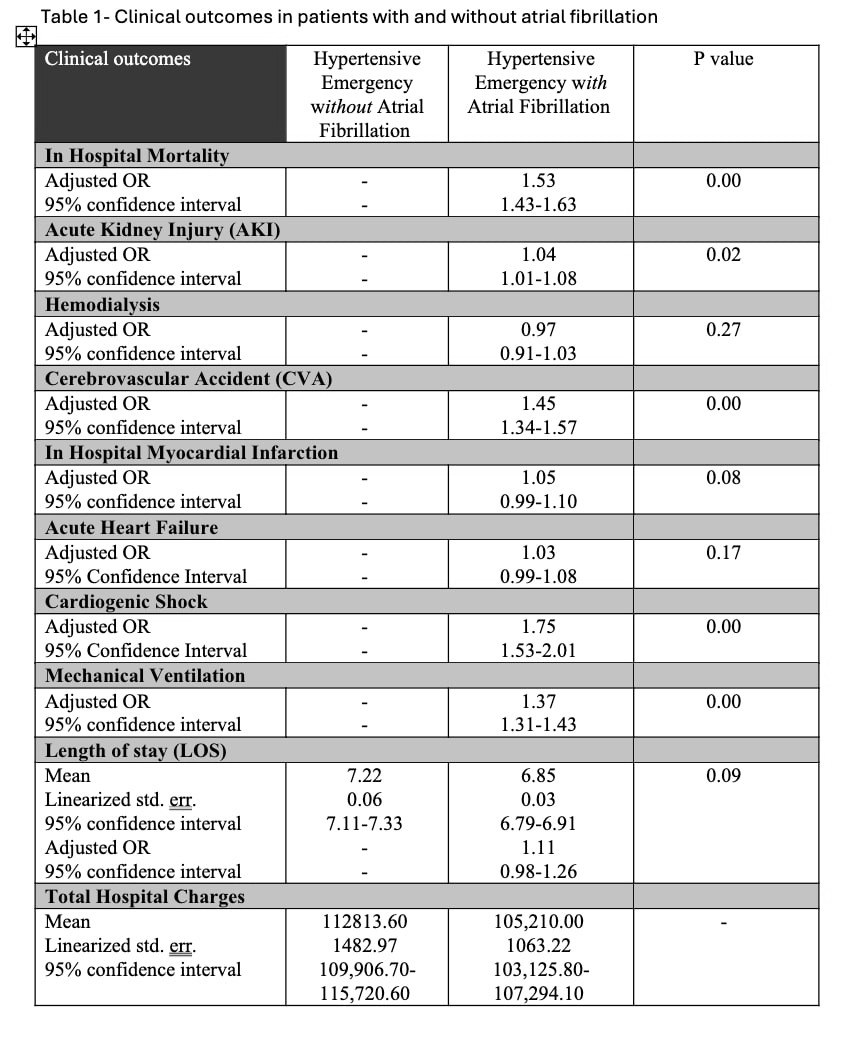
Results Among a total of 1,009,540 patients hospitalized with HE, 869,460 (86.2%) had concomitant AF. Patients with AF were significantly older (≥65 years: 74.8% vs. 42.6%, P<0.001), more likely to be White (41.9% vs 61.1%, P<0.00), and had higher rates of congestive heart failure (58.7% vs. 39.7%, P<0.00). AF patients had significantly increased odds of in-hospital mortality (aOR 1.53, CI 1.43–1.63), stroke (aOR 1.45, CI 1.34–1.57), cardiogenic shock (aOR 1.75, CI 1.53–2.01), and need for mechanical ventilation (aOR 1.37, CI 1.31–1.43). No significant differences were seen in rates of myocardial infarction, acute heart failure, or the need for dialysis. Despite worse outcomes, AF patients had slightly shorter lengths of stay and lower total hospital charges.
Conclusions AF is common among patients hospitalized with HE. It is independently associated with an increase in in-hospital mortality and cardiovascular complications. These findings highlight the need for targeted risk stratification and management strategies in this high-risk population.
Alsmairat, Yousef
(
Detroit Medical Center
, Farmington , Michigan , United States )
Shah, Rakesh Kumar
(
Detroit Medical Center
, Farmington , Michigan , United States )
Fenn, Shelby
(
Michigan State University
, Detroit , Michigan , United States )
Gopal, Shwetha
(
Bassett Medical Center
, Coopertown , New York , United States )
Author Disclosures:
Yousef Alsmairat:DO NOT have relevant financial relationships
| Rakesh Kumar Shah:DO NOT have relevant financial relationships
| Shelby Fenn:DO NOT have relevant financial relationships
| Shwetha Gopal:No Answer