Digital Transformation of Echocardiographic Data: Accuracy and Innovation in 3D Hemodynamic Simulation for Atrial Septal Defect Assessment
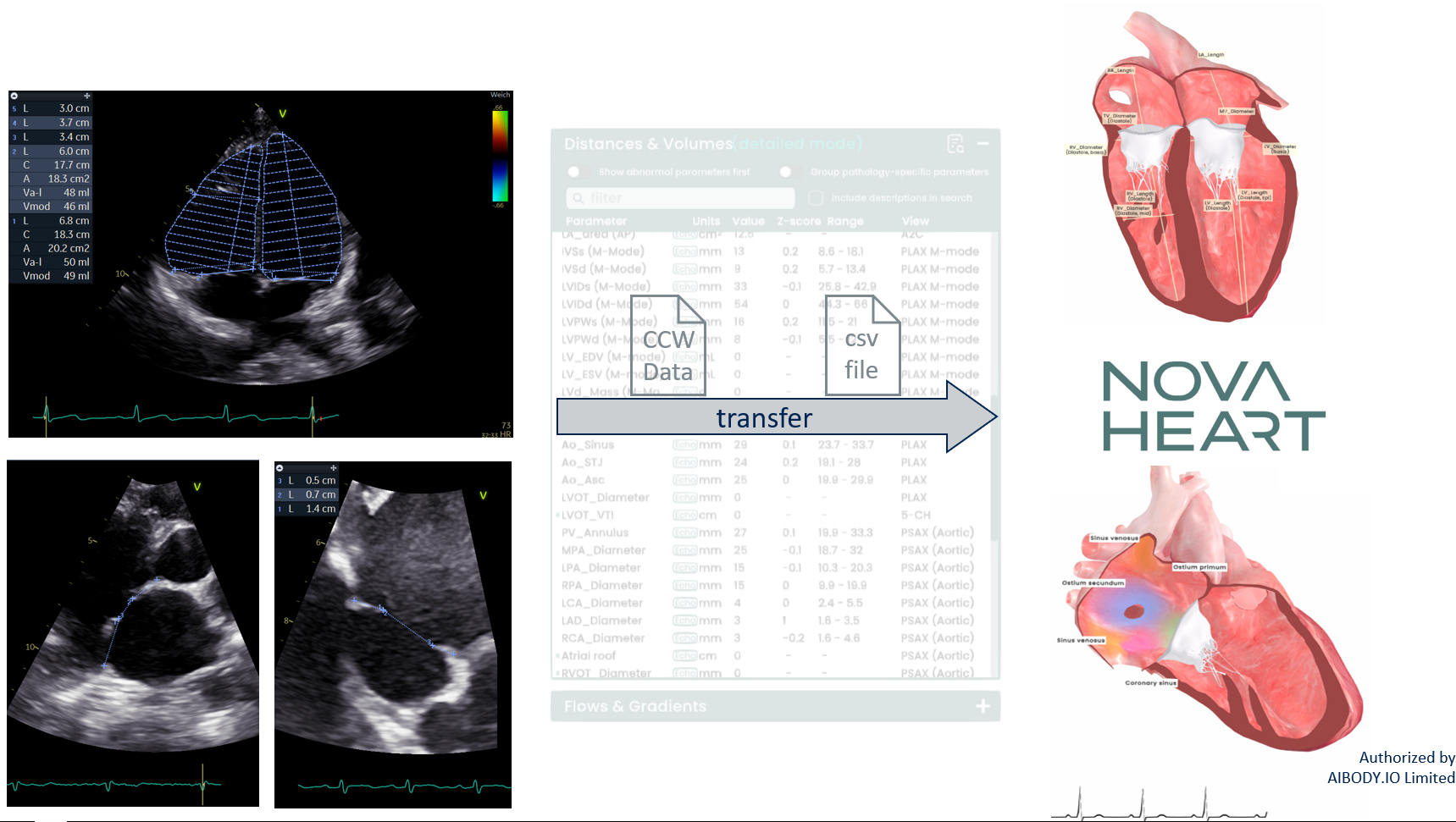
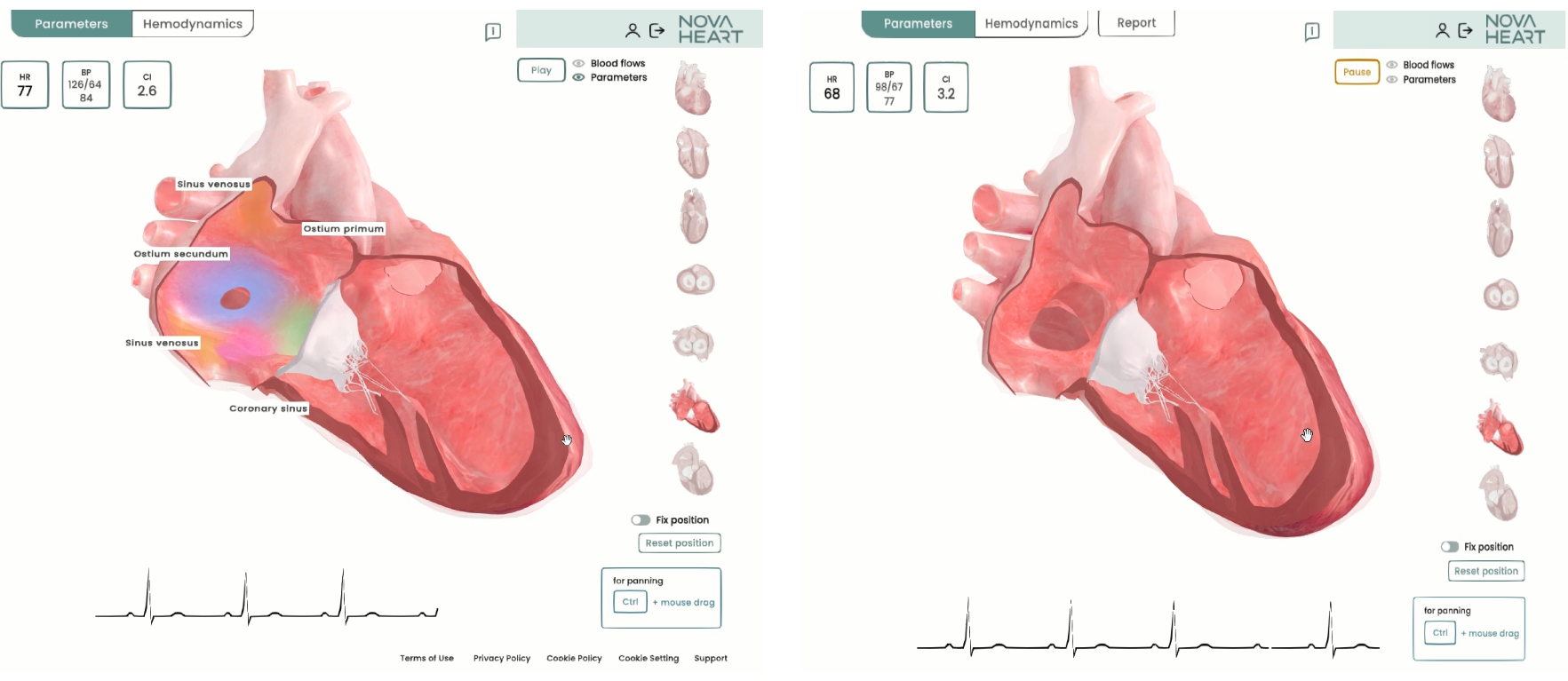
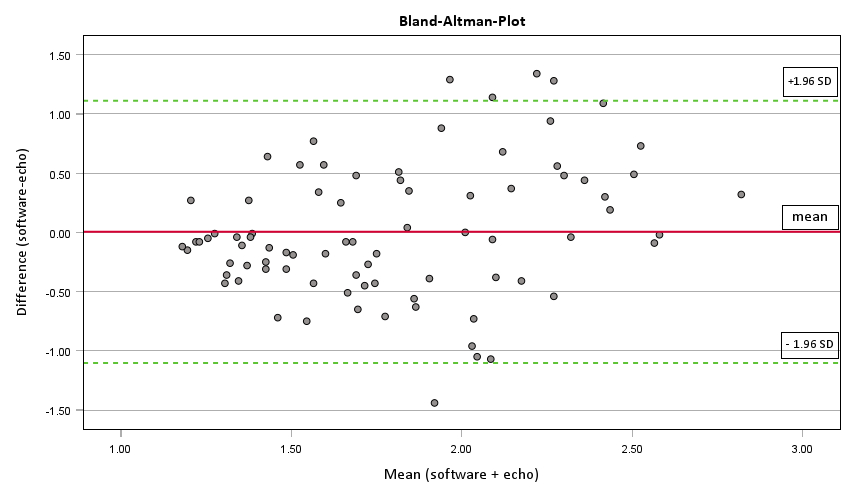
Abstract Body (Do not enter title and authors here): Background: Two-dimensional transthoracic echocardiography (2D TTE) remains the primary imaging modality in congenital heart disease (CHD) due to its accessibility, low cost, real-time functional assessment, and absence of radiation. However, 2D TTE lacks spatial resolution and is inherently operator-dependent, limiting consistent evaluation of structural lesions. To address these limitations, we developed an AI-assisted software that converts standardized 2D TTE data into interactive 3D hemodynamic models, enabling visualization and simulation of shunt volumes in atrial septal defect (ASD) patients. A dedicated acquisition protocol was implemented to improve reproducibility and reduce user dependency. Objective: To validate the accuracy of this novel 3D simulation tool by comparing its Qp:Qs calculations to standard echocardiographic estimates, and to evaluate its potential for clinical, educational, and procedural applications. Method: We included 82 patients with a median age of 6 years (range 0.6–70 years) and a mean weight of 35 kg (range 5–100 kg), all referred for ASD closure. Standard 2D TTE was used to calculate Qp:Qs by measuring outflow tract diameters and subvalvular velocity-time integrals. The same echocardiographic datasets were used to generate individualized 3D heart models with simulated shunt volumes. The software-calculated Qp:Qs values were compared to echo-derived estimates using Spearman’s correlation coefficient. Results: The mean deviation between the software-generated Qp:Qs ratio and the echocardiographically estimated value was +3% (SD ± 32.4%). A statistically significant correlation was observed between both methods (r = 0.403, p < 0.001). Visual assessments confirmed excellent topographic rendering of septal defects and intuitive interface usability for clinicians. Conclusion: This study confirms the technical feasibility and diagnostic validity of transforming 2D echocardiographic data into functional 3D simulations for ASD evaluation. The statistical correlation with conventional Qp:Qs estimates suggests that such software tools can augment clinical workflows, reduce operator dependency, and provide a foundation for patient-specific simulation in CHD care. Beyond diagnostic applications, this platform offers translational value in education, patient counseling, and virtual preprocedural planning. A prospective multicenter validation comparing simulation results to catheter-derived Qp:Qs values is currently underway.
Gross, Florian
( Deutsches Herzzentrum der Charite
, Berlin
, Germany
)
Dragendorf, Robert
( Deutsches Herzzentrum der Charite
, Berlin
, Germany
)
Seiler, Raphael
( Deutsches Herzzentrum der Charite
, Berlin
, Germany
)
Lerach, Teresa
( Deutsches Herzzentrum der Charite
, Berlin
, Germany
)
Hinke, Alexandra
( Deutsches Herzzentrum der Charite
, Berlin
, Germany
)
Berger, Felix
( Deutsches Herzzentrum der Charite
, Berlin
, Germany
)
Ovrutskiy, Stanislav
( Deutsches Herzzentrum der Charite
, Berlin
, Germany
)
Author Disclosures:
Florian Gross:DO NOT have relevant financial relationships
| Robert Dragendorf:DO NOT have relevant financial relationships
| Raphael Seiler:DO NOT have relevant financial relationships
| Teresa Lerach:No Answer
| Alexandra Hinke:No Answer
| Felix Berger:No Answer
| Stanislav Ovrutskiy:DO NOT have relevant financial relationships