Glucagon-Like Peptide 1 Mediated Reduction in Atrial Fibrillation Risk Is Independent of Weight Loss
Abstract Body (Do not enter title and authors here): Background: Glucagon-like peptide-1 (GLP-1) receptor agonists are known to have a protective effect on the risk of developing atrial fibrillation (AF). However, it is unknown if this benefit is primarily due to the weight loss driven by these medications, as weight loss has been shown to reduce the risk of AF. Prior large-scale studies have not examined the confounding effect of weight loss. Therefore, in this study we investigated relationship between weight loss and time-to-diagnosis of AF in a cohort of patients on a GLP-1. As prior studies focused mostly on semaglutide, we also examined how different GLP-1s affect AF risk.
Research Hypothesis: Patients with a larger degree of weight loss while on a GLP-1 will have longer diagnosis-free survival of atrial fibrillation.
Methods: In this single-center retrospective study, we evaluated 13,034 patients at the University of Virginia without a prior diagnosis of AF who were started on a GLP-1 between 2020–2024. A 1:1 matched control group was created using propensity score matching based on covariates known to effect the risk of AF. The time-to-diagnosis of AF was collected based on manual review of electrocardiograms and other cardiac rhythm assessment modalities, and the amount of weight loss was recorded. Hazard ratios (HRs) for AF incidence were calculated, with stratification based on both weight loss amount and specific GLP-1 selection.
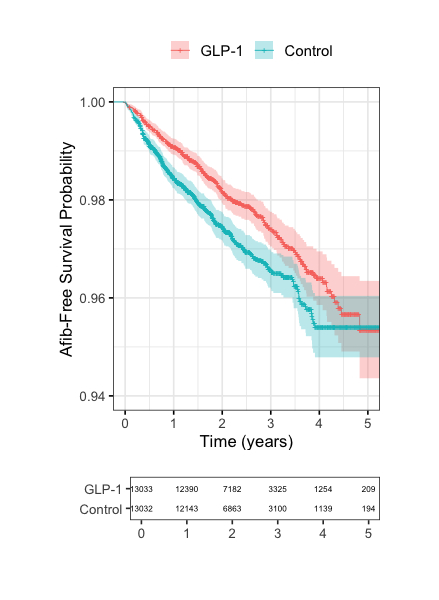
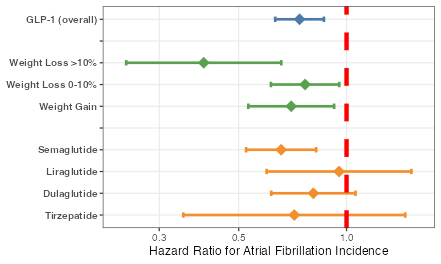
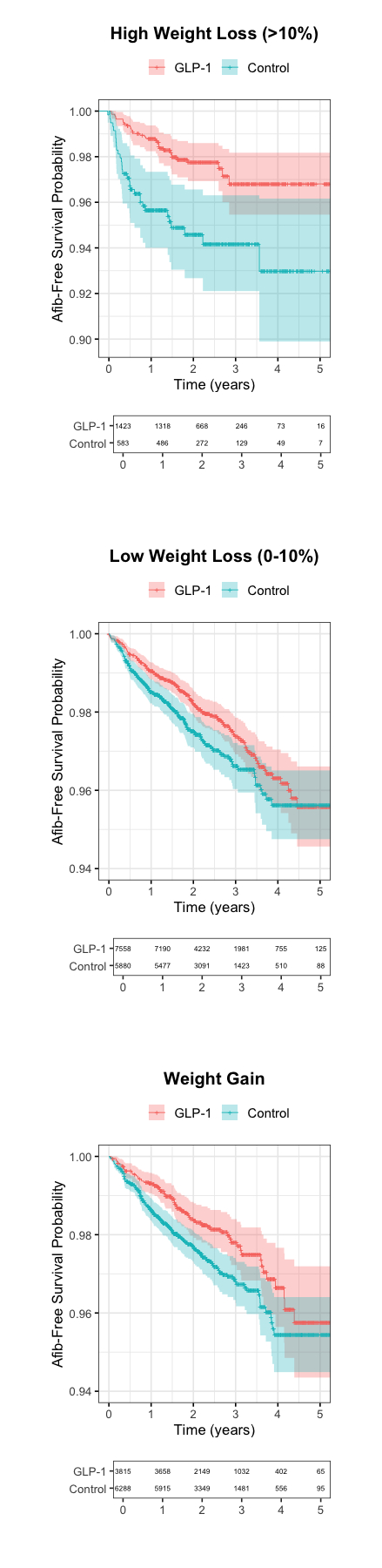
Results: GLP-1 use was associated with a lower risk of atrial fibrillation vs controls (HR 0.74, 95% CI 0.63–0.86, p < 0.001). Stratification by weight loss revealed that patients with robust (>10%) loss experienced the greatest reduction in AF risk (HR 0.40, 95% CI 0.24–0.66, p < 0.001). Those with mild (0–10%) weight loss also had a reduced risk (HR 0.77, 95% CI 0.62–0.95, p = 0.017). Surprisingly, those who gained weight while on a GLP-1 still saw benefit (HR 0.70, 95% CI 0.53–0.92, p = 0.012). By agent, semaglutide had the most significant reduction in AF incidence (HR 0.66, 95% CI 0.52–0.82, p < 0.001), while liraglutide, dulaglutide, and tirzepatide showed non-significant trends toward risk reduction.
Conclusion: GLP-1 therapy is associated with reduced atrial fibrillation risk regardless of weight change, although patients with robust weight loss saw the greatest benefit. Compared to other GLP-1s, semaglutide had the most protective effect on atrial fibrillation risk.
Palmisano, Tiago
(
University of Virginia
, Charlottesville , Virginia , United States )
Guarraia, David
(
University of Virginia
, Charlottesville , Virginia , United States )
Author Disclosures:
Tiago Palmisano:DO NOT have relevant financial relationships
| David Guarraia:DO NOT have relevant financial relationships