Logo

American Heart Association

  18
  0


Final ID: MP289

Psoas Muscle Index Is Associated With Native Heart Survival in Cardiogenic Shock Supported By Impella 5.5

Abstract Body (Do not enter title and authors here):
Background:
Frailty and sarcopenia are important predictors of outcomes in advanced heart failure. However, their prognostic value in patients with cardiogenic shock (CS) supported with Impella 5.5 has not been well defined. Psoas Muscle Index (PMI) is a promising metric of sarcopenia. In particular, the relationship between PMI and the likelihood of achieving native heart survival—ability to be weaned from temporary support without transition to LVAD or transplant—remains unclear.
Objectives:
To evaluate whether PMI, a marker of sarcopenia, is associated with in-hospital outcomes among CS patients treated with Impella 5.5.
Methods:
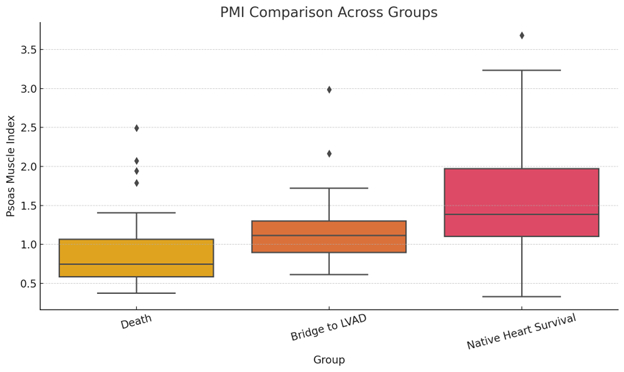
We conducted a retrospective cohort study of patients with CS supported by Impella 5.5 at a single tertiary center. Patients were categorized into three clinical outcome groups: (1) in-hospital death, (2) bridge to left ventricular assist device (LVAD), and (3) native heart survival. Patients supported by Impella 5.5 who ultimately received heart transplant were excluded due to limited data. PMI was calculated from computed tomography imaging of the chest obtained within 48 hours of admission. Axial slices at the level of the first lumbar vertebra (L1) were used to measure the cross-sectional area of the right and left psoas muscles. PMI was calculated using the formula: (Right Psoas Area + Left Psoas Area) / [Height in meters^2].
Results:
A total of 134 patients were included: 47 died during hospitalization, 30 were bridged to LVAD, and 57 achieved native heart survival. PMI differed significantly across groups (ANOVA p < 0.000001). Patients with native heart survival had the highest PMI (mean ± SD: 1.61 ± 0.69), significantly greater than those who died (0.94 ± 0.46, p < 0.000001) and those bridged to LVAD (1.19 ± 0.43, p = 0.0028). Additionally, bridge to LVAD patients had significantly higher PMI than those who died (p = 0.0085). Patients with PMI below 1 had significantly higher odds of in-hospital death compared to those with PMI ≥ 1, with an odds ratio of 7.87 (95% CI: 3.56–17.43).
Conclusions:
Higher PMI was significantly associated with native heart survival in patients with CS supported by Impella 5.5. Patients who survived without escalation to durable mechanical support had the highest PMI, while non-survivors had the lowest. A PMI below 1 was associated with an 8-fold increase in odds of in-hospital death, highlighting its potential utility as a noninvasive tool for early risk stratification in this high-risk population.
  • Adamian, Robert  ( UPMC , Pittsburgh , Pennsylvania , United States )
  • Fowler, Jeffrey  ( UPMC , Pittsburgh , Pennsylvania , United States )
  • Smith, Anson  ( UNIVERSITY PITTSBURGH MEDICAL CNTR , Pittsburgh , Pennsylvania , United States )
  • Thorngren, Christina  ( UPMC , Pittsburgh , Pennsylvania , United States )
  • Sriwattanakomen, Roy  ( UPMC , Pittsburgh , Pennsylvania , United States )
  • Keebler, Mary  ( UPMC , Pittsburgh , Pennsylvania , United States )
  • Wolfe, Jonathan  ( UPMC , Pittsburgh , Pennsylvania , United States )
  • Hickey, Gavin  ( UPMC , Pittsburgh , Pennsylvania , United States )
  • Hopkins, Steven  ( UPMC , Pittsburgh , Pennsylvania , United States )
  • Zawadzki, Jonathan  ( UPMC , Pittsburgh , Pennsylvania , United States )
  • Barnes, Alexis  ( UPMC , Pittsburgh , Pennsylvania , United States )
  • Crane, Alex  ( University of Pittsburgh , Pittsburgh , Pennsylvania , United States )
  • Klass, Wyatt  ( University of Pittsburgh , Pittsburgh , Pennsylvania , United States )
  • Rhinehart, Zachary  ( UPMC , Pittsburgh , Pennsylvania , United States )
  • Murray, Holt  ( UPMC , Pittsburgh , Pennsylvania , United States )
  • Toma, Catalin  ( UPMC , Pittsburgh , Pennsylvania , United States )
  • Author Disclosures:
    Robert Adamian: DO NOT have relevant financial relationships | Jeffrey Fowler: DO NOT have relevant financial relationships | Anson Smith: No Answer | CHRISTINA THORNGREN: No Answer | Roy Sriwattanakomen: No Answer | MARY KEEBLER: DO NOT have relevant financial relationships | Jonathan Wolfe: No Answer | Gavin Hickey: DO NOT have relevant financial relationships | Steven Hopkins: No Answer | Jonathan Zawadzki: DO NOT have relevant financial relationships | Alexis Barnes: DO NOT have relevant financial relationships | Alex Crane: DO NOT have relevant financial relationships | Wyatt Klass: DO have relevant financial relationships ; Consultant:Boston Scientific:Active (exists now) ; Speaker:Medtronic:Active (exists now) | Zachary Rhinehart: DO NOT have relevant financial relationships | Holt Murray: No Answer | Catalin Toma: No Answer
Meeting Info:

Scientific Sessions 2025

2025

New Orleans, Louisiana

Session Info:

Navigating Complexity in Cardiogenic Shock: Therapy, Monitoring, and Recovery Challenges

Saturday, 11/08/2025 , 03:15PM - 04:25PM

Moderated Digital Poster Session

More abstracts on this topic:
More abstracts from these authors:
Impella 5.5 Therapy as Bridge Therapy for Delayed Ventricular Septal Defect Repair

Kunzler Bronson, Barnes Alexis, Abdullah Mohamed, Klass Wyatt, Reis Steven, Sriwattanakomen Roy, Hickey Gavin, Kaczorowski David

Cardiogenic Shock Patients Achieving Native Heart Survival With Impella 5.5 Support Still Experience Significant Skeletal Muscle Loss

Adamian Robert, Fowler Jeffrey, Smith Anson, Thorngren Christina, Sriwattanakomen Roy, Keebler Mary, Wolfe Jonathan, Hickey Gavin, Hopkins Steven, Zawadzki Jonathan, Barnes Alexis, Crane Alex, Klass Wyatt, Rhinehart Zachary, Murray Holt, Toma Catalin

You have to be authorized to contact abstract author. Please, Login
Not Available