Triglyceride in different ApoB-containing lipoproteins and risk of coronary artery disease: particle type matters
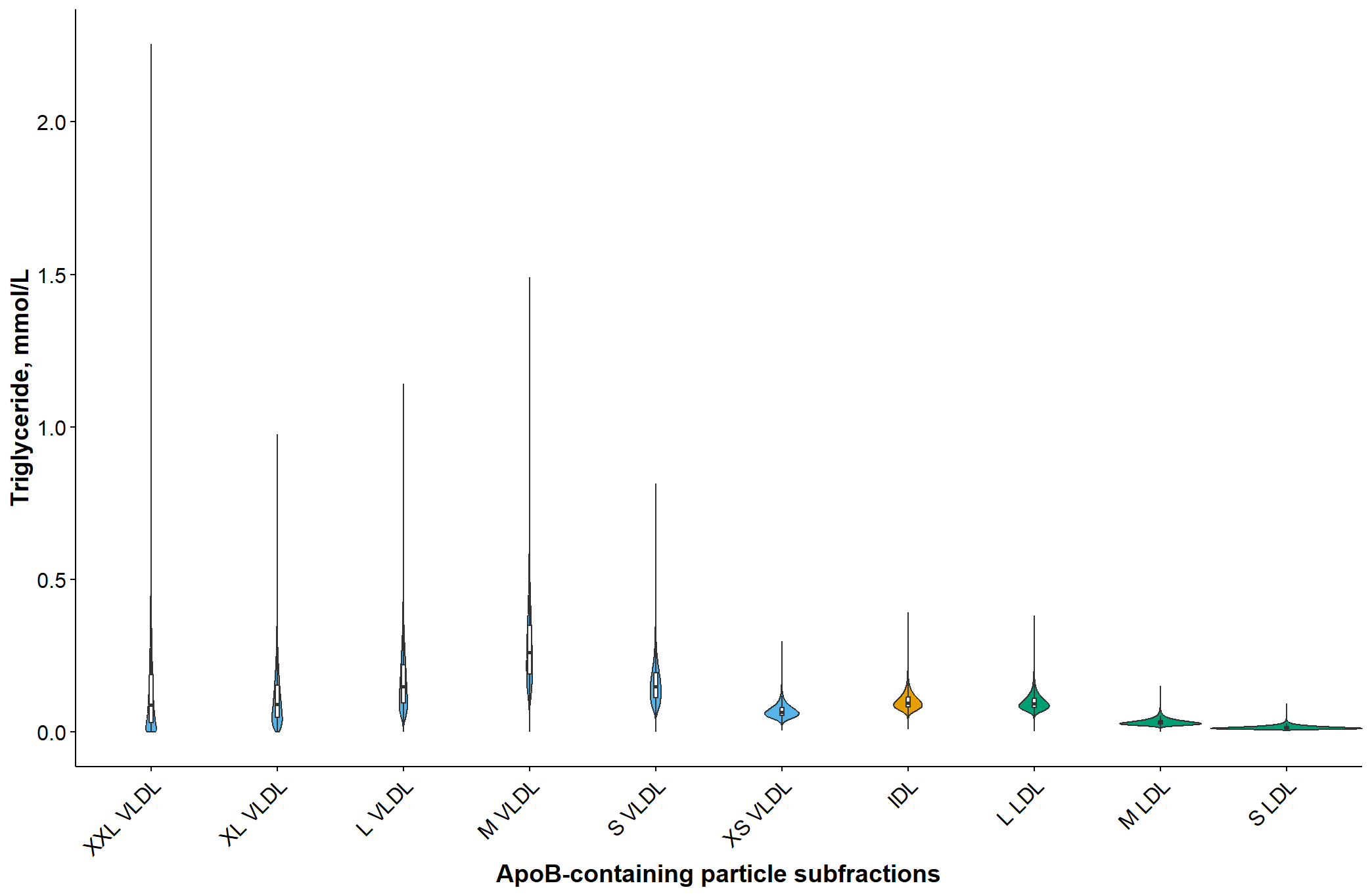
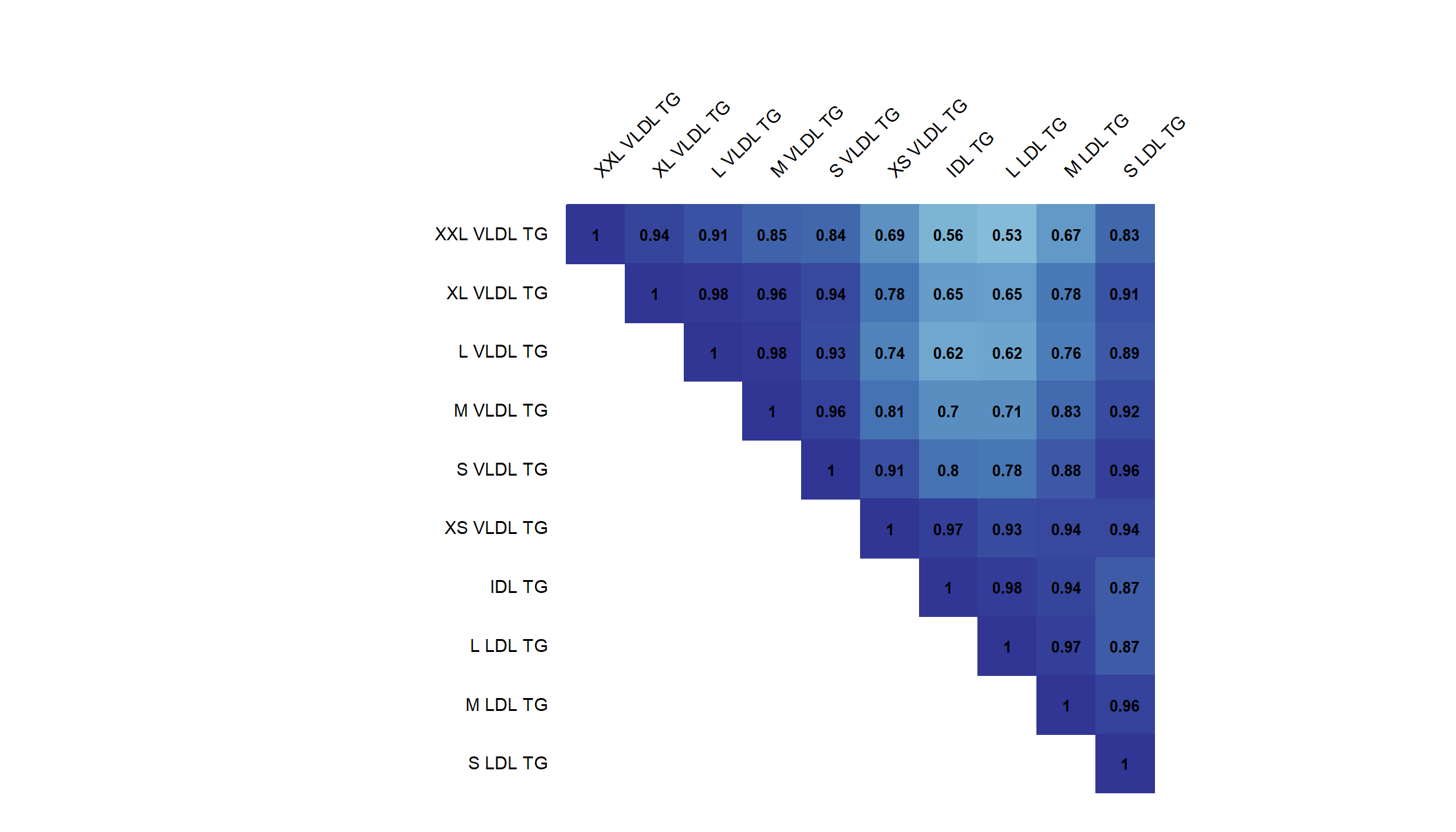
Abstract Body (Do not enter title and authors here): Introduction Plasma triglyceride (TG), mostly embedded in apoB-containing particle (apoB-P), has been proposed as a potential residual risk factor for atherosclerotic cardiovascular disease (ASCVD). However, the atherogenicity of TG in different types of ApoB-P, especially the causality, remains unclear given that the per-particle atherogenicity varies among different types of apoB-P.
Research questions To investigate the association TG content in various types of ApoB-P with the risk of coronary artery disease (CAD) in both observational and genetic study.
Methods Observational study was conducted in 169 301 UK Biobank participants with complete nuclear magnetic resonance lipoprotein profiling data and without a history of ASCVD, diabetes, or lipid-lowering therapy. Multivariate Cox proportional hazard regression was used to determine the association between TG levels in different apoB-P and risk of incident CAD. Genetic study was performed using individual-level data from 472 495 UK Biobank participants of European ancestry. One-sample mendelian randomization (MR) was performed with weighted polygenic scores as instrumental variables, which were calculated with genetic variants strongly associated with TG in various subfractions of ApoB-P.
Results In the observational study, very-low-density lipoprotein (VLDL) TG (adjusted hazard ratio [aHR] per one standard deviation [SD], 1.04; 95% CI, 1.02 - 1.06), intermediate-density lipoprotein (IDL) TG (aHR per one SD, 1.10; 95% CI, 1.08-1.12) and low-density lipoprotein (LDL) TG (aHR per one SD, 1.09; 95% CI, 1.07-1.11) were each individually associated with incident CAD. When subfractions of apoB-P were taken into account, the aHR were higher with TG in smaller size VLDL, ranging from 1.03 (95% CI, 1.01 - 1.05) for extra extra large VLDL TG to 1.08 (95% CI, 1.06 - 1.10) for extra small VLDL TG, whereas lower with TG in smaller size LDL, ranging from 1.06 (95% CI, 1.04 - 1.08) for small LDL TG to 1.10 (95% CI, 1.08 - 1.12) for large LDL TG. In one-sample MR, odds ratios (95% CI) per one SD higher genetically predicted VLDL TG, IDL TG, and LDL TG were 1.16 (1.12 - 1.21), 1.34 (1.29 - 1.39), and 1.37 (1.32 - 1.42) for CAD, respectively.
Conclusions The atherogenicity of both observed and genetically determined TG in apoB-P differs with regard to different particle size. The present observation reinforced the atherogenic mechanism of different apoB-P and shed light on critical target of TG-lowering strategy.
Qiao, Yu
(
Kunming Medical University
, Kunming , China )
Niu, Guodong
(
Kunming Medical University
, Kunming , China )
Yuan, Yifang
(
Peking University
, Beijing , China )
Author Disclosures:
Yu Qiao:DO NOT have relevant financial relationships
| Guodong Niu:DO NOT have relevant financial relationships
| Yifang Yuan:No Answer
Fei Jintao, Yao Yang, Zhang Ping, Xu Zhaoji, Liu Mingxue, Wu Xinyue, Wang Ding, Ding Shuhan, Li Minghui, Yuan Yifang, Luo Jiangying, Wang Guoxin, Zhao Jun, Cao Xuyang, Gao Minyu