Logo

American Heart Association

  25
  0


Final ID: MP58

Selective Sedation: Patient Characteristics Associated with Sedative Choice in Cardiogenic Shock

Abstract Body (Do not enter title and authors here): Introduction:
Propofol has demonstrated favorable outcomes in mechanically ventilated ICU patients, including shorter ventilation times and ICU stays. However, its use in cardiogenic shock remains controversial due to concerns about hypotension and negative inotropic effects. Despite its frequent use, limited evidence guides sedative selection in this high-risk group. We examined whether baseline characteristics and illness severity differed by sedative type in cardiogenic shock.
Research Question:
Among cardiogenic shock patients admitted to the CICU, how do baseline characteristics differ by predominant sedative exposure?
Methods:
We conducted a retrospective cohort study of 3,480 adults admitted to the Northwell Health CICU between 2016–2022 with an ICD-coded diagnosis of cardiogenic shock. Patients were grouped by sedative if >75% of cumulative sedation shifts involved a single agent: Propofol (n=669), Dexmedetomidine (n=745), Fentanyl (n=135), Midazolam (n=72), or categorized as Mixed (n=1859) if no single agent predominated. Ketamine users (n=3) were excluded. Key variables included age, Charlson Comorbidity Index (CCI), mean arterial pressure (MAP), serum lactate, creatinine, and maximum cardiogenic shock stage (SCAI). Kruskal-Wallis and Chi-squared tests were used for continuous and categorical comparisons.
Results:
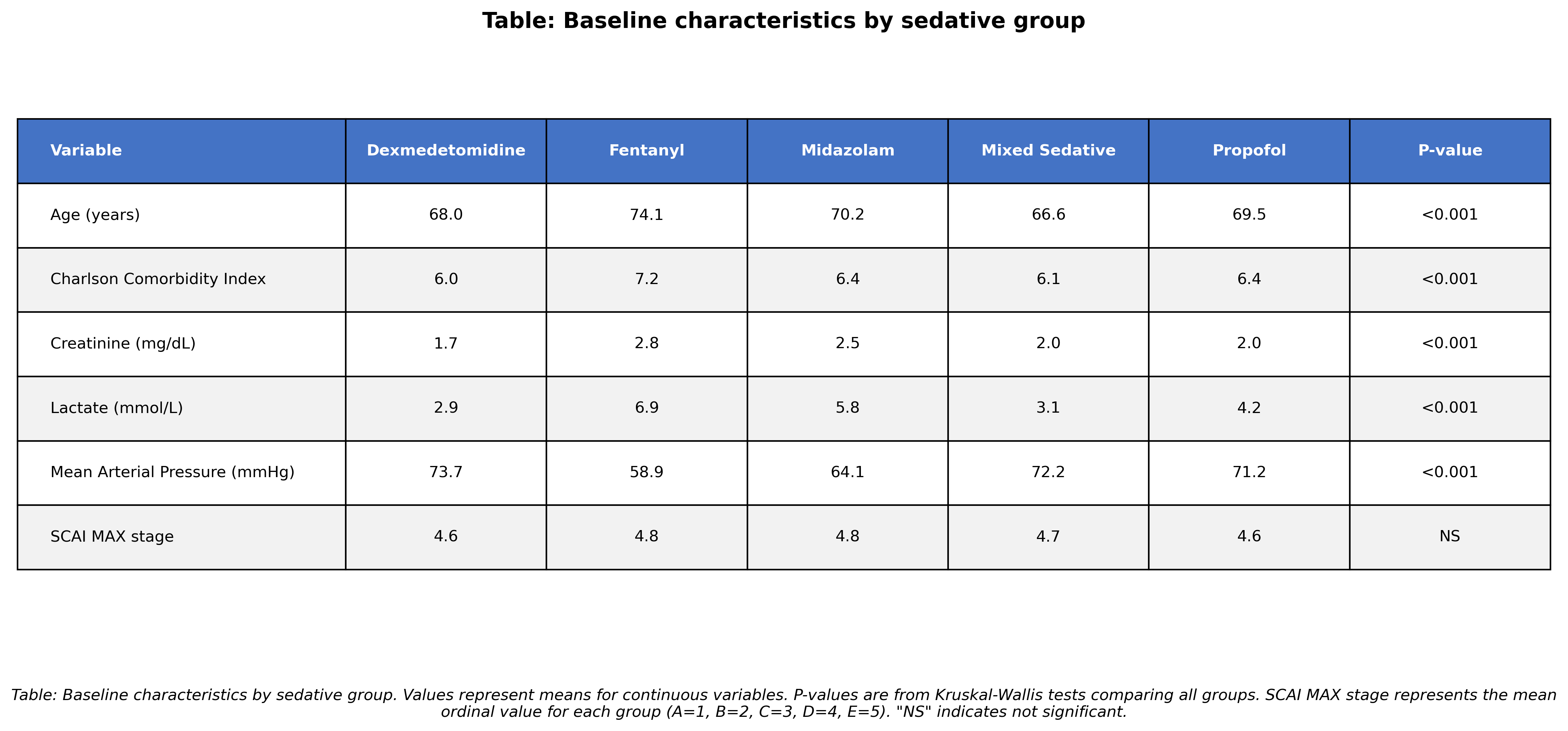
Baseline characteristics varied significantly by sedative group (all p<0.001). Propofol patients were younger (mean age 69.6), with higher MAP (71.2 mmHg), lower lactate (4.25 mmol/L), and lower creatinine (2.03 mg/dL). Fentanyl and Midazolam groups had greater illness severity: older age (74.1 and 70.2), lower MAP (58.9 and 64.1 mmHg), higher lactate (6.94 and 5.83 mmol/L), and higher creatinine (2.82 and 2.45 mg/dL). Max SCAI was similar across groups.
Conclusions:
Propofol recipients were generally younger with more favorable baseline hemodynamic profiles, while fentanyl and midazolam recipients exhibited greater markers of illness severity. Despite these differences, the maximum cardiogenic shock stage (SCAI) was similar across groups. These findings suggest a potential selection bias, with clinicians possibly reserving propofol for patients perceived as lower risk due to safety concerns. However, the similarity in SCAI stage suggests that such avoidance may not reflect actual illness severity. Prospective studies are needed to determine whether propofol is truly contraindicated—or underutilized—in patients with advanced cardiogenic shock.
  • Wallach, Yisrael  ( Northwell Health , Manhasset , New York , United States )
  • Bhatt, Madhav  ( Northwell Health , Manhasset , New York , United States )
  • Weintraub, Spencer  ( Northwell Health , Manhasset , New York , United States )
  • Sood, Aditya  ( Northwell Health , Manhasset , New York , United States )
  • Adi, Abduljabar  ( Northwell Health , Manhasset , New York , United States )
  • Griffin, Matthew  ( Northwell Health , Manhasset , New York , United States )
  • Alvarez, Miguel  ( Lenox Hill Hospital , New York , New York , United States )
  • Pierce, Matthew  ( Northwell Health , Manhasset , New York , United States )
  • Author Disclosures:
    Yisrael Wallach: DO NOT have relevant financial relationships | Madhav Bhatt: DO NOT have relevant financial relationships | Spencer Weintraub: No Answer | Aditya Sood: No Answer | Abduljabar Adi: No Answer | Matthew Griffin: DO NOT have relevant financial relationships | Miguel Alvarez: DO NOT have relevant financial relationships | Matthew Pierce: DO NOT have relevant financial relationships
Meeting Info:

Scientific Sessions 2025

2025

New Orleans, Louisiana

Session Info:

Critical Care Under Pressure: Hemodynamics, Sedation, and Survival in Cardiogenic Shock and Beyond

Saturday, 11/08/2025 , 12:15PM - 01:15PM

Moderated Digital Poster Session

More abstracts on this topic:
A Shocking Postpartum Course

Wozniak Phillip, Grodzinsky Anna

Adverse Events and Outcomes Among Patients with Temporary Mechanical Circulatory Support Devices Placed at Referring Versus Hub Cardiogenic Shock Centers

Patel Zachary, Silkowski Molly, Dodson Kaylen, Bull Lindsey, Gregoski Mathew, Tedford Ryan, Mcmurray Jeffrey, Witer Lucas, Kilic Arman, Houston Brian, Carnicelli Anthony, Ospina Meg, Mittelstaedt Roxanne, Peller Jacob, Samani Stephanie, Marchell Charlotte, Ohlrich Kelly, Gunn Brady, Varrone Michael

More abstracts from these authors:
Sedation Strategies in Cardiogenic Shock: Is Propofol Safer Than We Think?

Wallach Yisrael, Pierce Matthew, Bhatt Madhav, Salamatbad Gidon, Shknevskiy Shusterman Vlad, Sood Aditya, Weintraub Spencer, Adi Abduljabar, Griffin Matthew, Alvarez Miguel

Epidemiology of Patients Undergoing a Rapid Response within the First 24 Hours of Admission at an Urban Academic Center

Cyr Andrew, Salam Shafkat, Sood Aditya, Capustin Matthew, Smith Alexander, Weintraub Spencer, Bulsara Kishen, Honigman Jared, Alvarez Miguel, Griffin Matthew, Pierce Matthew, Patel Pushpendra, Jnani Jack, Chang Joshua, Jassal Ajay, Leung Christian, Li Shuojohn, Palati Sai, Guntaka Saimanoj

You have to be authorized to contact abstract author. Please, Login
Not Available