
Logo

American Heart Association

  19
  0


Final ID: MP1247

Turning Tides: Demographic Reversals in U.S. Infective Endocarditis Mortality (1999–2020)

Abstract Body (Do not enter title and authors here): Introduction
Infective endocarditis (IE) is a life-threatening condition with evolving epidemiology in recent decades. While IE-related mortality declined in early decades, recent trends suggest rising death rates, possibly linked to increased injection drug use, resistant pathogens, and care disparities.

Research Questions/Hypothesis
This study investigated how the age-adjusted IE mortality rates in the United States changed from 1999 to 2020 based on sex, race, and Census region. Our hypothesis predicted that the mortality rates started increasing during the early 2010s because of changing dynamics in vulnerable populations.

Methods
We used CDC WONDER data (1999–2020) and applied joinpoint regression to age-adjusted mortality rates stratified by sex, race, and region. Linear regression was used to estimate the trends before and after the significant inflection points.

Results
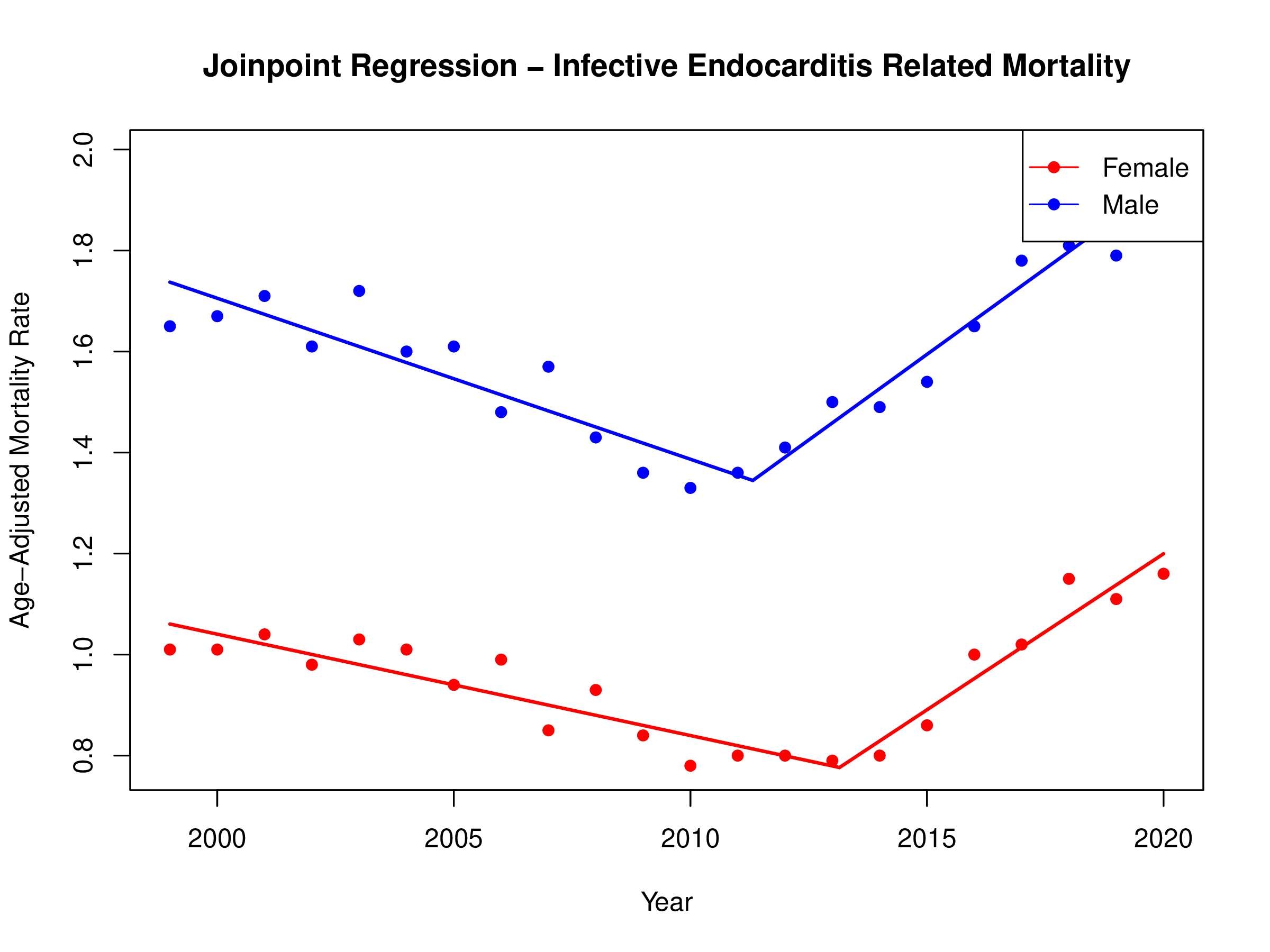
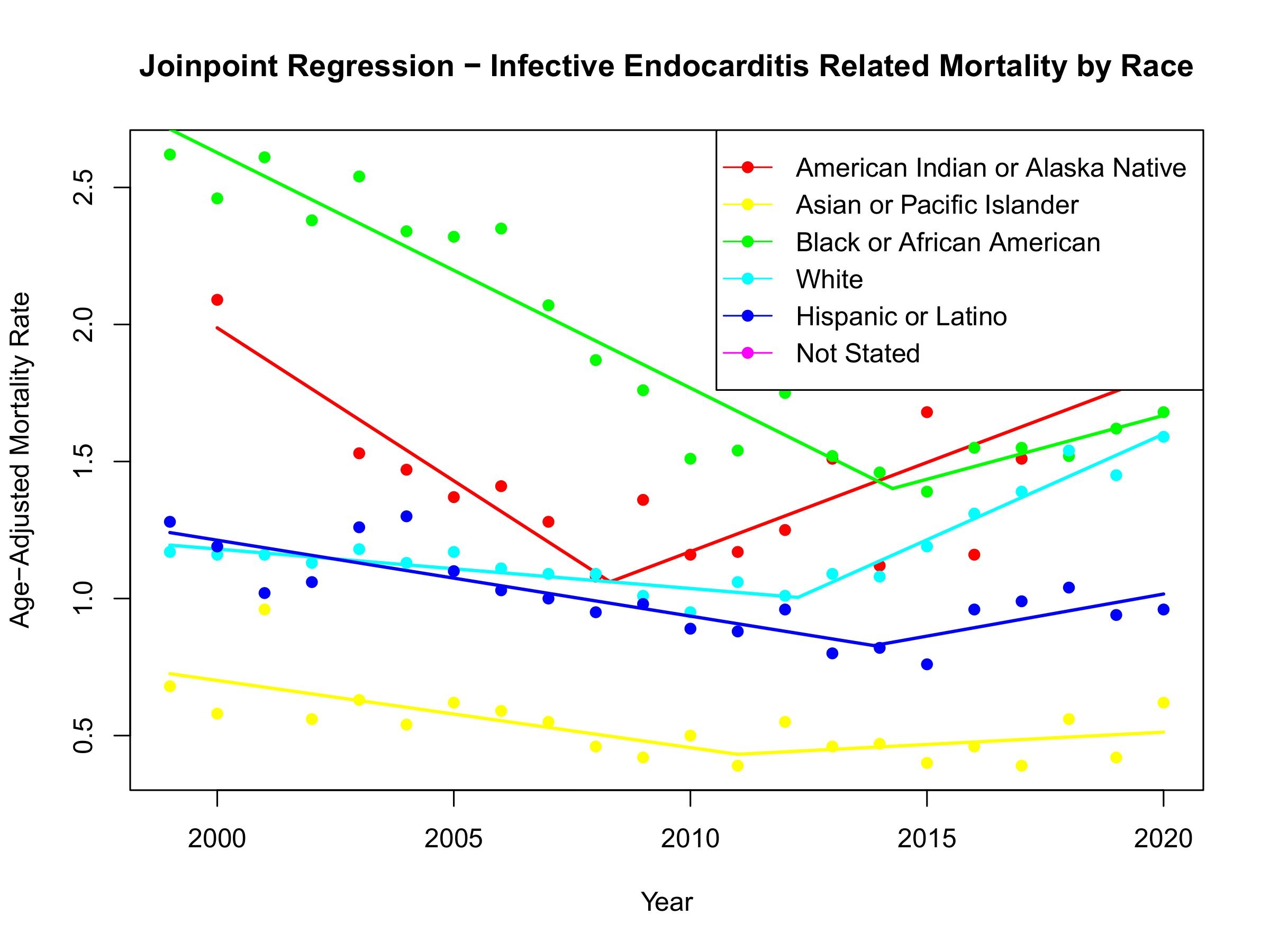
The mortality rates among males decreased until 2011 (β = -0.0319/year, p < 0.001), then increased dramatically (β = +0.0678/year, p < 0.001). The decline in mortality rates among females continued until 2013 (β = -0.0201/year), then rose significantly (β = +0.0618/year, p < 0.001). American Indian/Alaska Natives experienced a rapid increase in mortality after 2008 (from β = -0.112 to +0.065), while White populations also experienced a similar shift post-2012 (β = +0.077, p < 0.001). Other groups experienced milder changes. All Census regions had joinpoints between 2011–2014. The South had the steepest rise (β = +0.084/year), with the Midwest, West, and Northeast also reversing from declining to rising trends (β range: +0.057 to +0.064).

Conclusion
IE mortality rates in the United States experienced an important epidemiological change in the early 2010s after years of continuous decline. The groups most severely impacted by this rise consist of male patients along with American Indian/Alaska Native people and White individuals as well as Southern residents. The elevated mortality rates directly follow the timeline of the opioid epidemic thus making injection drug use an essential factor. Structural healthcare inequities along with rising antimicrobial-resistant infections create additional hypotheses which disproportionately harm rural and minority populations who receive inadequate healthcare. The urgent need for specific interventions becomes evident to decrease the negative effects of these simultaneous crises on IE outcomes.
  • Luthra, Gaurav  ( Central Michigan University , Saginaw , Michigan , United States )
  • Haddad, Nicholas  ( CMU Med Ed Partners , Saginaw , Michigan , United States )
  • Mohammed, Adil  ( Central Michigan University , Saginaw , Michigan , United States )
  • Christian, Cleris  ( Central Michigan University , Saginaw , Michigan , United States )
  • Farooqi, Mashood  ( Central Michigan University , Saginaw , Michigan , United States )
  • Khan, Afrasayab  ( Central Michigan University , Saginaw , Michigan , United States )
  • Ishfaq, Lyluma  ( Central Michigan University , Saginaw , Michigan , United States )
  • El-hajj, Jad  ( Central Michigan University , Saginaw , Michigan , United States )
  • Manzoor, Mohammad  ( GMC Srinagar , Srinagar , India )
  • Hussain, Fazeel  ( University of Dhaka , Dhaka , Bangladesh )
  • Author Disclosures:
    Gaurav Luthra: DO NOT have relevant financial relationships | Nicholas Haddad: DO NOT have relevant financial relationships | Adil Mohammed: DO NOT have relevant financial relationships | Cleris Christian: DO NOT have relevant financial relationships | Mashood Farooqi: DO NOT have relevant financial relationships | Afrasayab Khan: DO NOT have relevant financial relationships | lyluma ishfaq: DO NOT have relevant financial relationships | Jad El-Hajj: DO NOT have relevant financial relationships | Mohammad Manzoor: DO NOT have relevant financial relationships | Fazeel Hussain: DO NOT have relevant financial relationships
Meeting Info:

Scientific Sessions 2025

2025

New Orleans, Louisiana

Session Info:

Unseen but Deadly: Recognizing Rare, Reversible, and Rising Cardiovascular Challenges

Sunday, 11/09/2025 , 03:15PM - 04:15PM

Moderated Digital Poster Session

More abstracts on this topic:
More abstracts from these authors:
Heart of the Matter: Quantifying Fibrosis by LGE-CMR to Predict Sudden Death in Hypertrophic Cardiomyopathy

Khan Afrasayab, Ishfaq Lyluma, Sudan Sourav, Alhaddadin Robert, Qsous Amal, Darapaneni Haritha, Luthra Gaurav, Gogikar Amaresh, Fattal Peter

Intersecting Inequities: Mapping Racial and Social Vulnerability Hotspots in U.S. Cardiogenic Shock Mortality

Luthra Gaurav, Gariaqoza Yousif, Do Pauline, Mohammed Zaki Ur Rahman, Kambali Shrinivas, Mohammed Adil, Christian Cleris, Singh Sachin, Khan Afrasayab, Ishfaq Lyluma, El-hajj Jad, Yasmeen Umera, Beeharry Sarah

You have to be authorized to contact abstract author. Please, Login
Not Available