Cardiac Diffusion Tensor Imaging to Differentiate Advanced Variants of Cardiomyopathy
Abstract Body (Do not enter title and authors here): Introduction/Background: Cardiomyopathies (CMs) are heterogeneous myocardial disorders characterized by structural and functional abnormalities. Advanced cardiomyopathy variants (ACVs), including burnout hypertrophic cardiomyopathy (HCM) and dilated cardiomyopathy (DCM) with hypertrophy, pose diagnostic challenges due to overlapping features that traditional cine-MRI cannot easily differentiate.
Research Questions/Hypothesis: We hypothesized that cardiac diffusion tensor imaging (cDTI), especially the secondary eigenvector angle (E2A), provides superior microstructural differentiation among cardiomyopathy types compared to traditional imaging modalities.
Goals/Aims: To evaluate whether cDTI-derived parameters, particularly E2A, can effectively discriminate between ACVs and classical cardiomyopathies (HCM and DCM).
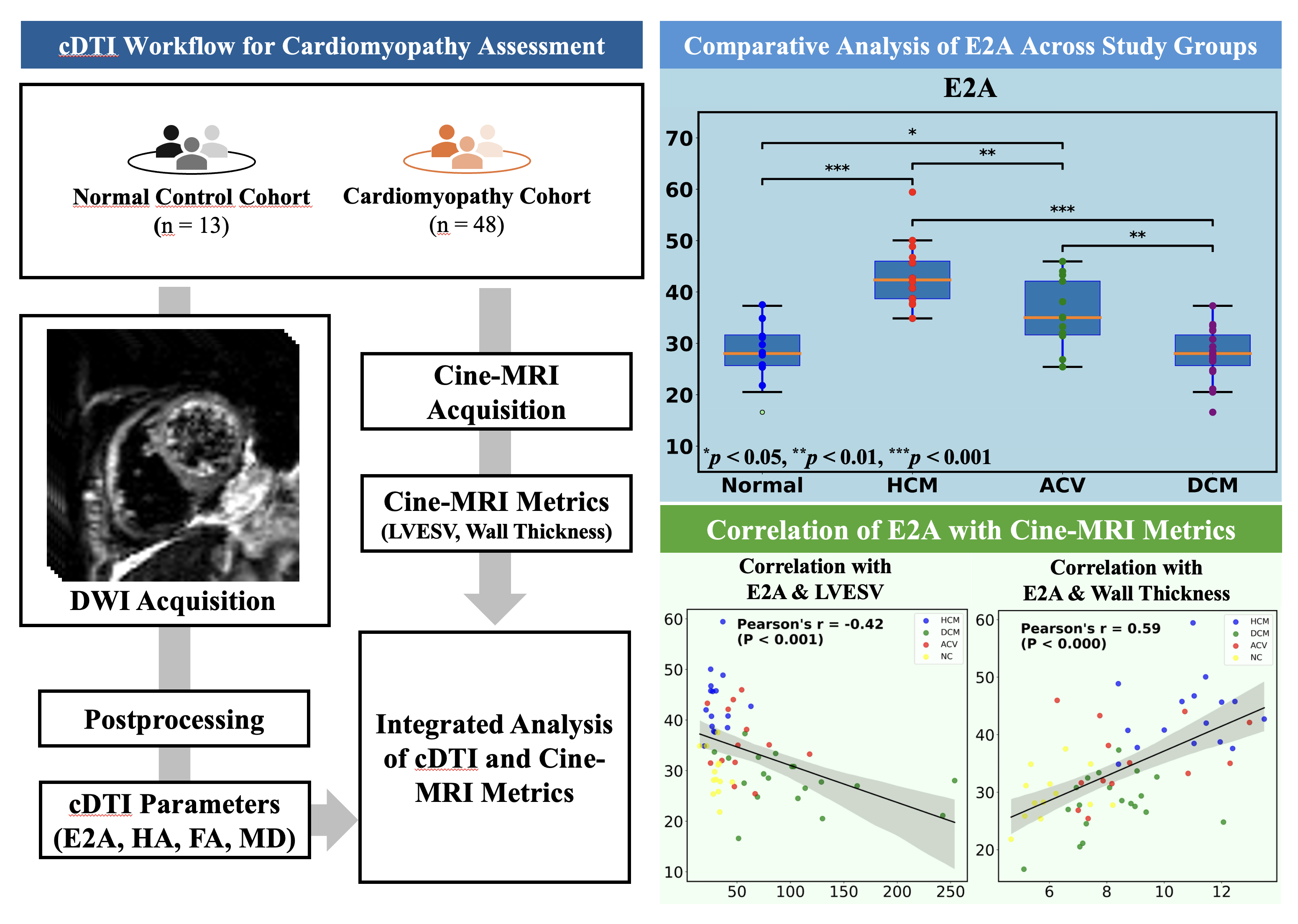
Methods/Approach: Sixty-one subjects (13 healthy controls, 16 HCM, 19 DCM, and 13 ACVs) underwent cine-MRI and cDTI at 3.0 Tesla. Diffusion-weighted imaging data underwent preprocessing, including rigid registration to correct motion artifacts, averaging, and interpolation for resolution enhancement. Diffusion tensors were computed using a linear least-squares method, followed by eigen-decomposition to derive fractional anisotropy (FA), mean diffusivity (MD), helix angle (HA), and secondary eigenvector angle (E2A). Statistical analyses included one-way ANOVA and Tukey’s post-hoc comparisons.
Results/Data: E2A significantly differentiated ACVs (35.71±6.31°) from HCM (43.49±5.91°, p=0.0024) and DCM (28.08±4.95°, p=0.0019), displaying intermediate values. FA, MD, and HA were less discriminatory. Cine-MRI reliably identified HCM by increased wall thickness and DCM by ventricular dilation and reduced function but struggled with intermediate phenotypes.
Conclusions: The cDTI parameter E2A notably enhances differentiation of advanced cardiomyopathy variants, complementing traditional cine-MRI assessments. This imaging biomarker may guide clinical decision-making and improve diagnostic clarity in complex cardiomyopathies.
Kim, Min Su
(
Pusan National University
, Busan , Korea (the Republic of) )
Jeong, Hongbin
(
Pusan National University
, Busan , Korea (the Republic of) )
Lee, Ji Won
(
Pusan National University Hospital
, Busan , Korea (the Republic of) )
Hwang, Min Hee
(
Pusan National University Hospital
, Busan , Korea (the Republic of) )
Moulin, Kevin
(
Boston Children's Hospital
, Boston , Massachusetts , United States )
Ennis, Daniel
(
Stanford University
, Stanford , California , United States )
Lee, Hyewon
(
Pusan National University Hospital
, Busan , Korea (the Republic of) )
Gahm, Jin Kyu
(
Pusan National University
, Busan , Korea (the Republic of) )
Author Disclosures:
Min Su Kim:No Answer
| Hongbin Jeong:No Answer
| Ji Won Lee:No Answer
| Min Hee Hwang:No Answer
| Kevin Moulin:No Answer
| Daniel Ennis:No Answer
| Hyewon Lee:No Answer
| Jin Kyu Gahm:DO NOT have relevant financial relationships