Logo

American Heart Association

  27
  0


Final ID: Sa3062

Long-Term Clinical Outcomes between P2Y12 Inhibitor Monotherapy and Prolonged Dual Antiplatelet Therapy in Patients with Poly-vascular Disease: Sub-study of the SMART-CHOICE Randomized Trial

Abstract Body (Do not enter title and authors here): Background: The optimal antiplatelet treatment strategy for poly-vascular disease after percutaneous coronary intervention (PCI) is uncertain.
Research Questions: Our study aimed to compare the effects of short-term dual antiplatelet therapy followed by P2Y12 inhibitor monotherapy and prolonged DAPT after PCI, according to the presence of poly-vascular disease.
Methods: We conducted a post-hoc analysis of the SMART-CHOICE randomized trial. Patients who underwent PCI were randomly assigned to receive either P2Y12 inhibitor monotherapy (DAPT for 3 months, n=1495) or prolonged DAPT (DAPT for ≥12 months, n=1498) after PCI. Poly-vascular disease was defined as coronaory artery disease with peripheral artery disease or cerebrovascular disease. The primary outcome was major adverse cardiac and cerebrovascular events (MACCE; a composite of all-cause death, myocardial infarction, or stroke). Bleeding Academic Research Consortium (BARC) type 2-5 bleeding, and major bleeding (defined as BARC type 3-5 bleeding) were investigated as secondary outcomes. Clinical follow-up was extended to 3 years.
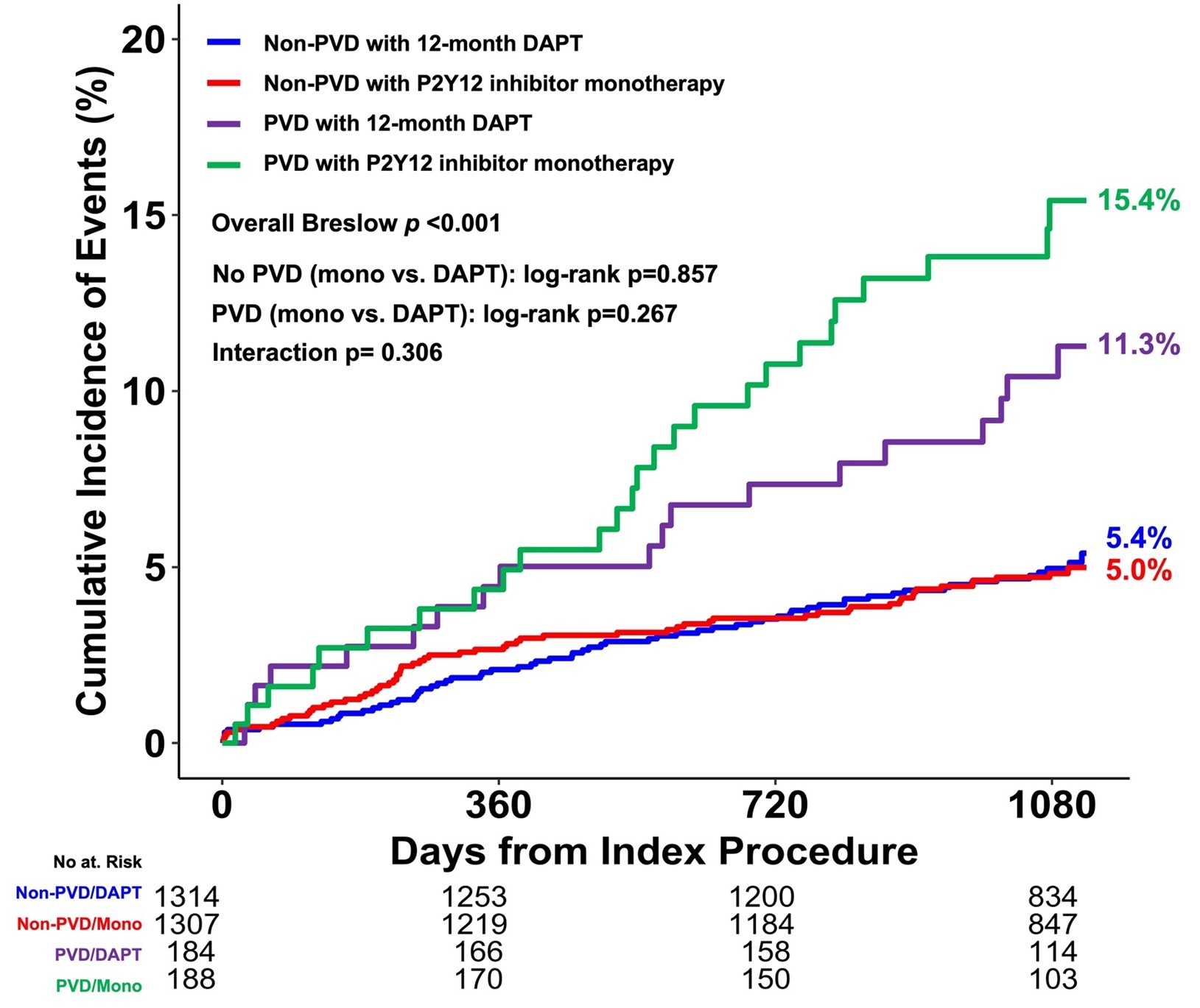
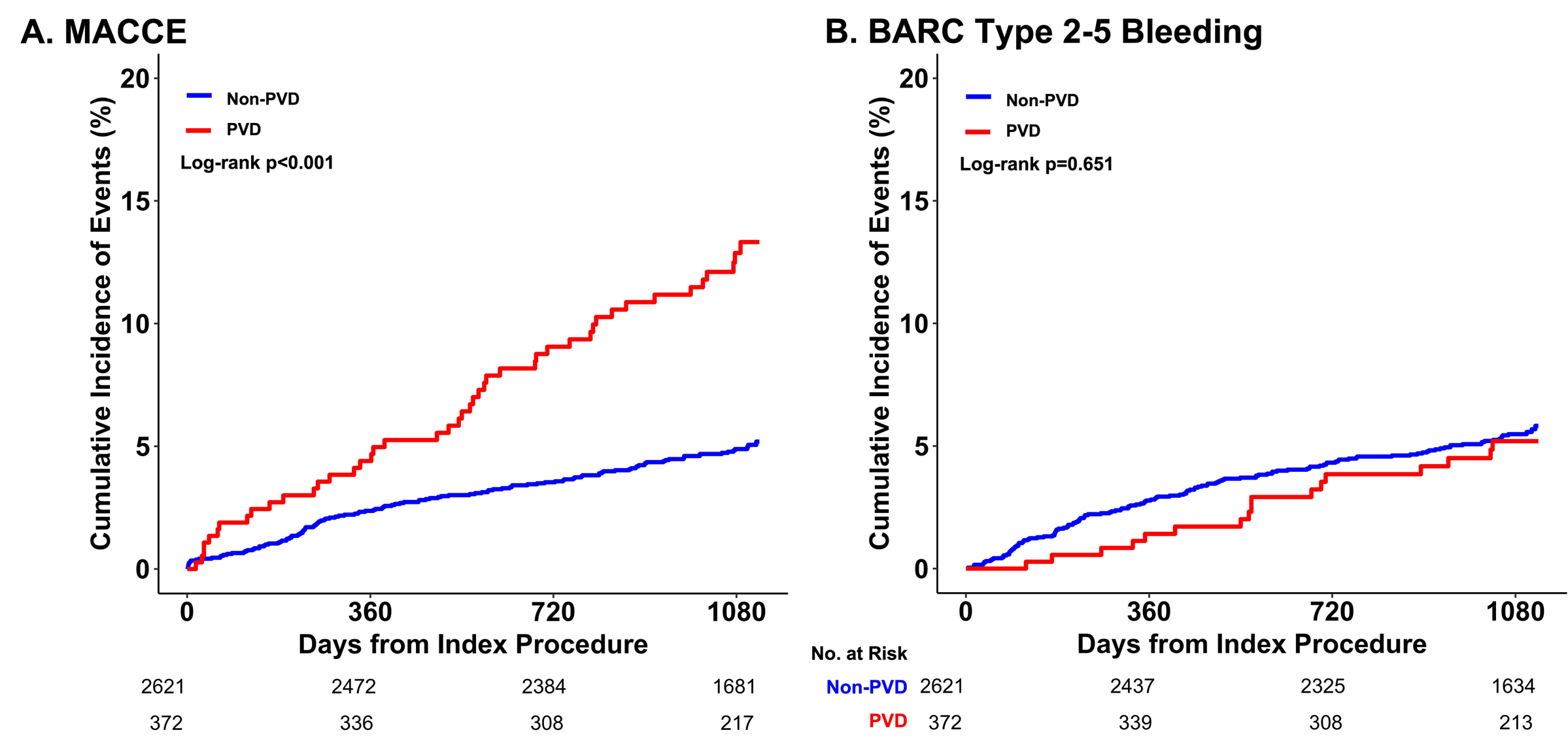
Results: Among the total population (n=2,993), 372 patients were poly-vascular disease (coronary artery disease with peripheral artery disease, n=171; cerebrovascular disease, n=180; both, n=21). Poly-vascular disease patients had a higher rate of MACCEs than those without poly-vascular disease (aHR 1.614, 95%CI 1.133-2.298, *P<0.001). No significant difference in MACCEs was observed between the P2Y12 inhibitor monotherapy and prolonged DAPT (reference) groups, both in poly-vascular disease and non-poly-vascular disease groups (poly-vascular disease: HR 1.396, 95%CI 0.773-2.523, P=0.269; non-poly-vascular disease: HR 0.968, 95%CI 0.682-1.375, P=0.857). There was no significant difference in BARC type 2-5 (p=0.449) and major bleeding (p=0.144) between P2Y12 inhibitor monotherapy and prolonged DAPT in poly-vascular disease group. There was no significant interaction between poly-vascular disease and antiplatelet strategies for the risk of MACCE at 3 years (Pinter=0.306).
Conclusions: Poly-vascular disease is associated with an increased risk of MACCE after PCI. P2Y12 inhibitor monotherapy after 3-month DAPT may be comparable to prolonged DAPT in terms of ischemic outcomes in patients with poly-vascular disease. Further study is required to assess the efficacy and safety of short-term P2Y12 inhibitor monotherapy after PCI in the poly-vascular disease patient population.
  • Yoo, Tae Kyung  ( Boston Medical Center , Boston , Massachusetts , United States )
  • Jeong, Jin-ok  ( Chungnam national univ. hospital , Daejeon , Korea (the Republic of) )
  • Cho, Byung-ryul  ( kangwon national university hospita , Chuncheon , Korea (the Republic of) )
  • Oh, Seok Kyu  ( Wonkwang University Hospital , Iksan , Korea (the Republic of) )
  • Yun, Kyeong Ho  ( Wonkwang University Hospital , Iksan , Korea (the Republic of) )
  • Cho, Deok-kyu  ( Yongin Severance Hospital , Yongin , Korea (the Republic of) )
  • Koh, Young-youp  ( Chosun University Hospital , Gwangju , Korea (the Republic of) )
  • Bae, Jang-whan  ( Chungbuk National University Hospital , Cheongju , Korea (the Republic of) )
  • Choi, Jae Woong  ( Eulji General Hospital , Seoul , Korea (the Republic of) )
  • Lee, Wang Soo  ( Chung-Ang University Hospital , Seoul , Korea (the Republic of) )
  • Yoon, Hyuck Jun  ( Dongsan medical center , Daegu , Korea (the Republic of) )
  • Choi, Ki Hong  ( Samsung Medical Center , Seoul , Korea (the Republic of) )
  • Lee, Seung Uk  ( Kwangju Christian Hospital , Gwangju , Korea (the Republic of) )
  • Cho, Jang Hyun  ( St Carollo Hospital , Suncheon , Korea (the Republic of) )
  • Choi, Woonggil  ( Chungbuk National University Hospit , Cheongju , Korea (the Republic of) )
  • Rha, Seung-woon  ( Korea University Guro Hospital , Seoul , Korea (the Republic of) )
  • Gwon, Hyeon-cheol  ( Samsung Medical Center, Sungkyunkwan University School of Medicine , Seoul , Korea (the Republic of) )
  • Choi, Seung-hyuk  ( Samsung Medical Center, Sungkyunkwan University School of Medicine , Seoul , Korea (the Republic of) )
  • Lee, Jong-young  ( Kangbuk Samsung Hospital , Seoul , Korea (the Republic of) )
  • Song, Young Bin  ( Samsung Medical Center , Seoul , Korea (the Republic of) )
  • Hahn, Joo-yong  ( Samsung Medical Center, Sungkyunkwan University School of Medicine , Seoul , Korea (the Republic of) )
  • Park, Yong Hwan  ( Samsung Changwon Hospital , Changwon , Korea (the Republic of) )
  • Oh, Ju Jyeon  ( Masan Samsung Hospital , Masan , Korea (the Republic of) )
  • Jang, Woo Jin  ( Ewha Woman's University Seoul Hospital , Seoul , Korea (the Republic of) )
  • Im, Eul-soon  ( Dongsuwon General Hospital , Suwon , Korea (the Republic of) )
  • Author Disclosures:
    Tae Kyung Yoo: DO NOT have relevant financial relationships | Jin-Ok Jeong: DO NOT have relevant financial relationships | Byung-Ryul Cho: No Answer | Seok Kyu Oh: No Answer | Kyeong Ho Yun: DO NOT have relevant financial relationships | Deok-Kyu Cho: No Answer | Young-Youp Koh: No Answer | Jang-whan Bae: No Answer | Jae Woong Choi: No Answer | Wang Soo Lee: No Answer | Hyuck Jun Yoon: No Answer | Ki Hong Choi: DO NOT have relevant financial relationships | Seung Uk Lee: No Answer | Jang Hyun Cho: No Answer | Woonggil Choi: No Answer | Seung-Woon Rha: DO NOT have relevant financial relationships | Hyeon-Cheol Gwon: No Answer | Seung-Hyuk Choi: No Answer | Jong-Young Lee: No Answer | Young Bin Song: DO NOT have relevant financial relationships | Joo-Yong Hahn: No Answer | Yong Hwan Park: No Answer | Ju Jyeon Oh: No Answer | Woo Jin Jang: DO NOT have relevant financial relationships | Eul-Soon Im: No Answer
Meeting Info:

Scientific Sessions 2025

2025

New Orleans, Louisiana

Session Info:

Evolving Antithrombotic Paradigms after PCI and ACS

Saturday, 11/08/2025 , 02:30PM - 03:30PM

Abstract Poster Board Session

More abstracts on this topic:
A novel method for measuring HDL-bound unconjugated bilirubin using an eel fluorescent protein reveals its association with reduced coronary artery disease

Fujioka Tomoo, Iino Takuya, Toh Ryuji, Harada Amane, Nagao Manabu, Shinohara Masakazu, Ishida Tatsuro, Otake Hiromasa

Duration of Potent P2Y12 Inhibitor-Based DAPT after Percutaneous Coronary Intervention for Acute Coronary Syndromes: A Frequentist Pairwise and Network Meta-Analysis

Joseph Meghna, Goldsweig Andrew, Nanna Michael, Krishna Mrinal, Ezenna Chidubem, Akman Zafer, Rossi Raiza, Nouri Armin, Al Mouslmani Mohammad, Damluji Abdulla, Kutty Shelby

More abstracts from these authors:
Impact of Non-Culprit Chronic Total Occlusion in Patients with Infarct-Related Cardiogenic Shock: Results from the RESCUE Registry

Kim Min Chul, Kwon Sung Uk, Lee Wang Soo, Jeong Jin-ok, Park Sang-don, Lim Seong-hoon, Ahn Youngkeun, Choi Ki Hong, Yang Jeong Hoon, Gwon Hyeon-cheol, Ahn Chul-min, Yu Cheolwoong, Chun Woojung, Bae Jang-whan

Impact of stent length on long-term clinical outcomes in acute myocardial infarction patients treated with second-generation drug-eluting stents

Choi Woonggil, Bae Jang-whan, Hwang Kyung-kuk, Kim Dong-woon, Cho Myeong-chan, Lee Ju-hee, Bae Dae-hwan, Kim Min, Lee Junyoung, Sun Jonghee, Rha Seung-woon, Choi Byoung Geol, Choi Se Yeon, Choi Cheol Ung, Hyun Sujin, Byun Jae Kyeong, Cha Jinah, Kim Sang Min

You have to be authorized to contact abstract author. Please, Login
Not Available