Association Between Hospital Teaching Status and Outcomes in Patients with Cardiogenic Shock Complicating Acute Myocardial Infarction
Abstract Body (Do not enter title and authors here): Background: Hospital settings may influence outcomes in patients with cardiogenic shock (CS) complicating acute myocardial infarction (AMI). Understanding these disparities is critical for improving care delivery and resource allocations across different hospital settings.
Research Question: Do teaching status and hospital location affect outcomes and resource use in patients with AMI- CS?
Methods: We extracted data from the National Inpatient Sample database from 2018 to 2020. We included patients aged ≥18 years with AMI and CS listed as either a primary or secondary diagnosis, identified using ICD-10-CM codes (AMI: I21.0–I21.4 and CS: R57.0). The primary outcome was in-hospital mortality. Secondary outcomes included length of stay (LOS), inflation- adjusted hospital charges, mechanical circulatory support (MCS) use, acute kidney injury (AKI), stroke, and septicemia. Multivariable logistic and linear regression models assessed associations across urban teaching, urban non-teaching, and rural hospitals, adjusting for patient and hospital-level factors.
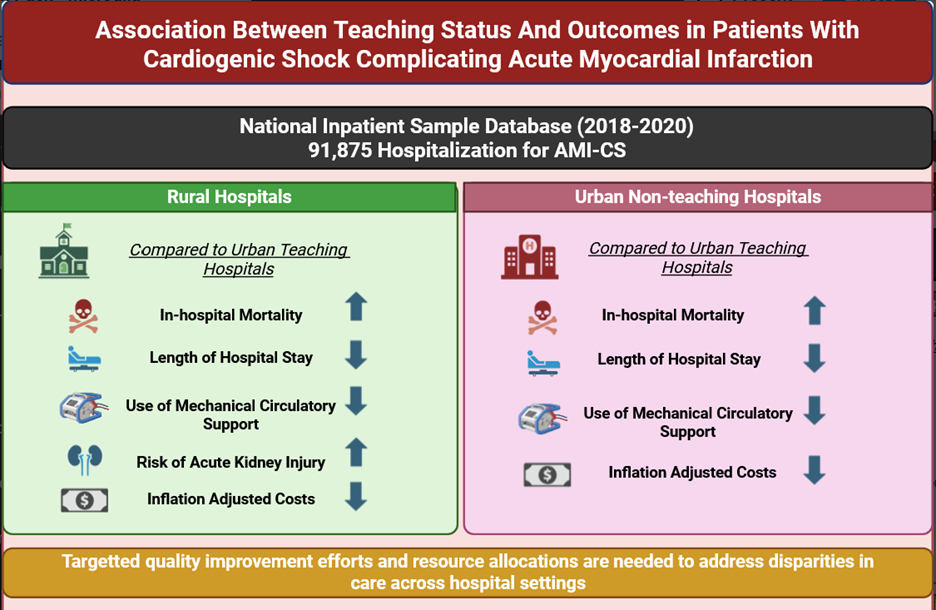
Results: Among 91,875 hospitalizations for AMI-CS, a significantly higher in-hospital mortality was observed in rural hospitals compared to urban teaching hospitals (adjusted odds ratio [aOR]: 1.20, 95%CI: 1.0 to 1.4; P=0.03). Rural hospitals were associated with shorter LOS (β=-1.6; 95% CI: -2.1 to -1.2; P<0.01), lower MCS use (aOR: 0.62; 95%CI: 0.51 to 0.75; P<0.01), lower hospital charges (β=-72,987; 95%CI: -85,134 to -60,840, P<0.01), and higher AKI (aOR: 0.74; 95% CI: 0.64 to 0.87; P<0.01) compared to urban teaching hospitals. There was no significant difference in septicemia, and stroke between rural and urban teaching hospitals (both P>0.05). Compared to urban teaching hospitals, urban non-teaching hospitals demonstrated higher in-hospital mortality (OR: 1.09; 95% CI: 1.00 to 1.19; P=0.04), shorter LOS (β=-0.7; 95%CI: -1.1 to -0.4; P<0.01), lower MCS use (OR: 0.74; 95%CI: 0.67 to 0.82; P<0.01), and lower hospital charges (β=-14,630; 95%CI: -26,525 to -2735; P=0.02). There was no significant difference in AKI, septicemia, and stroke between urban teaching and non-teaching hospitals. (all P>0.05).
Conclusions: Rural and urban non-teaching hospitals demonstrated lower resource use and higher mortality compared to urban teaching hospitals. Targeted quality improvement efforts and resource allocations are needed to address disparities in care across hospital settings.
Arshad, Muhammad Sameer
(
Dow University of Health Sciences
, Karachi , Pakistan )
Javaid, Syed Sarmad
(
University of Mississippi Medical Center
, Jackson , Mississippi , United States )
Arshad, Anosha
(
Dow University of Health Sciences
, Karachi , Pakistan )
Abbas, Faizan
(
F.M.H College of Medicine and Dentistry
, Lahore , Pakistan )
Abideen, Zain Ul
(
Quaid-e-Azam Medical College
, Bahawalpur , Pakistan )
Fatima, Saba
(
Jinnah Sindh Medical University
, Karachi , Pakistan )
Hassan, Shahzaib
(
D.G Khan Medical College
, Dera Ghazi Khan , Pakistan )
Irshad, Ayman
(
Amna Inayat Medical College
, Sheikhupura , Pakistan )
Iqbal, Naeem
(
Rawalpindi Medical University
, Rawalpindi , Pakistan )
Kumari, Komal
(
Islamabad Medical and Dental Collge
, Islamabad , Pakistan )
Manal, Ishba
(
Dow University of Health Sciences
, Karachi , Pakistan )
Nasir, Aamna
(
Jinnah Sindh Medical University
, Karachi , Pakistan )
Author Disclosures:
Muhammad Sameer Arshad:DO NOT have relevant financial relationships
| Naeem Iqbal:No Answer
| komal kumari:DO NOT have relevant financial relationships
| Ishba Manal:DO NOT have relevant financial relationships
| Aamna Nasir:No Answer
| Syed Sarmad Javaid:DO NOT have relevant financial relationships
| Anosha Arshad:No Answer
| Faizan Abbas:No Answer
| Zain Ul Abideen:DO NOT have relevant financial relationships
| Saba Fatima:No Answer
| Marian Harrison:No Answer
| Shahzaib Hassan:No Answer
| Ayman Irshad:DO NOT have relevant financial relationships
Sohail Muhammad Umer, Saad Muhammad, Arshad Muhammad Sameer, Sohail Muhammad Ovais, Ahmed Aymen, Azhar Aima, Kumar Pankaj, Memon Muhammad Mustafa, Shahid Izza
Arshad Muhammad Sameer, Tharwani Zoaib Habib, Saad Muhammad, Sohail Muhammad Umer, Deepak Fnu, Sohail Muhammad Ovais, Kumar Pankaj, Shahid Izza, Memon Muhammad Mustafa
4368018_File000000.jpg
You have to be authorized to contact abstract author. Please, Login