Trends in Cardiovascular Mortality Among Adults in United States With Sleep Disorders, 1999–2020: A CDC WONDER-Based Analysis
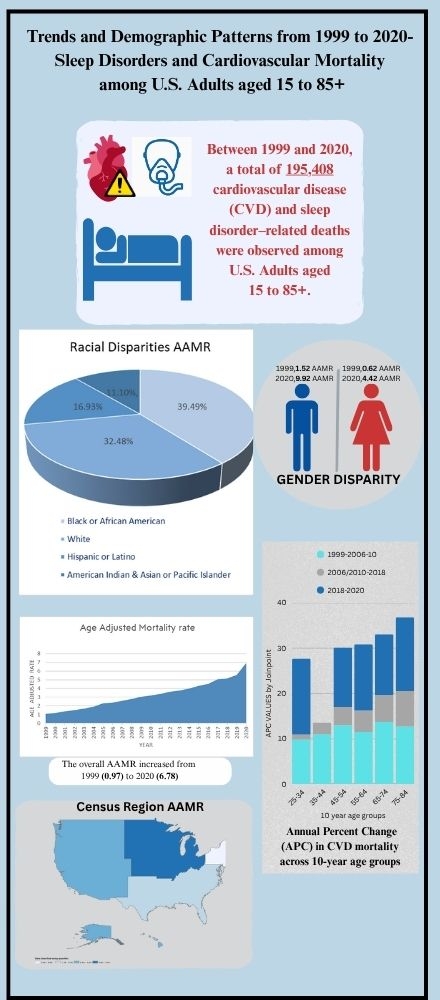
Abstract Body (Do not enter title and authors here): BACKGROUND: In the United States, Cardiovascular Disease (CVD) is a leading cause of mortality, particularly among individuals with sleep disorders. This national analysis (1999–2020) identifies racial, ethnic, and demographic disparities by analyzing mortality patterns to guide targeted interventions. AIM: To analyze mortality trends in cardiovascular diseases among U.S. adults with sleep disorders, considering socio-demographic variables. METHODS: A retrospective analysis was conducted using the CDC WONDER database death certificates from 1999 to 2020 to assess mortality related to CVD in people with sleep disorders for individuals aged 15 to 85+. The population was identified through the International Classification of Diseases, Tenth Revision (ICD-10) codes: I00–I99 for cardiovascular diseases and G47 for the spectrum of sleep disorders. Age-adjusted mortality rates (AAMRs) per 100,000 persons were analyzed and stratified by year, sex, race, census region, and 10-year age group-based classification. AAMR trends across the years were assessed using Joinpoint regression (Version 5.4.0, National Cancer Institute) to determine the annual percent change (APC) and the average annual percent change (AAPC). RESULTS: Between 1999 and 2020, a total of 195,408 cardiovascular diseases (CVD)–related deaths were recorded, with an overall trend showing an increase in age-adjusted mortality rates (AAMRs) from 1.02 per 100,000 in 1999 to 6.87 in 2020, exhibiting consistent fluctuations over the study period. Males consistently demonstrated higher AAMRs compared to females (Females: 4.42 in 2020; Males: 9.92 in 2020). Stratification by race and region showed that Non-Hispanic Black individuals had the highest AAMR, with the trend surging in 2018–2020 (APC: 20.66), while the Midwest recorded the highest rates among all census regions. Ten-year age group stratification indicated that individuals aged ≥85 years had the highest crude mortality rates, contributing disproportionately to the overall national trend. CONCLUSION: Our analysis reveals a consistent increase in cardiovascular mortality among U.S. adults with sleep disorders, especially in obstructive sleep apnea, with an emerging trend in narcolepsy. Pronounced disparities by race and region were observed. These findings necessitate targeted public health interventions addressing sleep health and cardiovascular risks, to reduce mortality and alleviate the debilitating effects of this association.
Qaisar, Mariam
(
Dow medical College
, KARACHI , sindh , Pakistan )
Sohail Fatani, Manahil
(
Dow medical College
, KARACHI , sindh , Pakistan )
Owais, Maryam
(
Dow medical College
, KARACHI , sindh , Pakistan )
Kumar, Sham
(
St. Francis Medical Center
, West Monroe , Louisiana , United States )
Author Disclosures:
Mariam Qaisar:No Answer
| Manahil Sohail Fatani:DO NOT have relevant financial relationships
| Maryam Owais:DO NOT have relevant financial relationships
| Sham kumar:DO NOT have relevant financial relationships
Ali Muhammad Faizan, Khan Muhammad, Sharif Aleena, Hossain Mohammad, Ahmad Husnain, Eltawansy Sherif, Faizan Muhammad, Ahmed Ashraf, Abdul Malik Mohammad Hamza Bin, Pahwani Ritesh, Patel Rahul, Mehdi Hassan