Logo

American Heart Association

  15
  0


Final ID: MP285

Association of Angiotensin Receptor-Neprilysin Inhibitor Initiation With Mortality and Organ Failure Post Non-Acute Myocardial Infarction Cardiogenic Shock: A Multicenter Propensity Matched Retrospective Study

Abstract Body (Do not enter title and authors here): Introduction:
Non-acute myocardial infarction (non-AMI) cardiogenic shock (CS) confers high mortality despite advances in therapy. Angiotensin Receptor-Neprilysin Inhibitor (ARNI) is known to improve outcomes in chronic heart failure, but its impact in non-AMI CS remains undefined.

Methods:
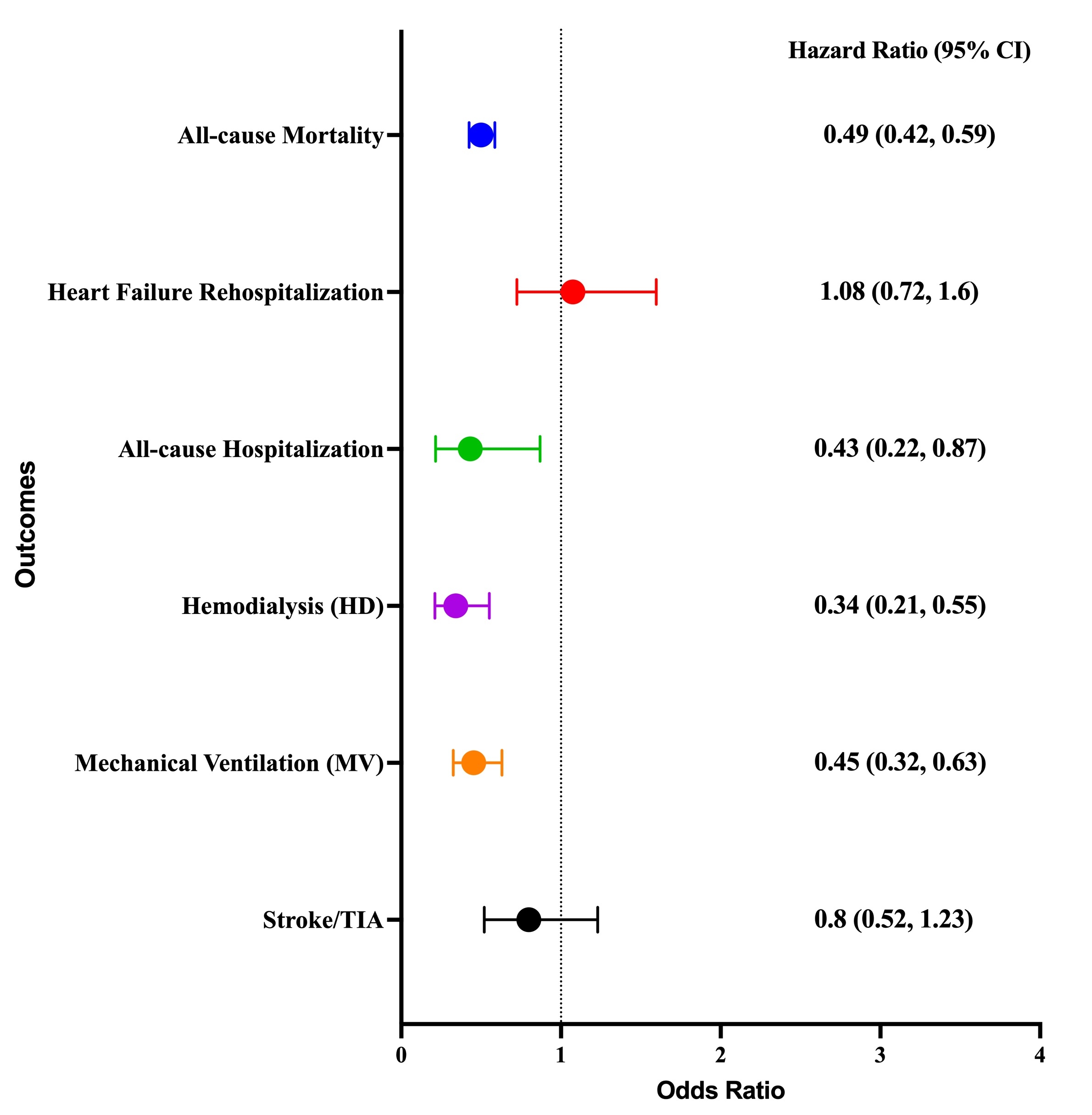
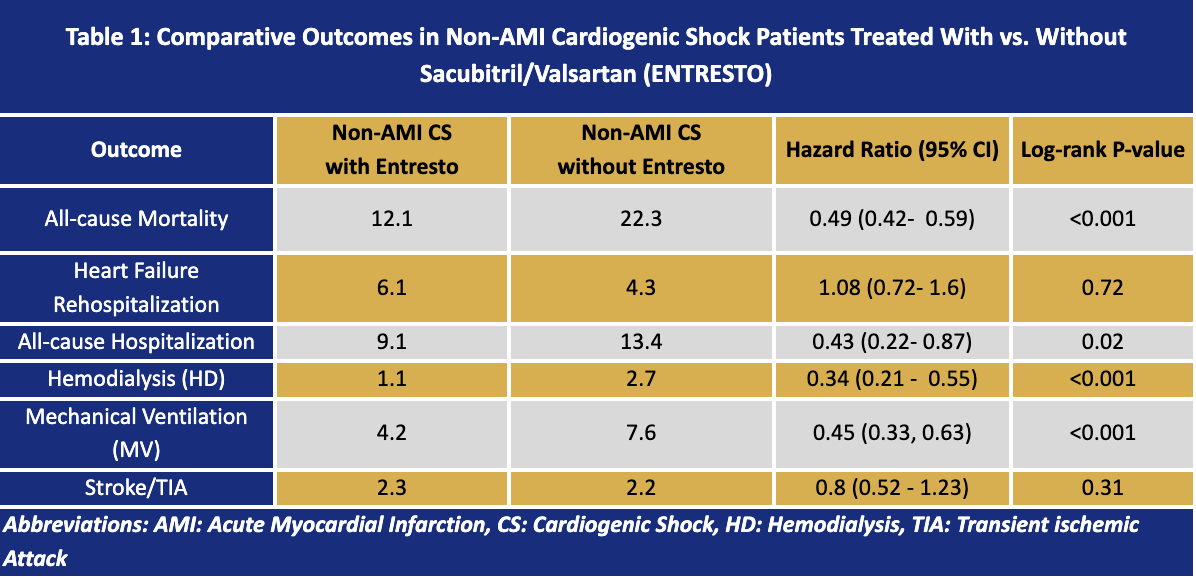
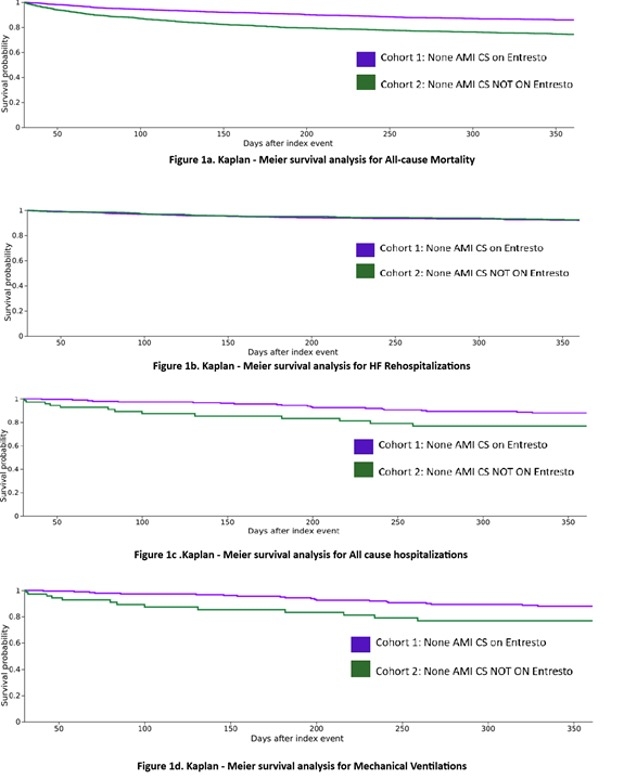
Our retrospective cohort study used the TriNetX US Collaborative Network to identify adult patients (≥18 years) with non-AMI CS receiving ARNI within 7 to 30 days of index admission between July 2015 and May 2024. We performed a 1:1 propensity-matched (PSM) analysis and evaluated the primary outcome: all-cause mortality. Secondary outcomes were all-cause and heart failure hospitalization, hemodialysis (HD) initiation, mechanical ventilation (MV), and stroke/transient ischemic attack (TIA). Kaplan-Meier curves were compared by log-rank test, and hazard ratios (HRs) were estimated via Cox proportional hazards models (Figure 1).

Results:
Of 180,498 patients with CS, 65.8% were non-AMI CS (ARNI group, N = 2,640, and No ARNI, N = 79,350). Patients in the ARNI groups were younger (60.2 vs 63 years), male (66.3% vs 57.4%), and of the Black (24.6% vs 18.0%) ethnicity (all p<0.001). In the propensity-matched cohort, ARNI was associated with a lower incidence of 1-year all-cause mortality (12.1% vs. 22.3%, HR 0.49; 95% CI 0.42–0.59; p < 0.001), lower rates of all-cause rehospitalization (9.1% vs. 13.4%; HR 0.43; 95% CI 0.22-0.87; p 0.015), and a significant reduction in HD initiation (3.5% vs. 10.0%; HR 0.34; 95% CI 0.21–0.55; p < 0.001). The risks of heart failure rehospitalization and strokes were similar.

Conclusions:
In our PSM of non-AMI CS patients, ARNI therapy was associated with a marked reduction in 1-year all-cause mortality and a significant reduction in all-cause hospitalizations, mechanical ventilation, and HD initiation with comparable risk of HF rehospitalizations or stroke/TIA. These findings suggest that early initiation of neurohormonal therapy may confer meaningful survival benefits in cardiogenic shock beyond ischemic etiologies.
  • Taha, Amro  ( West Virginia University Heart and Vascular Institute , Morgantown , West Virginia , United States )
  • Othman, Mohammed  ( Helwan University , Lahore , Egypt )
  • Al Hajji, Mohamed  ( Augusta University , Lawrenceville , Georgia , United States )
  • Lacoste, Jordan  ( WVU Medicine , Fairmont , West Virginia , United States )
  • Thyagaturu, Harshith  ( West Virginia University Heart and Vascular Institute , Morgantown , West Virginia , United States )
  • Bianco, Christopher  ( West Virginia University Heart and Vascular Institute , Morgantown , West Virginia , United States )
  • Mondal, Avilash  ( West Virginia University Heart and Vascular Institute , Morgantown , West Virginia , United States )
  • Atti, Lalitsiri  ( Michigan State University , Lansing , Michigan , United States )
  • Younas, Hafiz Muhammad Waqar  ( Weiss Memorial Hospital, Chicago , Chicago , Illinois , United States )
  • Sandhyavenu, Harigopal  ( UT Health San Antonio , San Antonio , Texas , United States )
  • Taha, Ahmed  ( Helwan University , Lahore , Egypt )
  • Mubeen, Hafiz Khizer  ( King Edward Medical University , Lahore , Pakistan )
  • Younas, Hafiz Muhammad Umair  ( King Edward Medical University , Lahore , Pakistan )
  • Safi, Layan  ( Chicago Medical School at Rosalind Franklin University of Medicine & Science , CHICAGO , Illinois , United States )
  • Author Disclosures:
    Amro Taha: DO NOT have relevant financial relationships | Mohammed Othman: DO NOT have relevant financial relationships | Mohamed Al Hajji: DO NOT have relevant financial relationships | Jordan Lacoste: DO NOT have relevant financial relationships | Harshith Thyagaturu: DO NOT have relevant financial relationships | Christopher Bianco: No Answer | Avilash Mondal: DO NOT have relevant financial relationships | Lalitsiri Atti: DO NOT have relevant financial relationships | Hafiz Muhammad Waqar Younas: DO NOT have relevant financial relationships | Harigopal Sandhyavenu: DO NOT have relevant financial relationships | Ahmed Taha: No Answer | Hafiz Khizer Mubeen: No Answer | Hafiz Muhammad Umair Younas: No Answer | Layan Safi: DO NOT have relevant financial relationships
Meeting Info:

Scientific Sessions 2025

2025

New Orleans, Louisiana

Session Info:

Navigating Complexity in Cardiogenic Shock: Therapy, Monitoring, and Recovery Challenges

Saturday, 11/08/2025 , 03:15PM - 04:25PM

Moderated Digital Poster Session

More abstracts on this topic:
A recombinant protein oxygen carrier with reduced nitric oxide scavenging as a blood substitute for resuscitation

Xu Qinzi, Rochon Elizabeth, Bocian Kaitlin, Huang Xue, Poropatich Ronald, Gladwin Mark, Tejero Jesus, Rose Jason, Rodriguez Deborah, Hwang Hyon, Turner Bryan, Hunt Thomas, Dent Matthew, Demartino Anthony, Abdelghany Youmna, Chen Xiukai

A Case of Concomitant Wild-Type Transthyretin and Systemic Light Chain Amyloidosis Involving Separate Organs

Chiu Leonard, Afrough Aimaz, Nadeem Urooba, Jebakumar Deborah, Grodin Justin

More abstracts from these authors:
Long-term Cardiovascular Outcomes and Predictors of Sodium Glucose Cotransporter 2 Inhibitor in Takotsubo Cardiomyopathy: A Propensity Matched National Analysis of The Trinetx Database

Sandhyavenu Harigopal, Taha Ahmed, Younas Hafiz Muhammad Umair, Othman Mohammed, Lacoste Jordan, Thyagaturu Harshith, Balla Sudarshan, Younas Hafiz Muhammad Waqar, Taha Amro, Atti Lalitsiri, Alruwaili Waleed, Al Hajji Mohamed, Mubeen Hafiz Khizer, Safi Layan, Al Hajji Alaa

Comparative Outcomes of Bivalirudin Versus Heparin in Cardiogenic Shock Patients Supported with Impella Device: A Propensity-Matched Multicenters Analysis

Atti Lalitsiri, Kumar Rohan, Safi Layan, Al Hajji Alaa, Thyagaturu Harshith, Balla Sudarshan, Younas Hafiz Muhammad Waqar, Taha Amro, Taha Ahmed, Mubeen Hafiz Khizer, Othman Mohammed, Younas Hafiz Muhammad Umair, Alruwaili Waleed, Al Hajji Mohamed

You have to be authorized to contact abstract author. Please, Login
Not Available