
Logo

American Heart Association

  24
  0


Final ID: Mo4075

Deep Learning-based OCT-FLIm Imaging for Quantitative Assessment of Plaque Compositions

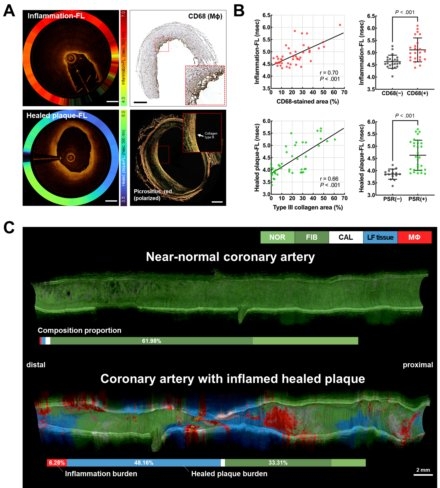
Abstract Body (Do not enter title and authors here): Introduction: Fluorescence lifetime imaging (FLIm) integrated with optical coherence tomography (OCT) enables compositional assessment of atherosclerotic plaques. However, the lack of histopathological validation for complex multi-channel FLIm signals limits their clinical applicability. We hypothesized that a deep learning based OCT-FLIm imaging of fresh human coronary specimens could accurately and quantitatively derive composition-specific fluorescence lifetime profiles.

Method and results: In 24 vessels from eight explanted human transplanted hearts from donors with coronary artery disease, OCT-FLIm imaging was performed. Regions of interest (ROIs) were ink-marked and prepared as 5 µm-thick paraffin sections. Ground-truth labels were established through immunohistochemical (IHC) staining using composition-specific markers. OCT images were used to guide pixel-level co-registration between FLIm signals and histological sections. Within each ROI, averaged fluorescence lifetime values were compared with corresponding IHC results, revealing significant associations between lifetime profiles and key plaque compositions (macrophages, loose fibrous tissue, lipid, and calcifications, p < 0.01). Quantitative analysis using IHC staining intensity demonstrated a strong linear relationship with the corresponding fluorescence lifetime values (r > 0.8). The validated associations were used to train a deep learning model for quantitative compositional analysis of OCT-FLIm images. The model was validated on independent coronary samples, demonstrating over 90% classification accuracy across all plaque compositions. Quantitative predictions closely matched IHC-based compositional measurements, with correlation coefficients of >0.8 for each tissue type.

Conclusion: OCT-FLIm imaging with fresh coronary tissues validation enables precise mapping of fluorescence lifetime signatures across atherosclerotic plaque key compositions. The strong correlation between FLIm signals and quantitative IHC measurements, together with the high accuracy achieved by the trained deep learning model, establishes a robust foundation for AI-driven plaque characterization and supports the clinical translation of OCT-FLIm multi-modal imaging for accurate, component-resolved assessment and personalized management of coronary artery disease.
  • Kim, Jin Hyuk  ( Korea University Guro Hospital , Seoul , Korea (the Republic of) )
  • Nam, Hyeong Soo  ( KAIST , Daejeon , Korea (the Republic of) )
  • Kang, Dong Oh  ( Korea University Guro Hospital , Seoul , Korea (the Republic of) )
  • Kim, Ryeong Hyun  ( Korea University Guro Hospital , Seoul , Korea (the Republic of) )
  • Shin, Seung Ho  ( Korea University Guro Hospital , Seoul , Korea (the Republic of) )
  • Kim, Hyun Jung  ( Korea University Guro Hospital , Seoul , Korea (the Republic of) )
  • Park, Ye Hee  ( Korea University Guro Hospital , Seoul , Korea (the Republic of) )
  • Yoo, Hongki  ( KAIST , Daejeon , Korea (the Republic of) )
  • Kim, Jin Won  ( Korea University Guro Hospital , Seoul , Korea (the Republic of) )
  • Author Disclosures:
    Jin Hyuk Kim: DO NOT have relevant financial relationships | Hyeong Soo Nam: No Answer | Dong Oh Kang: DO NOT have relevant financial relationships | Ryeong Hyun Kim: No Answer | Seung Ho Shin: DO NOT have relevant financial relationships | Hyun Jung Kim: DO NOT have relevant financial relationships | Ye Hee Park: No Answer | Hongki Yoo: DO have relevant financial relationships ; Individual Stocks/Stock Options:Dotter:Active (exists now) | Jin Won Kim: No Answer
Meeting Info:

Scientific Sessions 2025

2025

New Orleans, Louisiana

Session Info:

Novel Molecular Drivers of Coronary Circulation and Cardiometabolic Disease

Monday, 11/10/2025 , 10:30AM - 11:30AM

Abstract Poster Board Session

More abstracts on this topic:
β1-adrenergic autoantibodies (β1-AA) augment macropinocytosis in CD4+ T cells, leading to the expansion of CD4+CD28 T cell subsets in heart failure.

Sun Fei, Yao Junyan, Li Bingjie, Zhang Suli, Liu Huirong

Artificial Intelligence-Based Coronary Artery Calcium (AI-CAC) Score Empowers the “Power of Zero”: An AI-CVD Study within the Multi-Ethnic Study of Atherosclerosis (MESA)

Naghavi Morteza, Vliegenthart Rozemarijn, Nasir Khurram, Narula Jagat, Benjamin Emelia, Levy Daniel, Henschke Claudia, Yankelevitz David, Wong Nathan, Atlas Kyle, Zhang Chenyu, Reeves Anthony, Atlas Thomas, Wasserthal Jakob, Mcconnell Mike, Maron David, Williams Kim

More abstracts from these authors:
Macrophage-Targeted Theranostic Photoactivation Drives Inflammation Resolution and Stabilization of Atherosclerotic Plaques through Autophagy, Efferocytosis, and TGF-β-mediated Fibrotic Replacement

Kim Jin Hyuk, Park Kyeongsoon, Kim Jin Won, Kim Yeon Hoon, Kim Hyun Jung, Kim Ryeong Hyun, Park Ye Hee, Nam Hyeong Soo, Shin Seung Ho, Kang Dong Oh, Yoo Hongki

Intravascular Theranostic Photoactivation Guided By OCT-NIRF Dual-Modal Imaging Facilitates Inflammation Resolution of High-Risk Plaque

Kim Jin Hyuk, Kim Jin Won, Kim Yeon Hoon, Kim Hyun Jung, Kim Ryeong Hyun, Park Ye Hee, Nam Hyeong Soo, Kang Dong Oh, Yoo Hongki, Park Kyeongsoon

You have to be authorized to contact abstract author. Please, Login
Not Available