The Effectiveness and Outcomes of Atrial Fibrillation Ablation versus Medical Therapy in Patients with LVEF >35%: A Systematic Review and Meta-Analysis
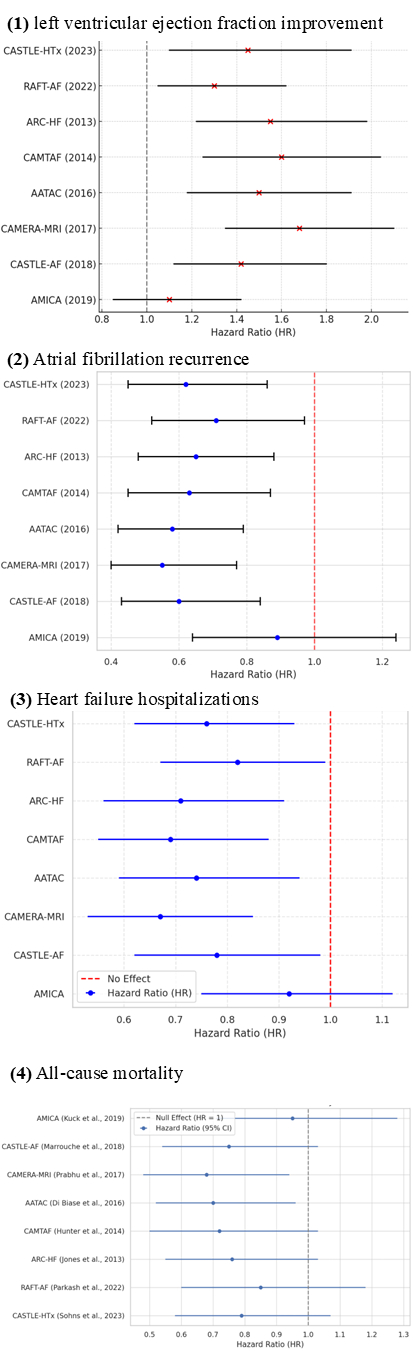
Abstract Body (Do not enter title and authors here): Background Atrial fibrillation (AF) ablation remains an essential therapeutic approach for patients who present with reduced left ventricular ejection fraction (LVEF); however, findings from patients with LVEF levels higher than 35% fail to match the certainty of earlier-stage results. This meta-analysis compared the effectiveness of catheter ablation versus medical therapy in patients with LVEF >35%. Methods We searched Cochrane Library, PubMed, and Embase up to March 2025 for randomized controlled trials (RCTs) comparing catheter ablation versus medical therapy in patients with LVEF >35%. Our outcomes included LVEF improvement, AF recurrence, hospitalization rates, and all-cause mortality. The Cochrane risk of bias tool (ROB2) was used for quality assessment. Statistical analyses included pooled effect size estimation, heterogeneity assessment using the I-squared statistic, and publication bias evaluation via funnel plots. Results Our analysis included eight RCTs published between 2012 and 2025 that enrolled 1,481 patients (745 ablation recipients and 736 individuals who received medical therapy). Patients participating in catheter ablation studies demonstrated a significant mean LVEF improvement of 8.2% (95% CI: 6.5–9.8, p < 0.001) compared to medical therapy. Additionally, the procedure reduced AF recurrence rates (HR: 0.62, 95% CI: 0.45–0.86, p = 0.005) and decreased the need for heart failure hospitalizations (HR: 0.67, 95% CI: 0.53–0.85, p = 0.002). Some studies displayed trends for reduced mortality rates, but the findings were inconsistent (HR: 0.79, 95% CI: 0.58–1.07, p = 0.11). The I-squared heterogeneity statistic reached 42.3%, which indicated moderate variability among the studies. The results from a funnel plot assessment indicated minimal publication bias, and sensitivity tests validated the reliability of overall study outcomes. Conclusion Patients with LVEF higher than 35% who received catheter ablation demonstrated better LVEF results and a lower incidence of AF recurrence, compared to the medical therapy group. Our findings demonstrated that heart failure treatment decisions should adopt a stratified strategy that uses LVEF class to make optimal clinical choices for patients with AF.
Inga, Evelyn
(
The University of New Mexico
, Albuquerque , New Mexico , United States )
Walsh, Kenneth
(
MercyOne Heart Institute
, Mason City , Iowa , United States )
Author Disclosures:
Evelyn Inga:DO NOT have relevant financial relationships
| Kenneth Walsh:No Answer