Tirzepatide Achieves Greater Weight and Blood Pressure Reduction Than Semaglutide in Routine Clinical Practice
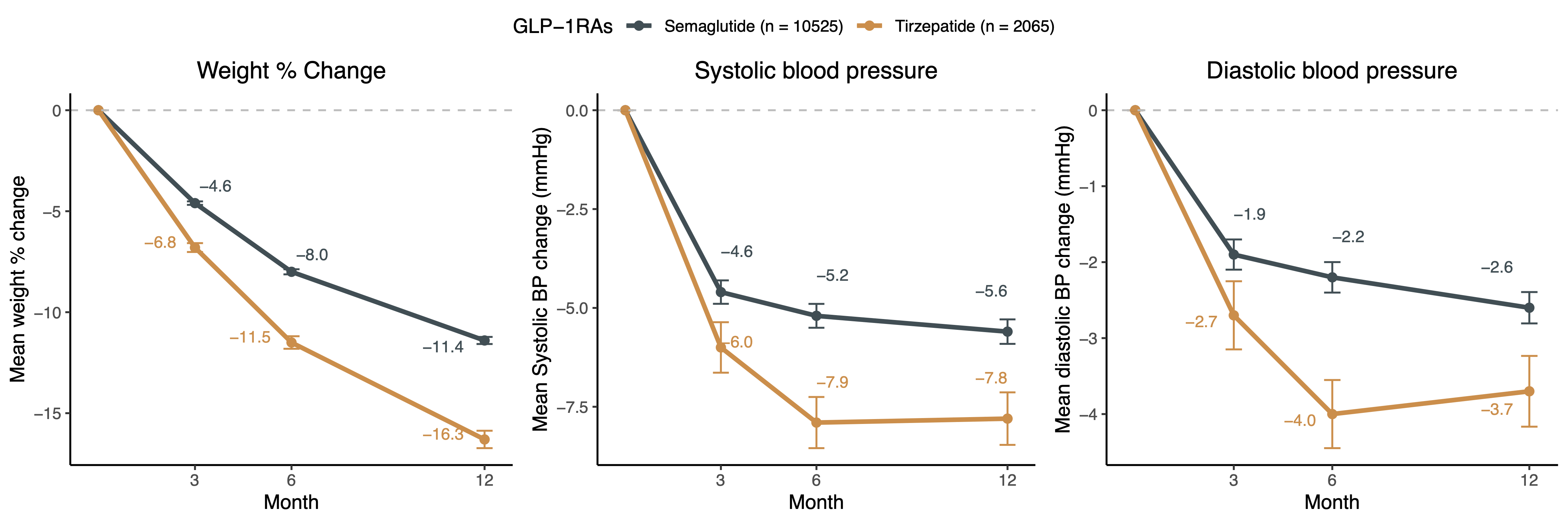
Abstract Body (Do not enter title and authors here): Introduction Although trials like SURMOUNT-5 demonstrated tirzepatide’s superiority over semaglutide in patients with obesity, real-world practice includes broader populations and varied use patterns. This study assesses the comparative effectiveness of the two agents on weight and blood pressure in routine clinical care. Methods We conducted a retrospective cohort study using the Epic Cosmos EHR database covering 300 million patients in the U.S. Adults (≥18 years) with obesity (BMI ≥30 kg/m2) or overweight (BMI ≥27 kg/m2) and at least one obesity-related or cardiovascular comorbidity were included if they initiated injectable semaglutide or tirzepatide between June 2021 and April 2025. Patients with type 2 diabetes were excluded. Eligible patients had baseline weight and BP measurements within 90 days before treatment and follow-up at 3, 6, and 12 months. Only patients with treatment persistence for at least 12 months were included, considering treatment changes and discontinuations. Primary outcomes were percent change in weight and absolute changes in systolic and diastolic BP over 12 months. A subgroup analysis was conducted among patients with hypertension. Results A total of 12,590 patients were included, with 10,525 receiving semaglutide and 2,065 receiving tirzepatide. The mean (SD) ages were 51.0 (12.7) and 51.7 (12.3) years, and the proportion of female patients was 8,441 (80.2%) and 1,604 (77.7%) in the semaglutide and tirzepatide groups, respectively. Baseline characteristics were similar: BMI 39.8 (7.7) vs. 39.7 (7.8) kg/m2, SBP 127.9 (14.6) vs. 128.3 (14.3) mmHg, DBP 79.3 (9.3) vs. 79.8 (9.3) mmHg. Comorbid hypertension was present in 5,824 (55.3%) and 1,101 (53.3%). At 12 months, tirzepatide showed greater reductions in weight (–16.3% [95% CI, –16.7 to –15.9] vs. –11.4% [–11.6 to –11.2]), SBP (–7.8 [–8.4 to –7.1] vs. –5.6 mmHg [–5.9 to –5.3]), and DBP (–3.7 [–4.2 to –3.2] vs. –2.6 mmHg [–2.8 to –2.4]) than semaglutide (Figure 1). Among patients with hypertension, mean SBP reductions were –9.1 (–9.9 to –8.3) mmHg with tirzepatide and –7.0 (–7.4 to –6.6) mmHg with semaglutide. Conclusion In this large real-world study of patients without diabetes, tirzepatide led to substantially greater weight and blood pressure reductions than semaglutide, reinforcing and extending trial findings to routine clinical practice and highlighting its potential for risk reduction.
Kim, Chungsoo
(
Yale University
, New Haven , Connecticut , United States )
Jastreboff, Ania
(
Yale School of Medicine
, New Haven , Connecticut , United States )
Krumholz, Harlan
(
Yale University
, New Haven , Connecticut , United States )
Lu, Yuan
(
Yale University
, New Haven , Connecticut , United States )
Author Disclosures:
Chungsoo Kim:DO NOT have relevant financial relationships
| Ania Jastreboff:No Answer
| Harlan Krumholz:No Answer
| Yuan Lu:DO NOT have relevant financial relationships