
Assessing medical resident knowledge of isometric handgrip training for hypertension control before and after review of a brief medical education packet
Abstract Body: Introduction: Isometric handgrip training (IHT) is a simple and time efficient blood pressure (BP)-lowering intervention endorsed in AHA/ACC clinical practice guidelines for HTN management, yet is not routinely prescribed. Understanding knowledge of IHT and the potential concerns for its implementation as a HTN management strategy will inform future strategies for physician uptake.
Hypothesis: We hypothesized that a brief medical education packet administered to internal medicine residents would improve knowledge and likelihood of recommending IHT as a BP-lowering tool.
Methods: An electronic Google Forms survey was distributed to internal medicine residents (PGY-1 to PGY-4, N=182) at a single academic institution. The anonymous survey consisted of 10 questions designed to assess residents’ knowledge of and willingness to implement IHT in clinical practice before and after the brief educational intervention. Implementation concerns were also recorded. The study was deemed exempt by the Institutional Review Board.
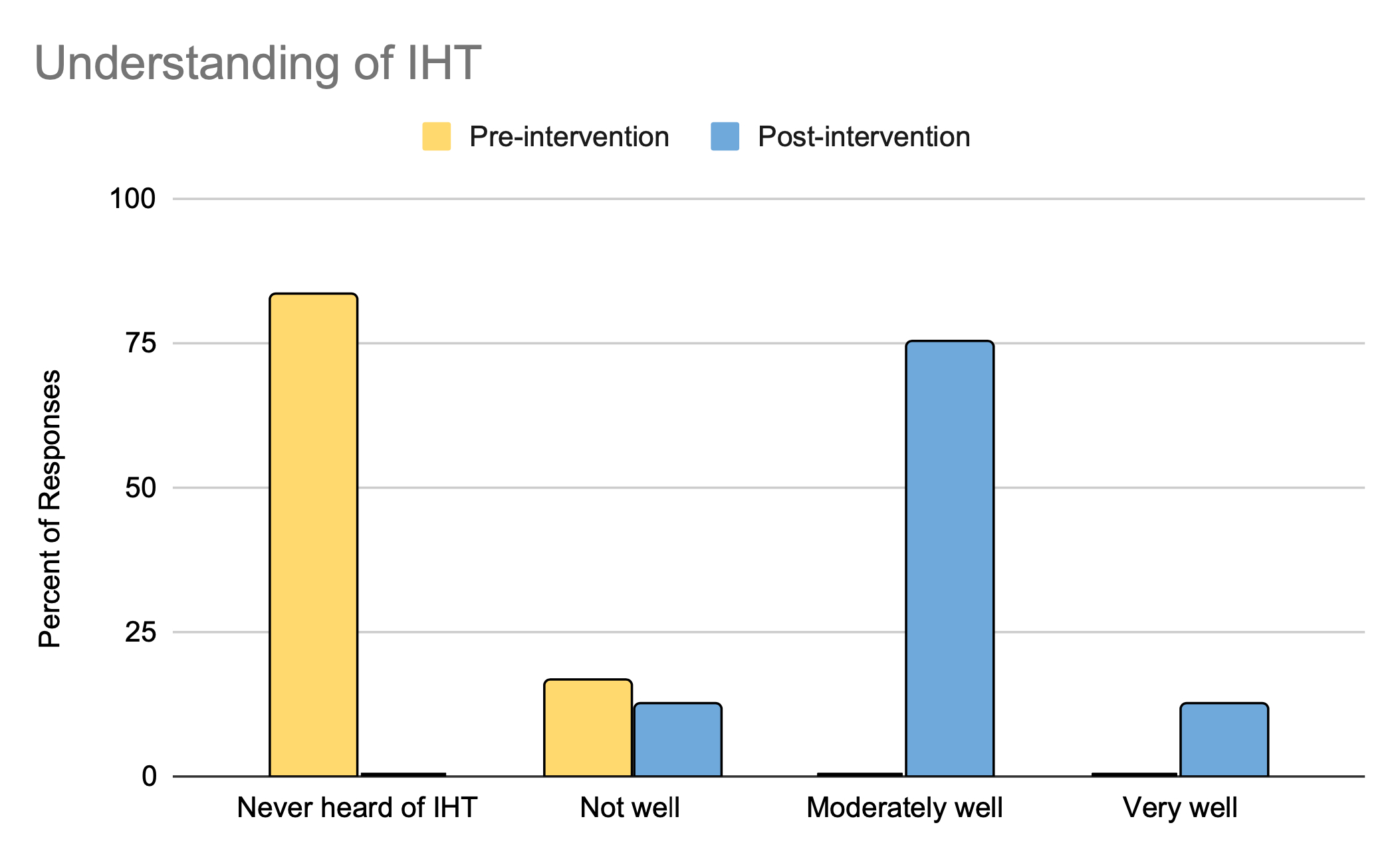
Results: Twenty-four residents (41.7% PGY-3) completed the survey. Of respondents, the top planned specialties were cardiology (25%) and primary care (16.7%). Before the educational intervention, respondents had never heard of IHT (83.3%) or did not understand the technique well (16.7 %). After a brief educational intervention, 75% of residents understood the technique moderately well and 70.8% were moderately likely to recommend this practice to patients [Figures 1, 2]. The majority of participants (66.8%) cited issues obtaining the equipment as a concern for suggesting the technique to patients.
Conclusions: As a first step in understanding the potential role of IHT as a BP-lowering tool in standard care HTN management, it is imperative to first understand the current state of provider knowledge. Enhancing this knowledge may lead to wider implementation of IHT in clinical practice and potentially improve patient outcomes in the future.
Wang, Jici
( University of Michigan
, Ann Arbor
, Michigan
, United States
)
Brush, Cayla
( University of Windsor
, Windsor
, Ontario
, Canada
)
Bisognano, John
( University of Michigan
, Ann Arbor
, Michigan
, United States
)
Mcgowan, Cheri
( University of Windsor
, Windsor
, Ontario
, Canada
)
Author Disclosures:
JiCi Wang:DO NOT have relevant financial relationships
| Cayla Brush:DO NOT have relevant financial relationships
| John Bisognano:DO NOT have relevant financial relationships
| Cheri McGowan:DO NOT have relevant financial relationships