
Logo

American Heart Association

  17
  0


Final ID: MP1572

Successful Mapping and Ablation of Incessant Ventricular Fibrillation on Mechanical Circulatory Support.

Abstract Body (Do not enter title and authors here): Background/Introduction: Ventricular fibrillation (VF) storm represents a life-threatening emergency with high mortality. When VF becomes incessant and refractory to antiarrhythmic therapy, catheter ablation is not usually considered. We present a case of successful VF ablation in a patient with incessant, refractory VF requiring mechanical circulatory support.
Objective: To report a successful catheter ablation of incessant VF in a patient with ischemic cardiomyopathy on mechanical circulatory support.
Methods: N/A
Results: A 77-year-old male with ischemic cardiomyopathy (LVEF 35%), multivessel CAD status post PCI, severe aortic stenosis status post TAVR, and prior out-of-hospital cardiac arrest with ICD implantation, presented with VF storm despite amiodarone and lidocaine infusions. Despite deep sedation, intubation, stellate ganglion block, and maximal antiarrhythmic therapy, he developed incessant VF with hemodynamic collapse, requiring emergent VA ECMO. Post-ECMO, VF became incessant over three consecutive days, and unresponsive to defibrillation.
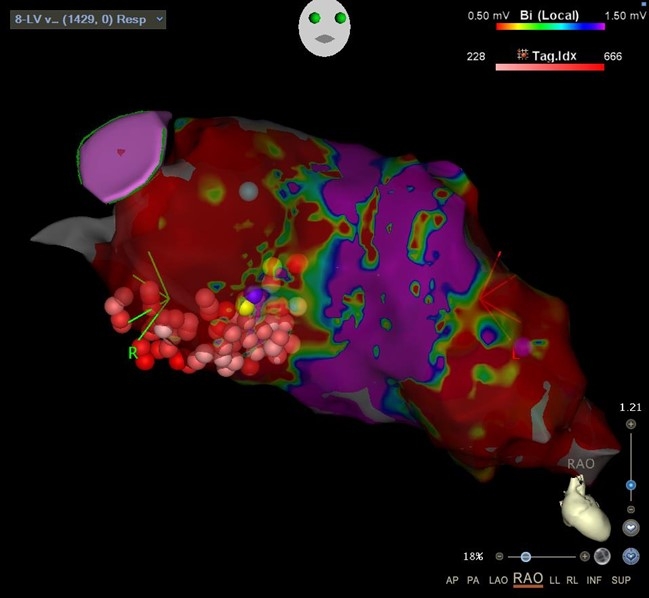
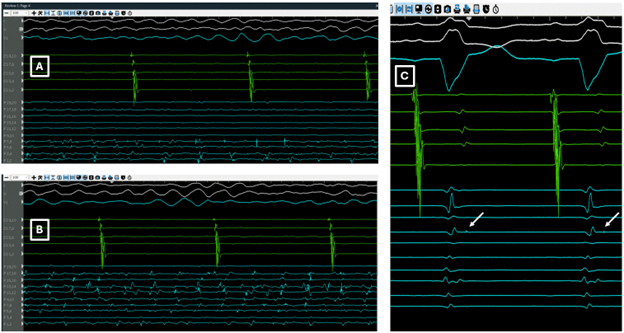
VF catheter ablation was performed while on VA ECMO support. Since the patient could not be defibrillated successfully, we decided to map the left ventricle during ongoing VF. We targeted the posterior and mid fascicular area based on high frequency fascicular signals on the border of a basal septal scar using 40-watt lesions for 30 seconds (Images 1 and 2). Following septal “defasciculation”, a single defibrillation at 360 joules successfully converted the patient to atrial-paced, ventricular-sensed rhythm. The QRS duration increased from 108 ms to 156 ms, which recovered the next day. For the first time in three days, the patient remained VF-free. Post-ablation, there was immediate hemodynamic improvement with reduced vasopressor requirements. The patient was decannulated after 48 hours and the antiarrhythmic therapy was rapidly de-escalated. He was discharged home on low dose amiodarone and in normal sinus rhythm.
Conclusion: This case demonstrates that targeted catheter ablation can successfully terminate incessant VF refractory to medical and adrenergic suppressive therapies by defasciculation of the septal scar and targeting very high frequency fascicular signals. VA ECMO provided essential circulatory support enabling precise ablation during VF. This potentially expands the role of catheter ablation as a life-saving intervention for incessant refractory VF.
  • Reyes, Jorge  ( University of Minnesota , Minneapolis , Minnesota , United States )
  • Benditt, David  ( University of Minnesota , Minneapolis , Minnesota , United States )
  • Von Wald, Lisa  ( University of Minnesota , Minneapolis , Minnesota , United States )
  • Yannopoulos, Demetris  ( UNIVERSITY OF MINNESOTA , Minneapolis , Minnesota , United States )
  • Roukoz, Henri  ( University of Minnesota , Minneapolis , Minnesota , United States )
  • Author Disclosures:
    Jorge Reyes: DO NOT have relevant financial relationships | David Benditt: DO NOT have relevant financial relationships | Lisa Von Wald: No Answer | Demetris Yannopoulos: DO NOT have relevant financial relationships | Henri Roukoz: DO have relevant financial relationships ; Research Funding (PI or named investigator):Medtronic:Active (exists now)
Meeting Info:

Scientific Sessions 2025

2025

New Orleans, Louisiana

Session Info:

Advances in VT: Cutting-Edge Therapies, Techniques, and Risk Management

Sunday, 11/09/2025 , 11:50AM - 01:05PM

Moderated Digital Poster Session

More abstracts on this topic:
Associations of Long-Chain and Very-Long-Chain Saturated Fatty Acids with Outcomes of Sudden Cardiac Arrest

Li Jason, Brody Jennifer, Wiggins Kerri, Swenson Brenton, Jensen Paul, Bockus Lee, Lemaitre Rozenn, Sootedehnia Nona

Characteristics and in-hospital outcomes of Illicit drug users in the FRENCHIE acute coronary syndrome cohort

Boccara Franck, Cayla Guillaume, Angoulvant Denis, Coste Pierre, Lemesle Gilles, Simon Tabassome, Danchin Nicolas, Bouleti Claire, Steg Philippe, Rousseau Alexandra, Lebal Soufiane, Henry Patrick, Pezel Theo, Dillinger Jean Guillaume, Cottin Yves

More abstracts from these authors:
You have to be authorized to contact abstract author. Please, Login
Not Available