Omega-3 Fatty Acid Supplementation in Patients with Prior Myocardial Infarction Receiving Statin Therapy: A Systematic Review and Meta-Analysis of Randomized Controlled Trials.
Abstract Body (Do not enter title and authors here): Background: The role of omega-3 fatty acids (O3-FAs) in secondary prevention following myocardial infarction (MI) remains uncertain in the era of high-intensity statin therapy, as recent randomized controlled trials (RCTs) evaluating eicosapentaenoic acid (EPA) or combined EPA and docosahexaenoic acid (DHA) have yielded conflicting results.
Methods: We systematically searched PubMed, Embase, and Cochrane Central for RCTs published from 2005 to May 2025, including patients with prior MI on guideline-directed statin therapy, comparing O3FAs (EPA, DHA, or both) supplementation to placebo or usual care reporting relevant outcomes. Hazard ratios (HRs) with 95% confidence intervals (CIs) were pooled using a random-effects model in Review Manager 9.3. We performed a subgroup analysis differentiating purified EPA studies from those with EPA/DHA combinations.
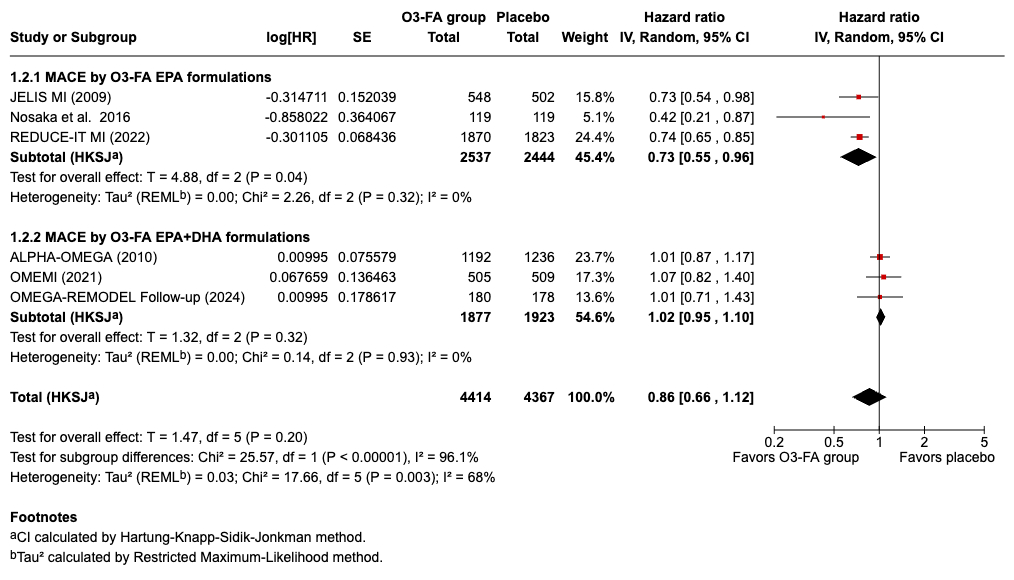
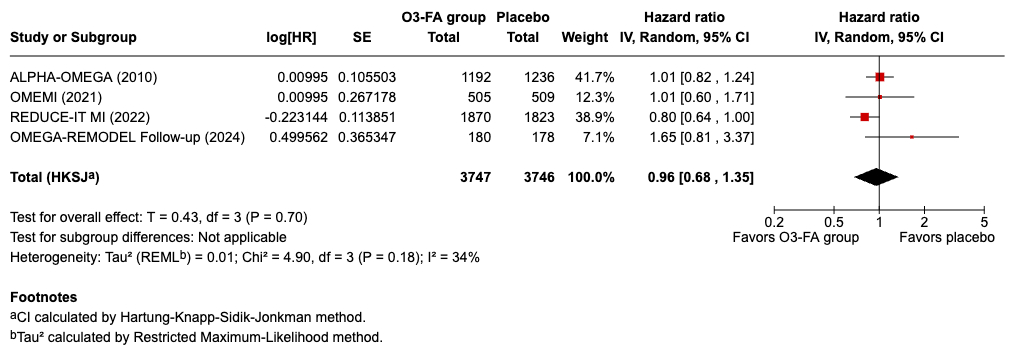
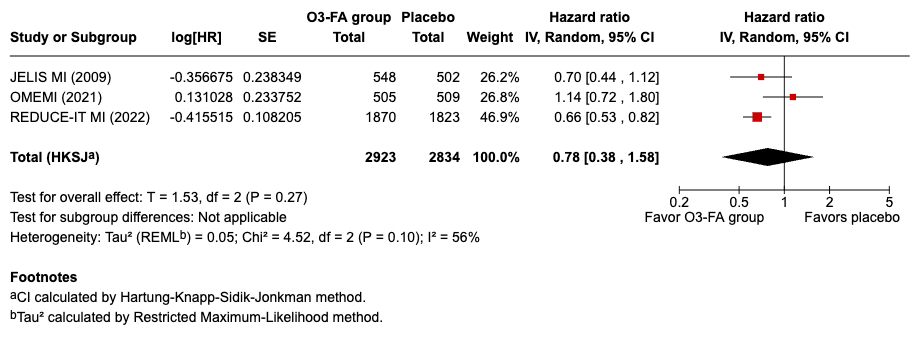
Results: Our meta-analysis included seven randomized controlled trials, comprising a total of 12,612 patients, of whom 50% received O3-FAs. Mean age was 66 years, with 74% being male, and the mean follow-up was 3.34 years. No significant difference was observed in major adverse cardiovascular events [MACE] (HR: 0.86, 95% CI: 0.66–1.12, p = 0.20), all-cause mortality (HR: 0.96, 95% CI: 0.68–1.35, p = 0.70), or recurrent MI (HR: 0.78, 95% CI: 0.38–1.58, p = 0.27) between groups. However, subgroup analysis revealed that purified EPA supplementation significantly reduced MACE (HR: 0.73, 95% CI: 0.55–0.96, p < 0.01).
Conclusions: Among patients with prior MI on statin therapy, supplementation with purified EPA significantly reduces major adverse cardiovascular events, while combined EPA and DHA formulations show no significant benefit. These findings support the use of purified EPA for secondary prevention following myocardial infarctions.
Ekhator, Nehikhare
(
UC Davis Health
, Sacramento , California , United States )
Souza, Carolina
(
Hospital Geral Roberto Santos
, Salvador , Bahia , Brazil )
Pinilla, Juan
(
CES University
, Medellin , Colombia )
Author Disclosures:
Nehikhare Ekhator:DO NOT have relevant financial relationships
| Carolina Souza:No Answer
| Juan Pinilla:DO NOT have relevant financial relationships