Scientific Sessions 2025
/
PAD Medical Therapies
/
Racial, Gender, and Regional Disparities in Peripheral Arterial Disease–Related Mortality Among Hypertensive Adults in the United States: A 1999–2020 CDC WONDER Analysis
American Heart Association
130
0
Final ID: Sa3145
Racial, Gender, and Regional Disparities in Peripheral Arterial Disease–Related Mortality Among Hypertensive Adults in the United States: A 1999–2020 CDC WONDER Analysis
Abstract Body (Do not enter title and authors here): Introduction Peripheral Arterial Disease (PAD) is a prevalent condition associated with considerable morbidity and mortality, a burden that is further intensified by the frequent co-occurrence of hypertension. The coexistence of these conditions not only amplifies cardiovascular risks but also complicates clinical management, thereby contributing to elevated mortality rates. Although their correlation is well understood, mortality trends in United States have not been studied.
Methods This study utilized International Classification of Diseases, 10th Revision (ICD-10) codes to extract age-adjusted mortality data for individuals with PAD and hypertension from the CDC WONDER (Center for Disease Control and Prevention Wide-Ranging Online Data for Epidemiologic Research) cohort. The overall sample and subgroups defined by demographics (age, sex, race/ethnicity) and region (state, census and urban-rural status) were analyzed. Trends in mortality were quantified by computing associated annual percentage changes (APC) using Joinpoint Regression Program Version 4.9.0.0 trend analysis software.
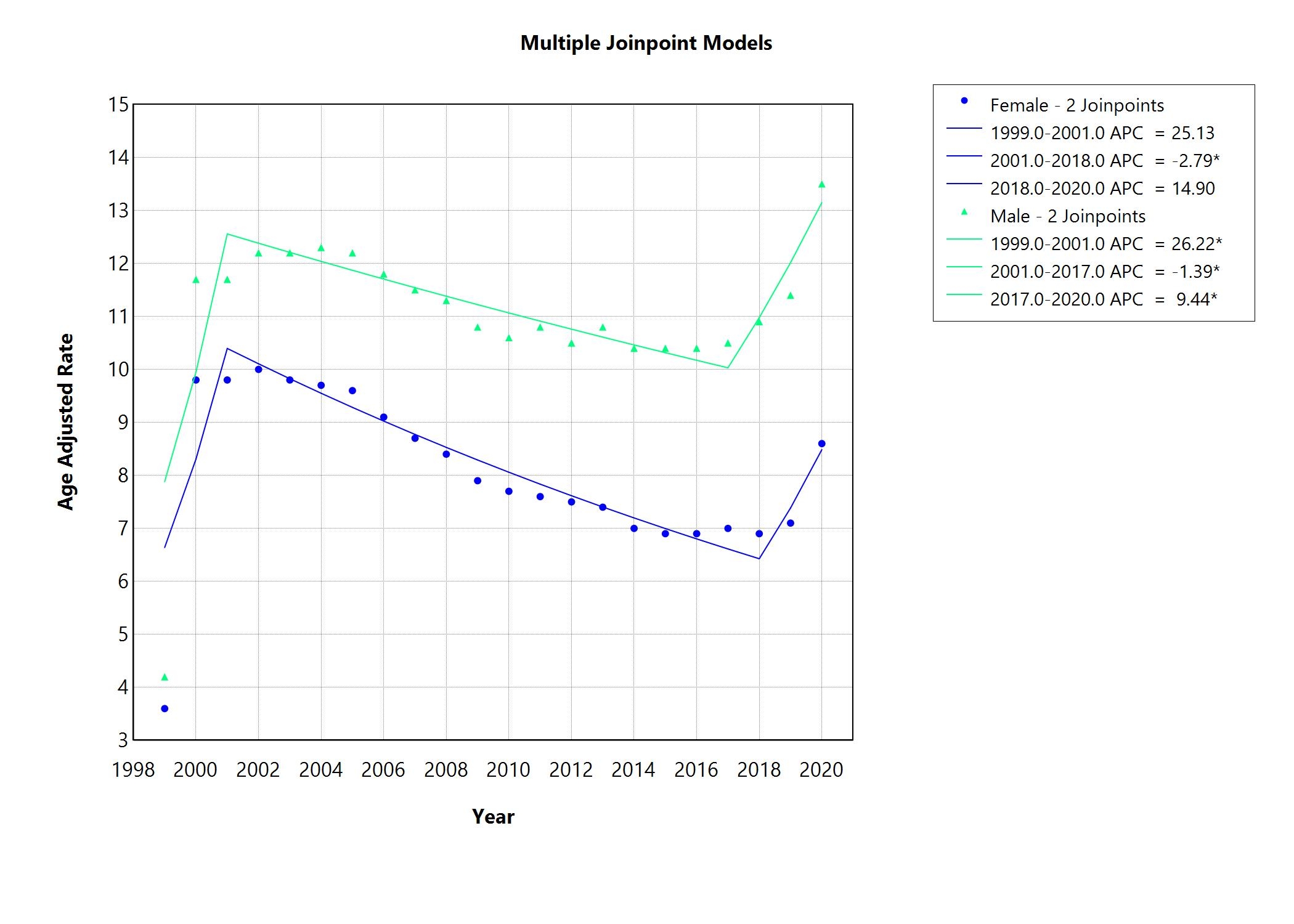
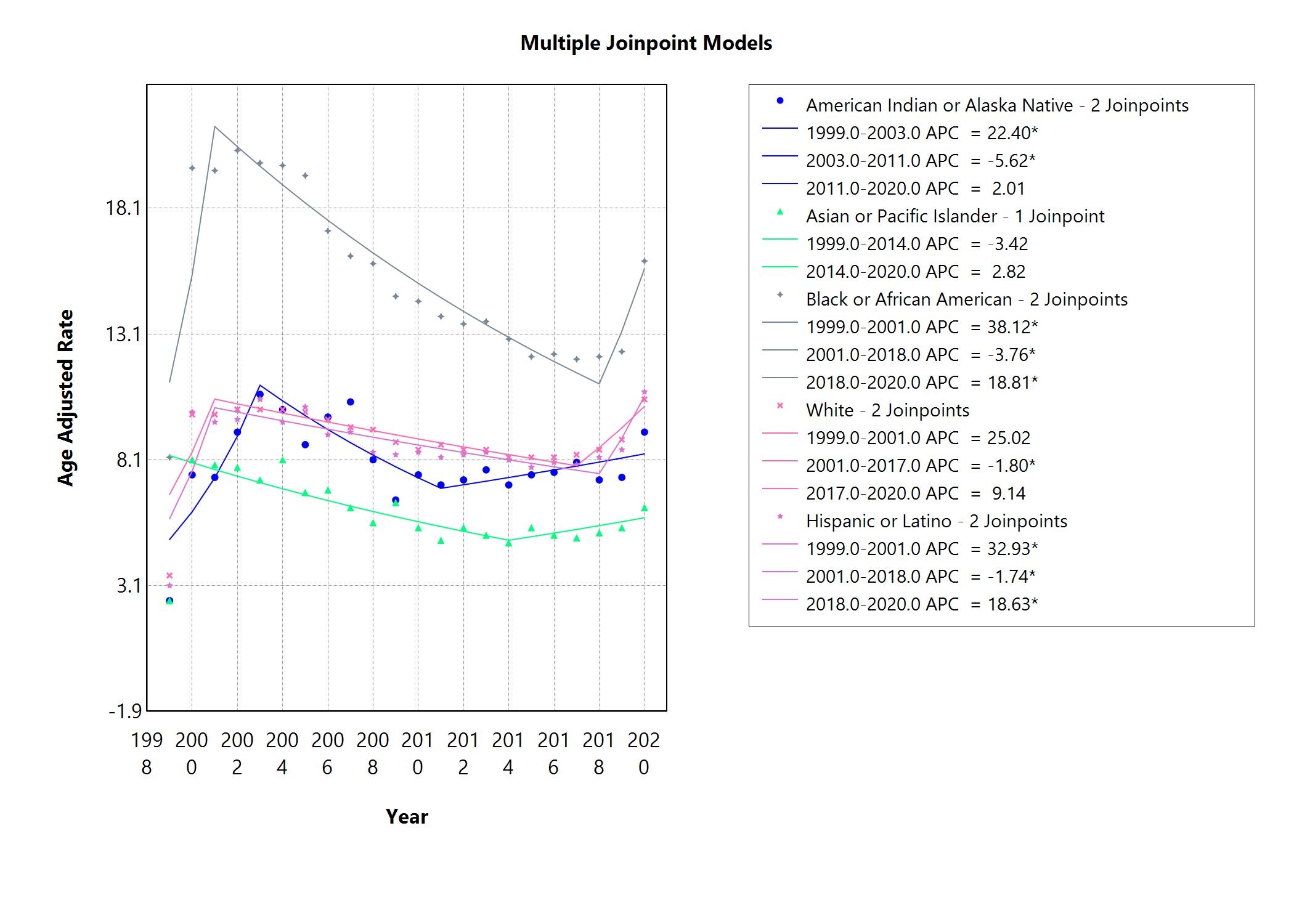
Results A total of 540954 deaths were observed, of which 260517 were men (48.2%). Overall, the age-adjusted mortality rates (AAMR) exhibited a sharp increase from 1999 to 2001 (APC:25.3; 95% CI: -0.36,56.2), followed by a sustained decrease until 2017 (APC: -2.16; 95% CI: -11.1, -1.52), after which a notable upward trend was observed (APC:9.38; 95% CI: -0.38,24.1). A similar AAMR trend was seen on gender-based subgroup analysis with male patients showing the highest AAMR 13.5 (95% CI: 13.1,13.7) in 2020. Amongst all racial groups, Black or African American showed the highest 14.9 (95% CI: 14.8-15) while Asian or Pacific Islander showed the lowest 5.8 (95% CI: 5.7-5.9) AAMR over 2 decades. The West region had the highest overall age-adjusted mortality rate (AAMR) of 10.2 (95% CI: 10.2-10.3). Among individual states, Vermont displayed the highest AAMR, reaching 15.8 (95% CI: 15.1-16.5).
Conclusion Healthcare disparities are evident. The unprecedented recent increase in mortality rates, following years of successful decline, necessitates a thorough evaluation of healthcare policies and PAD treatment advancements to identify the causative factors behind this trend reversal.
Ijaz, Muhammad Tayyab
(
MD Health Clinic
, Lahore , Pakistan )
Ubaid, Muhammad Furqan
(
Yale University
, New Haven , Connecticut , United States )
Asif, Anim
(
Harlem Hospital Center
, NYC , New York , United States )
Mukhtar, Haseeb
(
Mayo Clinic
, Rochester , Minnesota , United States )
Ijaz, Namra
(
FMH College of Medicine & Dentistry
, Lahore , Pakistan )
Haider, Zaroon
(
CMH Lahore Medical and Dental College
, Lahore , Pakistan )
Khan, Sher
(
Flushing Hospital Medical Center
, New York City , New York , United States )
Altin, Elissa
(
Yale University
, New Haven , Connecticut , United States )
Author Disclosures:
Muhammad Tayyab Ijaz:DO NOT have relevant financial relationships
| Muhammad Furqan Ubaid:No Answer
| Anim Asif:DO NOT have relevant financial relationships
| Haseeb Mukhtar:No Answer
| Namra Ijaz:DO NOT have relevant financial relationships
| Zaroon Haider:DO NOT have relevant financial relationships
| Sher Khan:No Answer
| Elissa Altin:No Answer