Temporal Trends of Contributing Cardiovascular Mechanisms of Mortality in Patients with Atrial Fibrillation Stratified by Age and Sex
Abstract Body (Do not enter title and authors here): Background Atrial Fibrillation (AF) is a significant cause of cardiovascular morbidity and mortality risk. Age is a powerful predictor of adverse outcomes in patients with AF. In the United States, the burden of AF is disproportionately borne by men until the age of 75, after which it shifts to being more prevalent among women. Our objective was to understand the influence of sex on cardiovascular contributors to mortality in patients with AF stratified by age over 2 decades.
Methods We analyzed the earliest and latest available data using national death certificates from the Centers for Disease Control Wide Ranging Online Data for Epidemiologic Research (CDC WONDER) from 1999 to 2023 with AF listed as the primary or contributing cause of death and one of 4 subconditions (dementia, heart failure [HF], myocardial infarction, and stroke). Using demographic information included in death certificates, we aimed to stratify trends in age and sex as it relates to AF and these subconditions. Confidence intervals were supplied by CDC WONDER database directly or calculated according to CDC supplemental information.
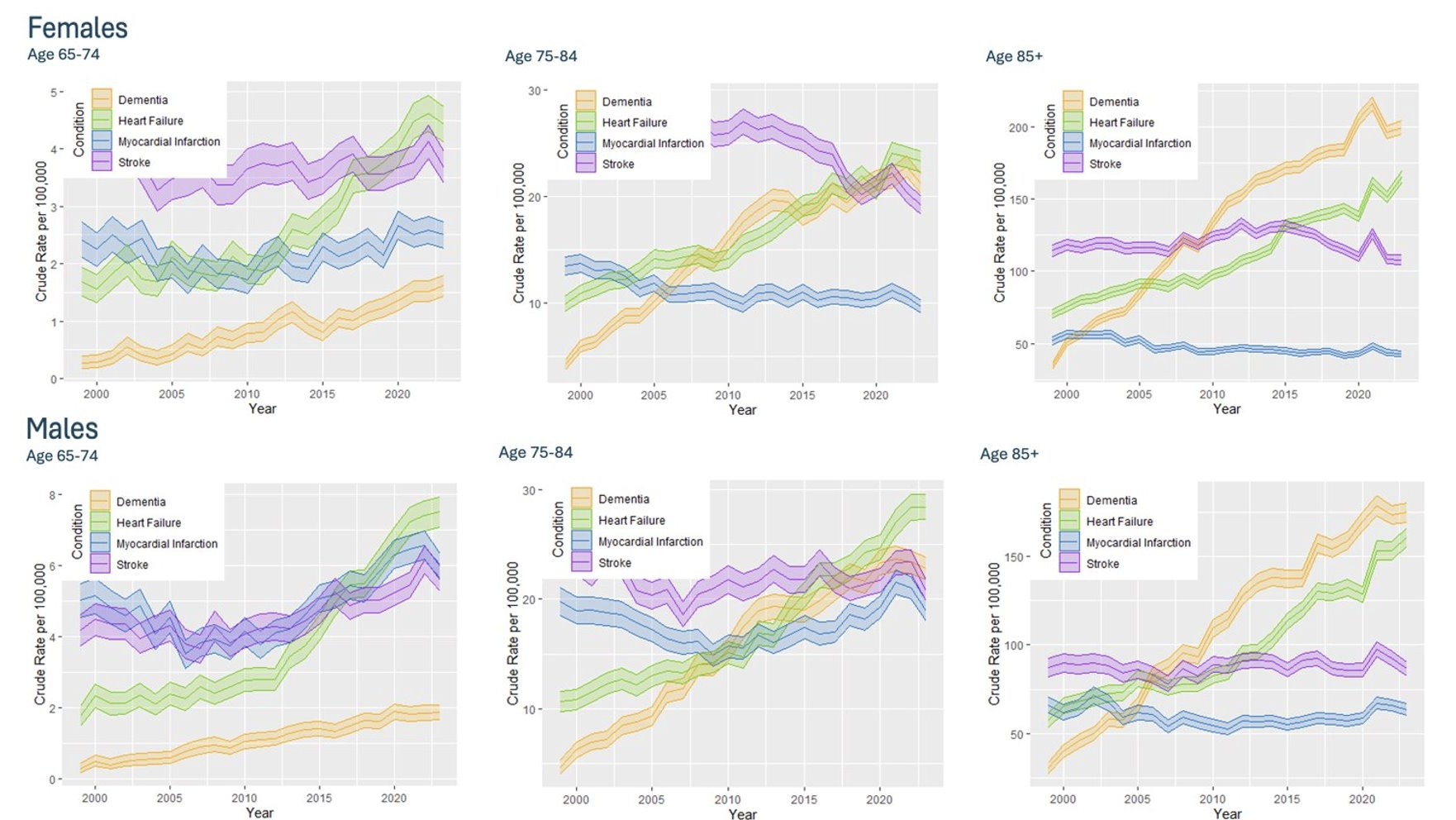
Results A total of 3,272,015 patients were identified with AF as a primary or secondary contributing cause of death denoted as total mortality (461,321 deaths had AF as the primary cause of death). In women with AF, HF and dementia are contributors to mortality and are increasing in all age groups, despite lower contributions of stroke and myocardial infarction (Figure). In women >75 years, the incidence of stroke has decreased and been increasingly replaced by HF and dementia as leading contributors. In contrast, stroke remains a more common contributor in men until they exceed 85 years of age, at which point the trends align with those observed in women. In younger men (<75), HF, myocardial infarction, stroke, and dementia are all modestly increasing as contributors to mortality.
Conclusion As individuals age, notable sex-based differences emerge in the cardiovascular factors contributing to mortality with AF. There are opportunities to enhance outcomes in women through targeted therapies aimed at reducing the risks of dementia and HF as they age. In younger men, early intervention to lower various cardiovascular risks may improve health outcomes, with continued efforts in later years focused on mitigating the risks of dementia and HF.
Goodwin, Ashley
(
University of Utah
, Salt Lake City , Utah , United States )
Dickey, Jacqueline
(
University of Utah
, Salt Lake City , Utah , United States )
Endo, Bobby
(
University of Utah
, Salt Lake City , Utah , United States )
Chen, Arthur
(
University of Utah
, Salt Lake City , Utah , United States )
Engels, Marc
(
University of Utah
, Salt Lake City , Utah , United States )
Konstantinidis, Klitos
(
University of Utah
, Salt Lake City , Utah , United States )
Lehmann, H. Immo
(
University of Utah
, Salt Lake City , Utah , United States )
Packer, Douglas
(
Intermountain Health
, Highland , Utah , United States )
Ranjan, Ravi
(
University of Utah
, Salt Lake City , Utah , United States )
Steinberg, Benjamin
(
Denver Health Medical Center
, Denver , Colorado , United States )
Bunch, Thomas
(
University of Utah
, Salt Lake City , Utah , United States )
Author Disclosures:
Ashley Goodwin:DO NOT have relevant financial relationships
| Benjamin Steinberg:DO NOT have relevant financial relationships
| Thomas Bunch:DO NOT have relevant financial relationships
| Jacqueline Dickey:DO NOT have relevant financial relationships
| Bobby Endo:No Answer
| Arthur Chen:DO NOT have relevant financial relationships
| Marc Engels:DO NOT have relevant financial relationships
| Klitos Konstantinidis:No Answer
| H. Immo Lehmann:No Answer
| Douglas Packer:DO have relevant financial relationships
;
Other (please indicate in the box next to the company name):COI will be uploaded to my account:Active (exists now)
| Ravi Ranjan:No Answer