V-REMi: A Novel Electro-Mechanical Index Highlights Trends Toward Superior Remodeling with Conduction System Pacing
Abstract Body (Do not enter title and authors here): Background: Cardiac resynchronization therapy (CRT) via conduction system pacing (CSP), particularly left bundle branch pacing (LBBP), offers a physiologic alternative to biventricular (BiV) pacing. However, comparative metrics for quantifying remodeling responses remain limited. We introduce the Ventricular Reverse Electro-Mechanical index (V-REMi) a novel composite score synthesizing changes in left ventricular ejection fraction (LVEF), QRS duration, and LV end-diastolic diameter (LVEDD) to assess global remodeling response to pacing strategies.
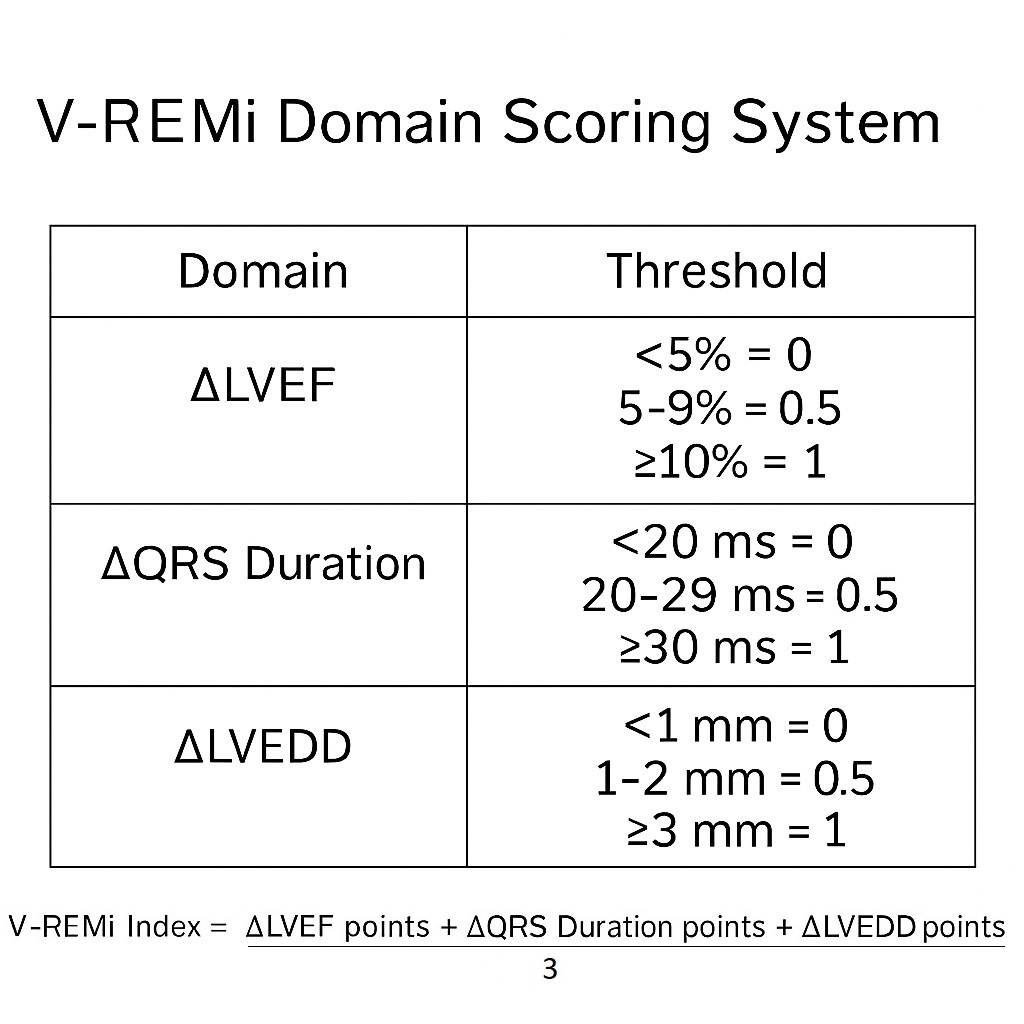
Methods: A PRISMA-guided meta-analysis of studies comparing LBBP versus BiV pacing was conducted via PubMed, Embase, and CENTRAL through March 2025. Inclusion required reporting ≥3 of the following outcomes: ΔLVEF, ΔQRS duration, ΔLVEDD. Statistical analysis included random-effects modeling, pooled mean differences, I2-based heterogeneity assessment, and predefined subgroup analyses by baseline LVEF, follow-up duration, QRS narrowing, and study design. The V-REMi index (range: 0–1) was derived from a tiered scoring system awarding points per domain (see image 1). The final score is the mean across domains.
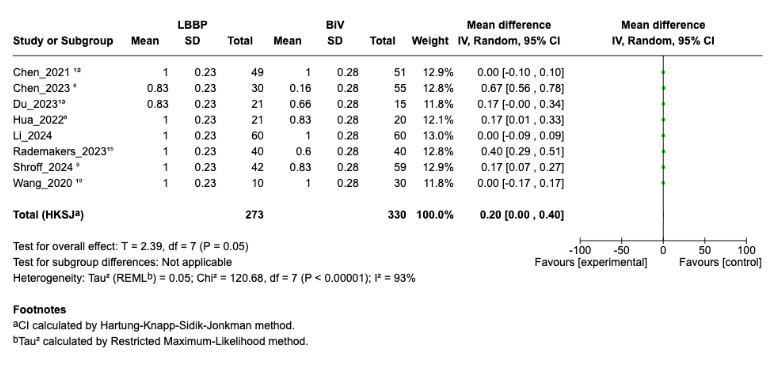
Results: Eight studies (n=603) qualified for analysis. Pooled results demonstrated significantly higher V-REMi scores with LBBP vs. BiV pacing (Mean Difference [MD] 0.20; 95% CI 0.00–0.40; p=0.05), though heterogeneity was high (I2=93%). Subgroup analysis favored LBBP in patients with LVEF ≥30% (MD 0.36), randomized designs (MD 0.23), and uniform QRS narrowing ≥30 ms. No significant effect was seen in observational cohorts. Conclusion: LBBP was associated with a superior electro-mechanical remodeling trend compared to BiV pacing, as captured by the V-REMi index. Despite high heterogeneity likely due to variable study design and imaging protocols, V-REMi consistently identified multidimensional CRT response. This index may serve as a useful surrogate endpoint in future CSP trials and guide therapy personalization.
Salguero, Douglas
(
Texas Tech University
, Lubbock , Texas , United States )
Tabowei, Godfrey
(
Texas Tech University
, Lubbock , Texas , United States )
Castillo Rodriguez, Cristian
(
Texas Tech University
, Lubbock , Texas , United States )
Thiravetyan, Ben
(
Texas Tech University
, Lubbock , Texas , United States )
Matute-martinez, Carlos
(
Texas Tech University
, Odessa , Texas , United States )
Whisenant, Ty
(
Texas Tech University
, Lubbock , Texas , United States )
Swaminath, Deephak
(
Texas Tech University
, Lubbock , Texas , United States )
Author Disclosures:
Douglas Salguero:DO NOT have relevant financial relationships
| Godfrey Tabowei:No Answer
| Cristian Castillo Rodriguez:DO NOT have relevant financial relationships
| Ben Thiravetyan:DO NOT have relevant financial relationships
| Carlos Matute-Martinez:DO NOT have relevant financial relationships
| Ty Whisenant:DO NOT have relevant financial relationships
| Deephak Swaminath:No Answer