Mutations in the C-terminal of the KCNJ2 gene increase the odds of sudden cardiac death in Andersen-Tawil Syndrome.
Abstract Body (Do not enter title and authors here): Background: Andersen-Tawil Syndrome (ATS) is an autosomal dominant disorder marked by dysmorphic features, periodic paralysis, and ventricular arrhythmias. While the overall risk of cardiac arrest in ATS patients is low, mutations in the C-terminal region of the KCNJ2 gene are linked to a higher risk of arrhythmias. This study aims to evaluate the significance of mutations in this region compared to others.
Methods: We conducted a meta-analysis by reviewing literature on KCNJ2-positive ATS cases and cohort studies from 1994 to 2025. Cases were included if they had a cardiac condition, categorized by the location of the mutation. Numerical variables were presented as mean and standard deviation (SD), and Student’s t-test was used for analysis. Categorical variables were evaluated with chi-square or Fisher’s exact test. Odds ratios (ORs) with 95% confidence intervals (CIs) were calculated for binary comparisons, with a significance level set at p < 0.05.
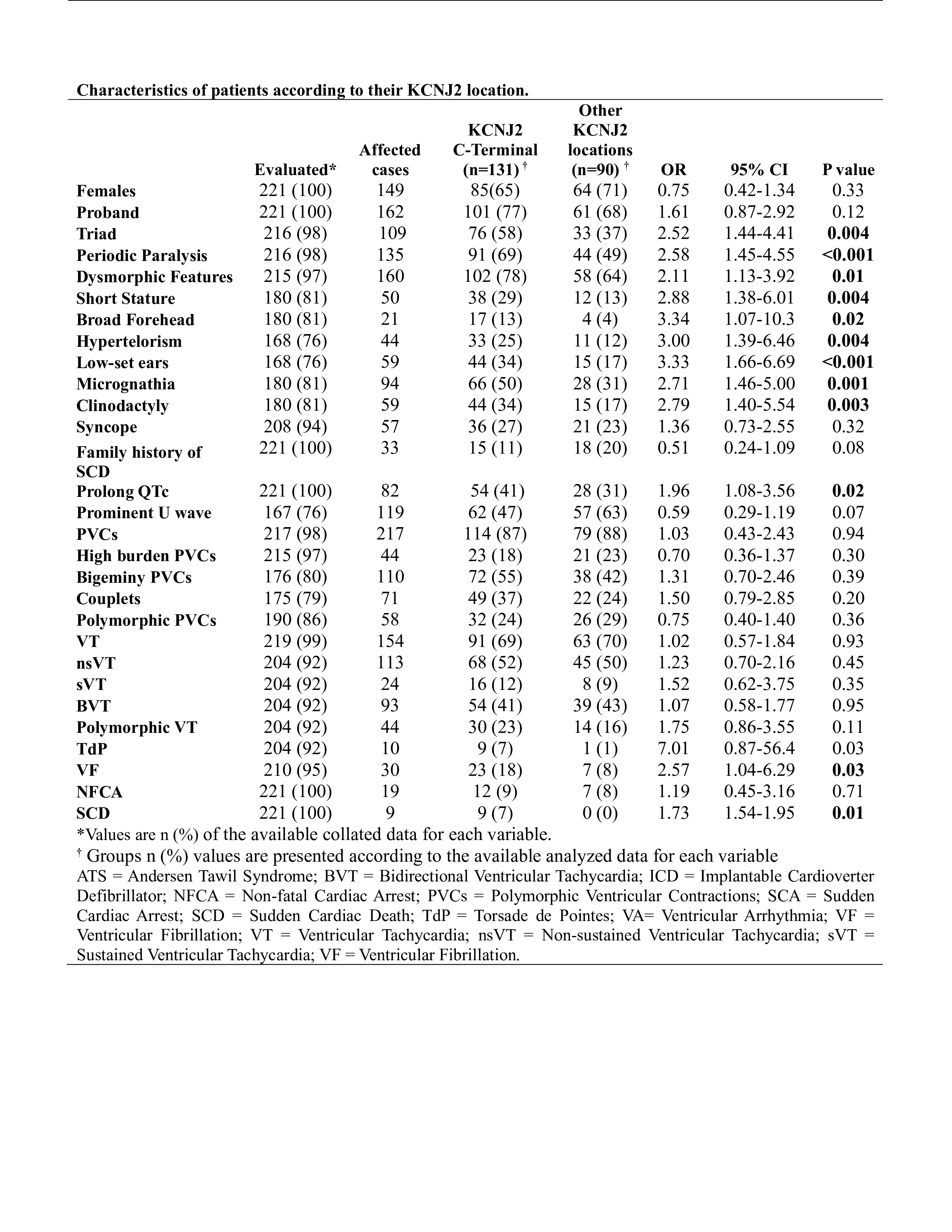
Results: A total of 221 patients with KCNJ2-positive ATS were analyzed, including 85 females. Those with C-terminal mutations had significantly higher odds of presenting with the ATS triad (p < 0.001) and periodic paralysis (p < 0.001). Dysmorphic features such as hypertelorism, micrognathia, and low-set ears were more common in this group. C-terminal mutations were also linked to increased QTc prolongation (p = 0.02) and higher frequencies of non-sustained ventricular tachycardia (nsVT) and sustained ventricular tachycardia (sVT) (52% vs. 50.0% and 12% vs. 9%, respectively). Ventricular fibrillation (VF) affected 18% of the C-terminal group (8% in other locations, p = 0.03). Non-fatal cardiac arrest (NFCA) was slightly more common in the C-terminal group (9% vs. 8%). Sudden cardiac death (SCD) occurred in 7% of patients in the C-terminal group, while none experienced it in the other location group (p = 0.01).
Conclusion: Mutations located at the C-terminal of the KCNJ2 gene in ATS are associated with a more severe clinical phenotype, periodic paralysis, QTc prolongation, dysmorphic features, and life-threatening arrhythmias, including ventricular fibrillation and sudden cardiac death.
Garcia, Alan
( Indiana University SOM
, Indianapolis
, Indiana
, United States
)
Salama Frisbie, Richard
( Instituto Nacional de Ciencias Medicas y Nutricion Salvador Zubiran
, Mexico City
, Mexico
)
Kayani, Abdul Mueez Alam
( AdventHealth Tampa
, Tampa
, Florida
, United States
)
Lemus-zamora, Ricky
( Indiana University SOM
, Indianapolis
, Indiana
, United States
)
Fretz, Thomas
( Indiana University
, Carmel
, Indiana
, United States
)
Patel, Brijesh
( Indiana University
, Carmel
, Indiana
, United States
)
Author Disclosures:
Alan Garcia:DO NOT have relevant financial relationships
| Richard Salama Frisbie:DO NOT have relevant financial relationships
| Abdul Mueez Alam Kayani:DO NOT have relevant financial relationships
| Ricky Lemus-Zamora:DO NOT have relevant financial relationships
| Thomas Fretz:DO NOT have relevant financial relationships
| Brijesh Patel:No Answer