Therapeutic Precision vs. Cardiac Risk: A Meta-Analytic Review of Osimertinib in NSCLC
Abstract Body (Do not enter title and authors here): Introduction Targeted therapies have revolutionized cancer treatment by focusing on specific oncogenic drivers. Osimertinib, a third-generation EGFR inhibitor, was developed to overcome resistance from T790M mutations. While it provides significant benefits, there have been reports linking it to cardiotoxic effects, which complicates attributing these events solely to the drug due to concurrent treatments. This study aims to clarify the direct cardiotoxicity of Osimertinib by reviewing trials and cohort studies involving its monotherapy.
Methods We performed a combined meta-analysis to evaluate cardiovascular toxicity in EGFR-mutant Non-Small Cell Lung Cancer patients treated with Osimertinib. Data were extracted from nine studies, including pivotal clinical trials (ADAURA, FLAURA, AURA2, MARIPOSA) and observational cohorts (e.g., Patel et al., Lin et al., Le et al., Goss et al.). The analysis included (1) a single-arm meta-analysis estimating the incidence of cardiotoxic events from clinical trials, and (2) a comparative meta-analysis using data from two randomized controlled trials and one retrospective cohort comparing Osimertinib with earlier-generation EGFR inhibitors. Random-effects models were used to calculate pooled proportions and relative risks (RRs) with 95% confidence intervals (CIs). Heterogeneity was assessed using I2, t2, and Cochran’s Q.
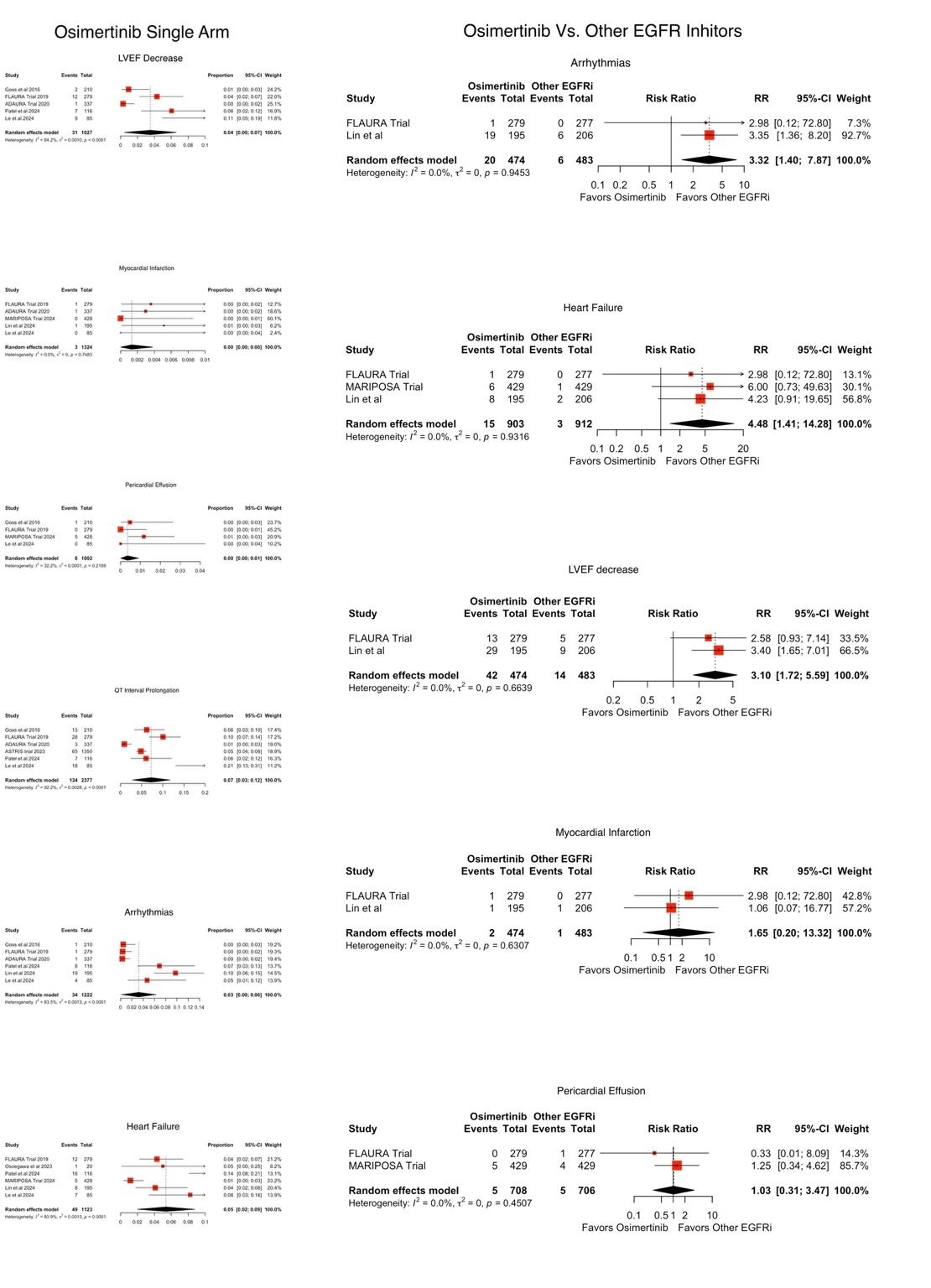
Results In the single-arm analysis, a total of 2,518 patients receiving Osimertinib monotherapy were included in the pooled analysis. The most frequent adverse events with Osimertinib were QT prolongation (7%), heart failure (5%), arrhythmias (3%), and LVEF decrease (4%). Less frequent events included myocardial infarction (MI) (<1%).
In a comparative analysis of Osimertinib versus other EGFR inhibitors, involving a total of 1,815 participants, Osimertinib showed increased risks of heart failure (RR = 4.48), arrhythmias (RR = 3.30), and LVEF decrease (RR = 3.10) compared to other EGFR inhibitors. No significant differences were observed for MI or pericardial effusion. Most outcomes showed low heterogeneity (I2= 0%).
Conclusion Osimertinib is associated with a higher risk of heart failure, arrhythmias, and LVEF decline. Although these events are infrequent, the potential severity warrants proactive cardiac monitoring for patients, especially those with existing cardiovascular risk factors.
Garcia, Alan
(
Indiana University SOM
, Indianapolis , Indiana , United States )
Kayani, Abdul Mueez Alam
(
AdventHealth Tampa
, Tampa , Florida , United States )
Lemus-zamora, Ricky
(
Indiana University SOM
, Indianapolis , Indiana , United States )
Salama Frisbie, Richard
(
Intituto Nacional de Ciencias Medicas y Nutricion Salvador Zubiran
, Mexico City , Mexico )
Fretz, Thomas
(
Indiana University
, Carmel , Indiana , United States )
Patel, Brijesh
(
Indiana University
, Carmel , Indiana , United States )
Author Disclosures:
Alan Garcia:DO NOT have relevant financial relationships
| Abdul Mueez Alam Kayani:DO NOT have relevant financial relationships
| Ricky Lemus-Zamora:DO NOT have relevant financial relationships
| Richard Salama Frisbie:DO NOT have relevant financial relationships
| Thomas Fretz:DO NOT have relevant financial relationships
| Brijesh Patel:No Answer