Transcatheter Mitral Edge-to-Edge Repair versus Surgical Mitral Valve Repair in Elderly Patients with Heart Failure: A Propensity Matched Analysis
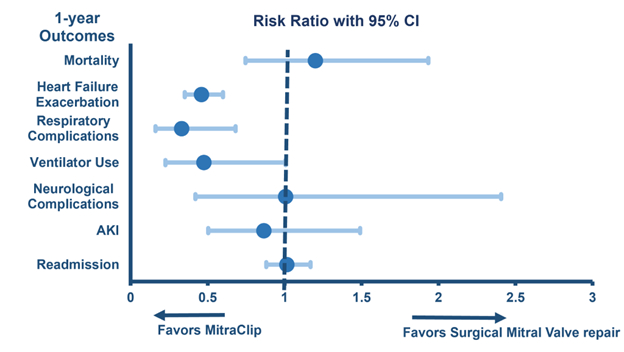
Abstract Body (Do not enter title and authors here): Background Transcatheter mitral valve edge-to-edge repair (M-TEER; MitraClip) has emerged as a less invasive alternative to surgical mitral valve repair (SMVr) in older adults with mitral regurgitation and heart failure (HF). However, comparative real-world data on outcomes between these approaches in elderly patients remain limited. Methods We conducted a retrospective analysis of the TriNetX global health network to identify adults over 65 years with heart failure (HF) who underwent transcatheter mitral valve edge-to-edge repair (M-TEER; MitraClip) or surgical mitral valve repair (SMVr). Patients were ascertained using ICD-10 codes. Baseline demographics (age, race), comorbidities (e.g., hypertension, diabetes, chronic kidney disease), and outpatient medication use (β-blockers, ACE inhibitors/ARBs, statins, anticoagulants) were collected. A 1:1 propensity score matching (PSM) algorithm—matching on age, race, key comorbidities, and medication use—was applied to generate two balanced cohorts. We then compared short-term (30-day) and long-term (1-year) outcomes between matched M-TEER and SMVr groups, including all-cause mortality, heart failure exacerbation, neurological, respiratory, and vascular complications, acute kidney injury (AKI), mechanical ventilator use, and readmission. Risk ratios with 95% confidence intervals were calculated, and statistical significance was defined as p < 0.05. Results Among 5,096 older adults undergoing M-TEER and 2,812 undergoing SMVr, PSM yielded two well-balanced cohorts of 1,020 patients each (mean age 80.1 ± 7.7 years; 40% female; 10.1% Black). At both 30 days and 1 year, the M-TEER group experienced significantly fewer respiratory complications (p = 0.002), reduced mechanical ventilator use (p = 0.046), and lower rates of heart failure exacerbation (p < 0.001) compared to SMVr. However, SMVr was associated with a lower all-cause mortality rate at 1 year (p < 0.001). Conclusion In older adults with HF, M-TEER was associated with fewer cardiopulmonary complications and HF exacerbations, while SMVr conferred improved long-term survival. These findings highlight the need to individualize procedural decisions based on patient comorbidity profiles and clinical goals.
Shehzad, Mustafa
(
Hackensack University Medical Cente
, Hackensack , New Jersey , United States )
Shehzad, Dawood
(
University of South Dakota
, Sioux Falls , South Dakota , United States )
Yousafzai, Osman
(
Hackensack University Medical Cente
, Hackensack , New Jersey , United States )
Ahmad, Muhammad
(
Khyber Medical University
, Peshawar , Pakistan )
Chaudhry, Hammad
(
University of South Dakota
, Sioux Falls , South Dakota , United States )
Vandyck-acquah, Marian
(
Hackensack University Medical Cente
, Hackensack , New Jersey , United States )
Author Disclosures:
Mustafa Shehzad:DO NOT have relevant financial relationships
| Dawood Shehzad:DO NOT have relevant financial relationships
| Osman Yousafzai:No Answer
| Muhammad Ahmad:DO NOT have relevant financial relationships
| Hammad Chaudhry:DO NOT have relevant financial relationships
| Marian VanDyck-Acquah:DO NOT have relevant financial relationships