
High VExUS Score Predicts In-Hospital Mortality in Acute Heart Failure: A Systematic Review and Bayesian Meta-Analysis
Abstract Body (Do not enter title and authors here): Background: As systemic congestion takes center stage in the prognosis of acute heart failure (AHF), the Venous Excess Ultrasound (VExUS) protocol has emerged as a compelling tool for its bedside assessment. However, its prognostic value remains unclear. To address this gap, we performed a systematic review and meta-analysis evaluating whether VExUS can reliably predict in-hospital mortality in patients admitted with AHF.
Research Question: Can the VExUS protocol reliably predict in-hospital mortality in patients admitted with AHF?
Methods: We systematically searched PubMed, Embase, and the Cochrane Library for studies evaluating the prognostic value of the VExUS protocol in patients with AHF. Bayesian random-effects meta-analysis was yielded for marginal posterior distributions for the overall effect and between-study heterogeneity. We used mean and 95% credible intervals (CrI) to describe these distributions, defined as the narrowest interval containing 95% of the probability density function. Our primary estimands are expressed as odds ratio (OR), and also focused on the calculation of posterior probabilities. Statistical analyses were performed with R version 4.5.0.
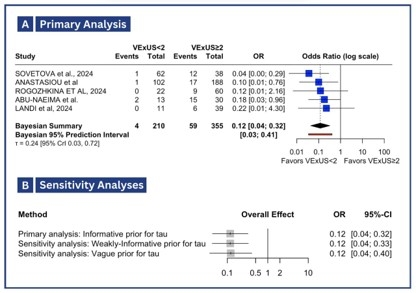
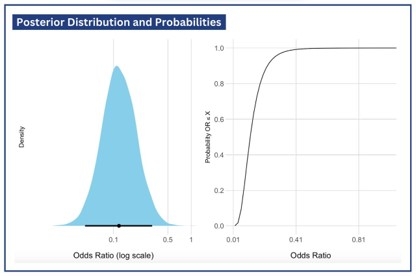
Results: Five studies, comprising 565 patients, were included in the analysis. Mean ejection fraction ranged from 32% to 54%. Figure 1A contains the forest plot of the in-hospital mortality outcome. The average odds ratio was 0.12 (95% CrI: 0.04, 0.32). The posterior probability indicating any level of certainty regarding the score (OR<1) was 99.99%, while the probability of a clinically meaningful level of certainty (OR<0.8) was 99.97%. In terms of predictive distribution, we determined a 95% probability that the true odds ratio in a future study would fall within the range of 0.03 to 0.41 (as shown in Figure 1), with a 99.76% likelihood that it would be less than 1.0. Sensitivity analyses showed that overall effect results were not heavily influenced by different priors (Figure 1B). Figure 2 shows the posterior distribution of the overall effect and posterior probabilities related to any odds ratio cutoff.
Conclusions: This systematic review and meta-analysis suggests that a VExUS grade greater than 2 is associated with increased in-hospital mortality in patients with AHF. These findings support the potential role of VExUS as a prognostic tool for risk stratification in this population, warranting further investigation in larger, prospective studies.
Chaves, Vinicius
(
Hospital de Urgencias de Goias
, Goiania , Brazil )
Barbosa, Lucas
(
Federal University of Minas Gerais
, Belo Horizonte , Brazil )
Oliveira, Vinicius
(
Federal University of Goias
, Goiania , Brazil )
Silva, Rafaela
(
Federal University of Maranhão
, São Luiz , Brazil )
Guimarães Maciel, Lucas
(
Hospital Alberto Rassi
, Goiânia , Brazil )
De Almeida, Vitor
(
Universidade Federal de Catalão
, Catalão , Brazil )
Fonseca Coutinho Fernandes Gomes, Marcelo
(
Hospital de Urgencias de Goias
, Goiania , Brazil )
Nunes, Maria Carmo
(
Federal University of Minas Gerais
, Belo Horizonte , Brazil )
Author Disclosures:
Vinicius Chaves:DO NOT have relevant financial relationships
| Lucas Barbosa:DO NOT have relevant financial relationships
| Vinicius Oliveira:DO NOT have relevant financial relationships
| Rafaela Silva:No Answer
| Lucas Guimarães Maciel:No Answer
| Vitor Paiva de Almeida:DO NOT have relevant financial relationships
| Marcelo Fonseca Coutinho Fernandes Gomes:No Answer
| Maria Carmo Nunes:No Answer