Logo

American Heart Association

  17
  0


Final ID: MP1366

Utilizing Epicardial Adipose Tissue As A Risk Marker For Patients With Chronic Kidney Disease

Abstract Body (Do not enter title and authors here): Background: Epicardial adipose tissue (EAT) “fat-omics” is an inflammation-sensitive depot that may provide prognostic information in cardiometabolic disease. Chronic Kidney Disease (CKD) is associated with high rates of major adverse cardiovascular events (MACE) and heart failure (HF). We assess the utility of opportunistic EAT radiomic analysis in patients with CKD undergoing CT calcium-score (CTCS) scans and its association and mediation of adverse events.

Hypothesis: Stage-specific EAT features in CKD mediates MACE and HF risk.

Methods: Using data obtained from the CLARIFY registry (NCT04075162), a large prospective study of no-charge CAC testing, we performed descriptive analysis on patients with CKD via a 1:1 propensity matching approach after balancing for age, race, gender, hypertension, smoking, medications, and CAC score. Due to limited power, CKD was categorized into the combined stage (GFR <60), stage 3a (CKD-3a with GFR 45-59), and CKD stages 3b-4 (CKD-3b4 with GFR 15-30). A validated AI segmentation tool was used to segment EAT, followed by extraction of >200 “fat-omics” features from EAT in 4 inferior-to-superior cardiac spanning slab quartiles (PQ) Hounsfield unit (HU) histogram bins (20-HU increments), and more. We performed time to event Kaplan Meier analysis in propensity-matched and the unmatched cohorts for MACE and HF, and mediation analyses to quantify the proportion of effects mediated by significant fat-omics features.

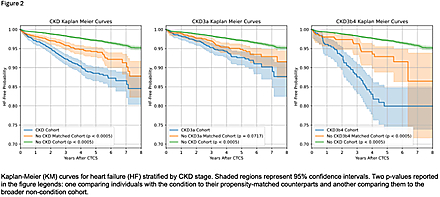
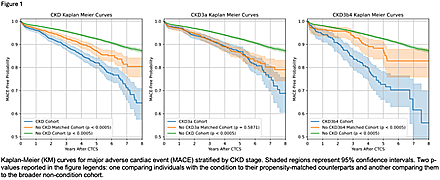
Results: A total of 1594 patients with CKD (1170 CKD-3a and 308 CKD-3b4) were included in the study. In the overall CKD group, there were 5 unique EAT features including total HU skewness and kurtosis HU in the superior slab of the heart, involving major coronary arteries. CKD-3a had 61 unique features and CKD3b-4 had 53 unique features. When compared to the propensity-matched non-CKD cohort, the overall CKD group and CKD 3b-4 had significantly worse MACE-free probability (p<0.005) (Figure 1) and worse HF-free probability (p<0.005) (Figure 2). Mediation analysis in the CKD 3b-4 cohort revealed 8 EAT features in the superior slab of the heart (PQ4) in the higher HU range (130-50) that mediated MACE. 11 features that significantly mediated HF also mainly involved the superior slab.

Conclusions: Propensity-matched CKD patients have higher MACE and HF events when compared to non-CKD patients. CKD patients have distinct EAT features and appear to be in the mediation pathway for MACE and HF risk.
  • Okyere, Robert  ( University Hospitals - Case Western , Cleveland , Ohio , United States )
  • Neeland, Ian  ( University Hospitals - Case Western , Cleveland , Ohio , United States )
  • Wilson, David  ( Case Western Reserve University , Cleveland , Ohio , United States )
  • Rajagopalan, Sanjay  ( UNIV HOSP CLEVELAND MEDICAL CTR , Cleveland , Ohio , United States )
  • Singh, Prerna  ( Case Western Reserve University , Cleveland , Ohio , United States )
  • Ponnana, Sai Rahul  ( University Hospitals - Case Western , Cleveland , Ohio , United States )
  • Sirasapalli, Santosh  ( University Hospitals - Case Western , Cleveland , Ohio , United States )
  • Marion, William  ( Case Western Reserve University , Cleveland , Ohio , United States )
  • Kandi, Sneha  ( Case Western Reserve University , Mason , Ohio , United States )
  • Amoah, Joseph  ( University Hospitals , Cleveland , Ohio , United States )
  • Glidden, Michael  ( University Hospitals - Case Western , Cleveland , Ohio , United States )
  • Deo, Salil  ( University Hospitals - Case Western , Cleveland , Ohio , United States )
  • Author Disclosures:
    Robert Okyere: DO NOT have relevant financial relationships | Ian Neeland: DO have relevant financial relationships ; Consultant:Boehringer Ingelheim:Past (completed) ; Advisor:MJH Life Sciences:Active (exists now) ; Advisor:Novo Nordisk:Past (completed) ; Speaker:Bayer:Active (exists now) ; Speaker:Eli Lilly:Active (exists now) ; Consultant:Eli Lilly:Past (completed) ; Speaker:Boehringer Ingelheim:Active (exists now) | David Wilson: No Answer | Sanjay Rajagopalan: DO NOT have relevant financial relationships | Prerna Singh: DO NOT have relevant financial relationships | Sai Rahul Ponnana: DO NOT have relevant financial relationships | Santosh Sirasapalli: No Answer | William Marion: No Answer | Sneha Kandi: DO NOT have relevant financial relationships | Joseph Amoah: DO NOT have relevant financial relationships | Michael Glidden: DO NOT have relevant financial relationships | Salil Deo: No Answer
Meeting Info:

Scientific Sessions 2025

2025

New Orleans, Louisiana

Session Info:

Lipids and Adiposity: Growing Use of Multimodality Imaging

Sunday, 11/09/2025 , 11:50AM - 01:00PM

Moderated Digital Poster Session

More abstracts on this topic:
Adipose tissue plasticity in response to early pathological stress on the heart and mediation by adipose thermogenic activation

James Natasha Maria, Stanford Kristin, Challa Azariyas, Vidal Souza Pablo, Pardeshi Parth, Maurya Santosh, Wang Yang, Baer Lisa, Carley Andrew, Lewandowski E Douglas

A Multi-Tier, Natural-Language Processing Framework to Automate Labeling of Acute Cerebrovascular Events From Radiology Reports and Diagnosis Codes

Erekat Asala, Stein Laura, Delman Bradley, Karp Adam, Kupersmith Mark, Kummer Benjamin

More abstracts from these authors:
Green Space Engagement and Chronic Disease Prevalence Across Urban and Rural U.S. Communities: A Nationwide Analysis Using Mobility Data

Zhang Tong, Okyere Robert, Al-kindi Sadeer, Deo Salil, Chen Zhuo, Rajagopalan Sanjay, Narang Yuvraj, Ponnana Sai Rahul, Dazard Jean-eudes, Sirasapalli Santosh, Dong Weichuan, Sivanantham Kanimozhi, Glidden Michael, Shamsa El Hussain

Prostate Cancer Imposes Significant Risk for Cardiovascular Events: Insights from the CLARIFY Registry

Shamsa El Hussain, Neeland Ian, Deo Salil, Rajagopalan Sanjay, Sirasapalli Santosh, Okyere Robert, Khawaja Tasveer, Chen Zhuo, Dazard Jean-eudes, Ponnana Sai Rahul, Sivanantham Kanimozhi, Zhang Tong

You have to be authorized to contact abstract author. Please, Login
Not Available